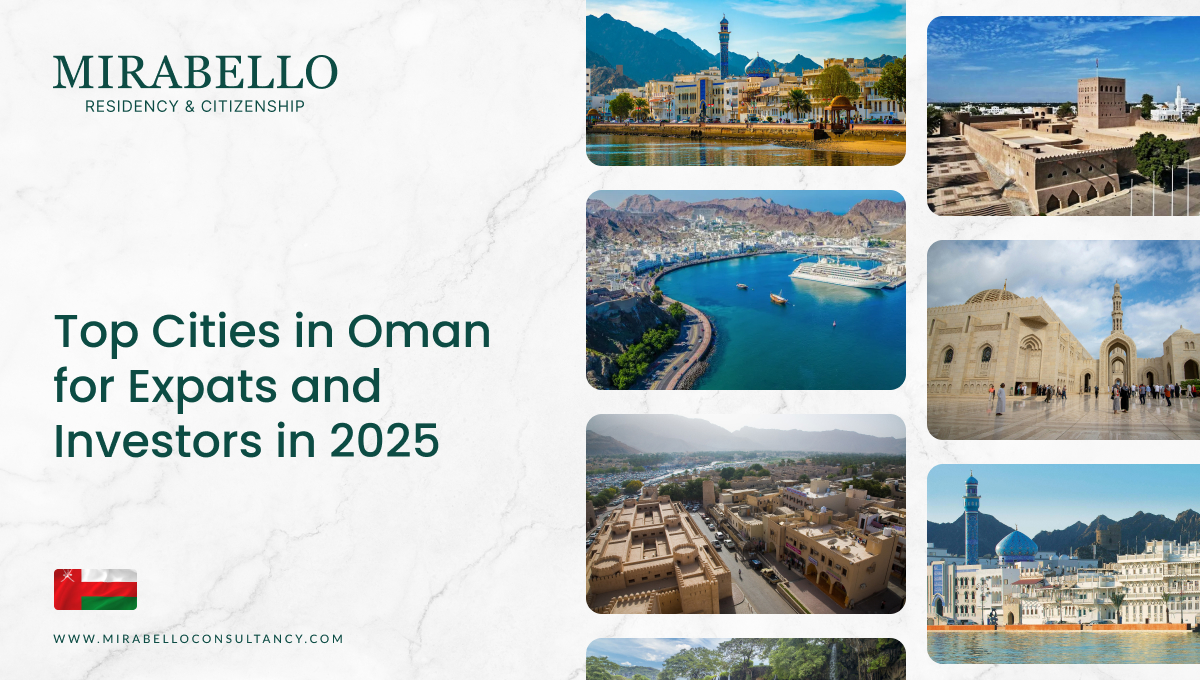
Oman's top cities for investment migration are Muscat, the capital and economic hub, alongside emerging centres such as Salalah, Sohar and Duqm . Driven by Vision 2040, these cities offer real-estate opportunities that can support Oman residency, modern infrastructure, and growth in logistics, tourism and industry beyond the traditional oil and gas economy.
Key Takeaways
- Muscat, the capital of Oman, offers the strongest opportunities for business, employment, and high-quality urban living.
- Salalah is one of the top cities in Oman that combines natural sights with high tourist demand, making it an ideal option for both lifestyle lovers and investors.
- Sohar is one of Oman’s industrial hubs and is an attractive option for investors in manufacturing, logistics, and large-scale commercial operations.
- Duqm offers the highest long-term growth potential because of its big projects, free-zone incentives, and industrial opportunities.
- Nizwa is a peaceful city that offers a calm lifestyle. It’s ideal for retirees, families, and investors in culture and tourism.
The Top Cities in Oman for Investment Migration in 2026
Last updated: March 2026
Key Takeaways
- Oman's Integrated Tourism Complex (ITC), as outlined by the Oman Investment Authority, programme allows foreign nationals to purchase freehold property and obtain residency, with qualifying investments starting from approximately OMR 500,000 (around $1.3 million USD).
- Muscat remains the premier destination for business, finance, and luxury living, while Salalah and Sohar offer compelling opportunities in tourism and industrial sectors respectively.
- Oman's residency by investment programme grants renewable residence permits, with processing times typically ranging from 2 to 4 months.
- Oman operates as a tax-friendly environment with no personal income tax, making it highly attractive for wealth preservation and business structuring.
- The Omani government's Vision 2040 agenda is actively reshaping the country's economic landscape, creating fresh opportunities across real estate, logistics, tourism, and technology.
- Family members, including spouse and dependent children, can be included in an investor's residency application.
📋 At a Glance: Oman is currently experiencing some huge transformations. Because of Vision 2040, the country is diversifying its economy beyond oil and gas by improving infrastructure, expanding its logistics network, and attracting foreign investment.
Oman is currently experiencing some huge transformations. Because of Vision 2040, the country is diversifying its economy beyond oil and gas by improving infrastructure, expanding its logistics network, and attracting foreign investment. To help expats and investors find their ideal destination, we've decided to craft this article, which covers the top cities in Oman, explains the key opportunities in each of them, and gives you a clear picture of what to expect in terms of lifestyle, business potential, and overall living conditions.
Why Is Oman Attracting Global Investors and Expats in 2026?
For decades, Oman occupied a quieter corner of the Gulf investment narrative, overshadowed by the flashier profiles of Dubai and Doha. That picture is changing rapidly. The Sultanate's strategic location, sitting at the crossroads of Africa, Asia, and Europe, combined with its political stability and genuine cultural openness makes it one of the most underrated relocation destinations in the region.
Oman's government has made a decisive commitment to attract foreign direct investment and international talent. The Integrated Tourism Complex (ITC) programme is the cornerstone of this effort, permitting expatriates to purchase freehold property in designated developments and, crucially, to obtain a renewable residency permit as a result. This is one of the clearest pathways for investors seeking a legal foothold in the Arabian Peninsula outside of the UAE.
Beyond the programme mechanics, Oman offers something the Gulf region's other power players sometimes struggle to match: a sense of authenticity. The country's mountains, fjords, deserts, and ancient souqs exist alongside modern infrastructure, and the Omani people are widely regarded as some of the warmest hosts in the Arab world. For high-net-worth families who prioritise quality of life alongside investment returns, this combination is exceptionally compelling.
If you are exploring broader options across the region, our comprehensive guide to the best golden visa investment programmes provides a useful comparative framework.
What Are the Top Cities in Oman for Investment Migration?
| City | Investment Focus | Property From | Lifestyle | Rental Yield |
|---|---|---|---|---|
| Muscat | ITC freehold, commercial | OMR 250,000 (~$650,000) | Cosmopolitan, expat-friendly | 4%-7% |
| Salalah | Tourism, hospitality | OMR 150,000 (~$390,000) | Tropical, relaxed pace | 5%-8% |
| Sohar | Industrial, logistics | OMR 100,000 (~$260,000) | Emerging, growth potential | 3%-5% |
| Nizwa | Heritage tourism | OMR 80,000 (~$208,000) | Cultural, mountainous | 3%-5% |
Oman is not a monolithic destination. Its cities each carry a distinct character, economic role, and lifestyle proposition. Understanding the differences between them is essential to making an informed investment migration decision. Below, we examine the cities that matter most to internationally mobile investors and families.
Muscat: The Capital of Opportunity
Muscat is, without question, the first port of call for most investors exploring the top cities in Oman. As the capital and largest city, it houses the country's principal financial institutions, government ministries, international schools, and premium healthcare facilities. The city sprawls along the Gulf of Oman coastline, divided into distinct districts, Qurum, Al Khuwair, Madinat Al Sultan Qaboos, and the Muscat Hills, each offering different lifestyle and real estate propositions.
From an investment perspective, Muscat is home to several prominent ITC developments, including The Wave Muscat, Muscat Hills Resort, and Saraya Bandar Jissah. Properties within these complexes qualify for freehold ownership by foreign nationals, with prices typically starting from OMR 50,000 (approximately $130,000 USD) for apartments, rising significantly for villas and waterfront properties. To qualify for residency, the property must meet the minimum investment threshold stipulated by the relevant ITC authority.
Muscat's business environment is mature and well-connected, with direct flight routes to major European, Asian, and African hubs via Muscat International Airport. The city is also home to Oman's primary free zone ecosystem, and the government has been actively streamlining business registration processes to reduce bureaucratic friction for foreign entrepreneurs.
Salalah: Tourism, Climate, and Growing Investment Potential
Salalah, the capital of Dhofar Governorate in southern Oman, is emerging as one of the most exciting investment destinations in the country. The city is famous for the Khareef season, the annual monsoon period between June and September, which transforms the surrounding landscape into a lush, green environment utterly unlike the rest of the Arabian Peninsula. This natural phenomenon draws hundreds of thousands of tourists each year and has become the engine driving Salalah's booming hospitality sector.
Tourism investment in Salalah has accelerated considerably. Major hotel groups have established a significant presence, and the government has been developing new ITC-designated zones to capture growing foreign interest. Salalah's port, Port of Salalah, is one of the largest container transshipment hubs in the world, adding a logistics and trade dimension to the city's investment appeal.
For lifestyle-focused investors and families, Salalah offers a slower pace of life, lower property costs compared to Muscat, and a spectacular natural environment. The city's international airport provides connections to the Gulf's major hubs, and educational facilities are improving steadily as the expatriate community grows.
Sohar: The Industrial Powerhouse
Sohar may not be on the radar of most lifestyle-oriented investors, but for entrepreneurs and business owners with interests in manufacturing, logistics, or industrial supply chains, it warrants serious attention. Located approximately 220 kilometres north of Muscat, Sohar is home to the Sohar Freezone and Sohar Industrial Port, which together form one of the Gulf's most strategically positioned industrial hubs.
The Sohar Freezone offers companies 100% foreign ownership, competitive leasing rates, and streamlined customs procedures. Sectors including petrochemicals, steel, food processing, and logistics have established a strong footprint here. For investors whose migration strategy is connected to establishing a business presence in Oman, Sohar provides infrastructure and incentives that Muscat's more commercial environment cannot always replicate.
Residential options in Sohar are more limited than in Muscat or Salalah, but the city is developing rapidly, and property values remain considerably more accessible for those seeking to plant roots in the industrial north.
Nizwa and the Interior: Cultural Heritage Meets Emerging Tourism
Nizwa, once the ancient capital of Oman, sits in the heart of the country surrounded by the Al Hajar mountains. While it does not currently feature the same density of ITC developments as Muscat or Salalah, Nizwa is increasingly attracting attention from investors interested in heritage tourism, boutique hospitality, and sustainable travel experiences.
The Omani government has identified cultural tourism as a key pillar of Vision 2040, and Nizwa's restored fort, traditional souq, and proximity to iconic natural landmarks such as Jebel Akhdar and Wadi Bani Auf position it as a compelling destination for investors willing to move ahead of the curve. Property values remain low relative to coastal cities, and for those with an appetite for longer-term appreciation potential, Nizwa and the broader interior offer intriguing possibilities.
How Does Oman's Residency by Investment Programme Work?
What is Oman's residency by investment programme? In essence, it is a mechanism through which foreign nationals who purchase qualifying freehold property within government-designated Integrated Tourism Complexes receive the right to obtain a renewable Omani residence permit. Unlike citizenship by investment programmes in the Caribbean, which you can explore in our guide to the best citizenship by investment programmes, Oman's scheme provides residency rather than passport rights, but it remains one of the most accessible and cost-effective entry points into Gulf residency for internationally mobile individuals.
The programme is governed by the relevant Omani ministerial regulations, and qualifying investments must be made through approved ITC developers. The minimum investment threshold to qualify for residency eligibility has been set at OMR 500,000 (approximately $1.3 million USD) for the primary investor's residency permit, though properties within ITC developments can be purchased at lower values for those not seeking the residency benefit.
It is worth noting that Oman does not currently offer a direct citizenship pathway through investment, but long-term residency combined with eventual naturalisation remains a theoretical possibility for those who remain committed to the country over many years.
For a detailed breakdown of the UAE's comparable offering, visit our page on UAE Golden Visa.
What Are the Eligibility Requirements and Application Process?
Eligibility for Oman's residency via property investment is relatively straightforward compared to many European golden visa programmes. There is no requirement to demonstrate prior business experience, and the programme is open to nationals of most countries globally, with some exceptions governed by bilateral relations.
Key eligibility requirements include:
- Purchase of a freehold property within a government-approved ITC development meeting the minimum investment threshold
- A clean criminal record from the applicant's country of origin or current country of residence
- Valid health insurance coverage for the applicant and any dependants
- Medical fitness certification (standard health checks)
- Proof of financial means to support the applicant and family during residency
The application process typically follows these steps:
- Due diligence and property selection: Engage a qualified investment migration consultant and identify a qualifying property within an approved ITC. Legal due diligence on the developer and the specific unit is essential at this stage.
- Purchase agreement and payment: Execute the sale and purchase agreement and complete the financial transaction in accordance with Omani property law.
- Title deed registration: Register the property with the relevant Omani land registry authority to obtain the official title deed in the investor's name.
- Residency application submission: Submit the residency application to Oman's Royal Oman Police (ROP) or the designated migration authority, along with supporting documentation.
- Biometric registration and permit issuance: Complete in-country biometric requirements and receive the residence permit upon approval.
Processing times for Oman's residency applications typically range from 2 to 4 months from the point of submitting a complete application, though timelines can vary depending on the applicant's nationality and the volume of applications being processed at any given time.
Our team at Mirabello Consultancy manages every step of this process on behalf of clients. Book a free consultation today to discuss your specific circumstances.
What Are the Benefits of Obtaining Omani Residency Through Investment?
The benefits of Oman's residency by investment programme extend well beyond the simple right to reside in the country. For UHNW and HNW individuals, the programme delivers a combination of lifestyle, financial, and strategic advantages that compare favourably with many other Gulf and global residency options.
- Tax efficiency: Oman levies no personal income tax, no capital gains tax, and no inheritance tax on individuals. This makes it an attractive jurisdiction for wealth preservation and international business structuring.
- Strategic location: Oman's position at the mouth of the Arabian Sea provides exceptional connectivity to Africa, South Asia, and the broader Middle East, with Muscat International Airport offering direct routes to over 70 destinations worldwide.
- Political stability: Oman has maintained one of the most stable political environments in the Gulf region for decades, a quality that resonates deeply with families seeking long-term security.
- Quality of life: World-class healthcare, improving international school provision, safe streets, and an authentic cultural environment combine to deliver a quality of life that surprises many newcomers.
- Property appreciation potential: With Vision 2040 driving significant infrastructure investment, Omani real estate, particularly within ITC developments, is expected to appreciate meaningfully over the medium to long term.
- Business opportunities: Free zone access, 100% foreign ownership in many sectors, and a government actively courting foreign entrepreneurs create genuine commercial opportunities for investor-residents.
For further context on how Oman compares to other Gulf residency options, explore our guide to the Oman Residency by Investment programme.
Can I Include My Family in Oman's Residency Programme?
One of the most reassuring aspects of Oman's investment residency framework is its accommodating approach to family reunification. The primary investor's spouse and dependent children can be included in the residency application, allowing families to relocate together and build their lives in Oman as a unit.
Dependent children are typically defined as unmarried children under the age of 18, though older children in full-time education may qualify for extended dependent status in some circumstances. Parents of the primary investor may also be eligible for residency on a case-by-case basis, subject to satisfying additional requirements.
Each family member will need to provide their own documentation, including health insurance, medical fitness certificates, and clean criminal records, but the overall process is managed as a consolidated family application through a qualified consultant. There are additional government fees associated with each dependent's permit, though these are modest relative to the overall investment size.
Oman's growing international school sector, particularly in Muscat, provides reassurance for families with school-age children. British, American, and International Baccalaureate curricula are all available, with annual fees typically ranging from OMR 3,000 to OMR 8,000 ($7,800 to $20,800 USD) depending on the institution and year group.
Frequently Asked Questions About Investment Migration to Oman
What is the minimum investment required for Omani residency?
The minimum qualifying property investment for residency eligibility through Oman's ITC programme is approximately OMR 500,000 (around $1.3 million USD). Properties within ITC developments can be purchased below this threshold, but only investments meeting or exceeding this amount confer residency rights. Exact thresholds can vary between specific developments and are subject to regulatory updates, so engaging a qualified investment migration adviser is recommended before committing.
How long does it take to process an Omani investment residency application?
Once a complete application with all supporting documentation has been submitted, processing typically takes between 2 and 4 months. The timeline can vary depending on the applicant's nationality, the volume of applications being processed, and whether any additional due diligence is required by the Omani authorities. At Mirabello Consultancy, we work proactively to ensure all documentation is prepared to the highest standard, minimising delays.
Which cities in Oman offer the best real estate investment opportunities?
Muscat offers the broadest range of ITC developments, the strongest rental market, and the most established infrastructure for expatriate living, making it the most popular choice for the majority of investment migrants. Salalah is compelling for those interested in tourism-related real estate and a more relaxed lifestyle, while Sohar suits investors with industrial or logistical business interests. Nizwa and the interior are best suited to long-horizon investors focused on heritage tourism potential.
Does Oman offer a path to citizenship through investment?
Oman does not currently operate a formal citizenship by investment programme. The country's naturalisation process is discretionary and typically requires many years of legal residency, along with additional criteria. Those seeking a second passport through investment may wish to consider complementary programmes in other jurisdictions, our guide to the best citizenship by investment programmes provides a comprehensive overview of currently available options.
Can I rent out my property in Oman if I am not resident there full-time?
Yes. Properties purchased within approved ITC developments can generally be rented to third parties when the owner is not in residence. Rental yields within Muscat's established ITC complexes have typically ranged between 4% and 7% per annum, though this varies by property type, location within the complex, and prevailing market conditions. Many ITC developers offer managed rental pool arrangements that simplify this process for non-resident owners.
Is Oman a safe country for expatriate families?
Oman consistently ranks as one of the safest countries in the Arab world and indeed globally. The country benefits from extremely low crime rates, a welcoming attitude towards expatriates, and a stable political environment. Muscat in particular is considered highly family-friendly, with a well-developed expatriate community, quality healthcare, and access to international education. Oman's safety profile is one of the most frequently cited reasons that UHNW families choose it as a long-term residency destination.
Ready to Start Your Journey?
Book your free consultation with Mirabello Consultancy and let our expert team guide you through every step of your investment migration journey to Oman. Whether you're drawn to the capital energy of Muscat, the natural wonder of Salalah, or the industrial opportunity of Sohar, we will help you identify the right city, the right property, and the right strategy for your unique circumstances. Our Swiss precision and personal approach ensure that your path to Omani residency is efficient, transparent, and tailored entirely to you.
Book Free ConsultationIn summary
Conclusion
To sum it up, in this article, we’ve covered the top cities in Oman, which are Muscat, Salalah, Sohar, Duqm, and Nizwa. We highlighted the key differences and opportunities in each of these cities, and explained who would benefit most from living or investing there. Whether you’re an investor, who is looking for high returns, a family looking for a calm environment, or a retiree who needs a quiet place to live, Oman has something for everyone. To make sure you choose the right path, you can book a free consultation with our experts and create a personalized path for your move to Oman.
Frequently asked questions
Frequently asked questions
Which city is ideal for retirees seeking a calm lifestyle?
Many retirees are attracted by Nizwa or the smaller coastal town of Sur. Nizwa is a quiet city with a low cost of living. The city provides access to fresh produce and weekly markets. Sur has around 70,000 residents and affordable rents. Both Nizwa and Sur have good hospitals, schools, and limited nightlife, which makes them an attractive option for retirees rather than young professionals.
How does Muscat compare to Dubai in cost of living?
Compared to Dubai, Muscat is much more affordable. Times of Dubai states that the renting and daily expenses in Oman are much lower than in Dubai. The rent in Oman is 71.7% lower than in the UAE. Food, transport, and utilities are also more affordable in Oman. In our guides, you can read about the Oman vs UAE comparison and learn more about the cost of living in Oman.
Which Omani city offers the best business opportunities for foreign investors?
First of all, investors need to consider their sector, capital requirements, and desired lifestyle to choose the city with the best business opportunities aligned with their goals. The top cities that lead the list are Muscat, Duqm, Sohar, and Salalah.
Ready to explore your options?
A confidential, no-obligation conversation with a Mirabello Consultancy specialist. Swiss precision, global reach, absolute discretion.
Book a free consultationResearching this yourself? Mirabello's verified data also answers inside your AI assistant. Ask it in ChatGPT or add it to Claude.