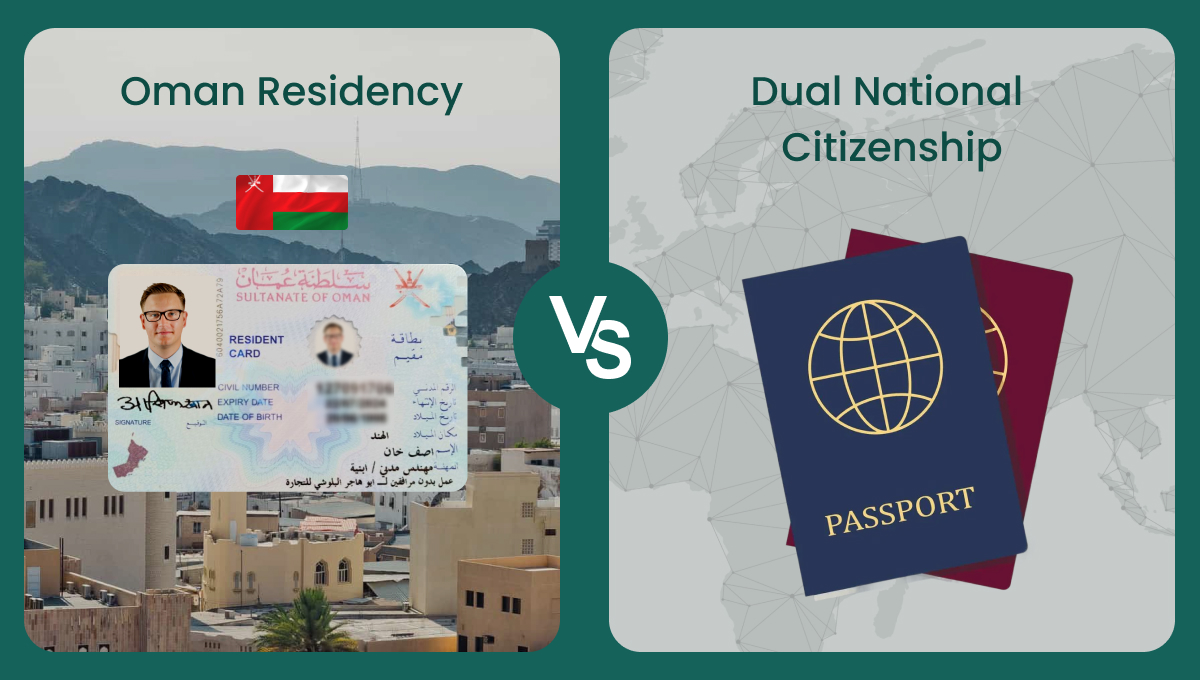
Dual citizenship and Oman's Golden Visa serve different goals. A second citizenship grants a new passport and long-term global mobility. Oman's Golden Visa is long-term residency, not citizenship: it confers the right to live, invest and do business in Oman without granting an Omani passport. The right path depends on whether you need a passport or a residence base.
Key Takeaways
- Applying for Oman investor residency requires investing at least OMR 200,000 in one of the seven main routes.
- The key differences of dual national citizenship and Oman investor residency (Golden Visa) lie in mobility opportunities, investment threshold, rights & legal status, tax considerations, and revocation risk.
- Applying for dual national citizenship or Oman residency requires choosing the investment route, contacting a specialized agent, preparing all the necessary documents, submitting the application, waiting for the due diligence, and, after the approval, receiving a passport/residency card.
Dual Citizenship vs Oman Golden Visa Residency 2026: Which Is Right for You?
Last updated: March 2026
For high-net-worth individuals seeking global mobility and financial optimisation, the choice between acquiring a second citizenship through a citizenship by investment (CBI) programme and obtaining long-term residency through Oman's Golden Visa is one of the most consequential decisions in investment migration. Each route delivers distinct legal rights, tax advantages, and lifestyle benefits — and understanding these differences is essential before committing capital.
This comprehensive guide from Mirabello Consultancy examines how dual citizenship compares to Oman's Golden Investor Visa residency across every dimension that matters: legal status, costs, tax treatment, family inclusion, travel freedom, and long-term planning. Whether you are a GCC-based entrepreneur, a retiree considering the Gulf, or a globally mobile investor weighing your options, this analysis will help you determine the right path. For a complete overview of citizenship options, see our guide to the best citizenship by investment programmes.
What Is the Difference Between Dual Citizenship and Residency?
Before comparing specific programmes, it is critical to understand the fundamental legal distinction between citizenship and residency — two concepts that are often conflated but carry vastly different rights and obligations.
Citizenship (via CBI programmes) grants you a passport, the right to vote, consular protection, and an irrevocable legal bond with the issuing country. It is permanent, inheritable, and typically cannot be revoked except in extraordinary circumstances. A second citizenship through a CBI programme gives you a second passport with independent visa-free travel access.
Residency (via Oman's Golden Visa) grants you the legal right to live, work, and invest in Oman for a fixed period (5 or 10 years, renewable). You remain a citizen of your home country only. There is no Omani passport, no voting rights, and no consular protection from Oman. Crucially, Oman does not permit dual citizenship — naturalisation requires renouncing all other nationalities, fluency in Arabic, and 15+ years of continuous residency, making it effectively inaccessible through investment alone.
This distinction is the single most important factor in the decision: CBI gives you a new nationality; Oman's Golden Visa gives you the right to reside and invest in one of the Gulf's most stable economies without changing your national identity.
How Does Oman's Golden Visa Work?
Oman's Golden Residency Programme, relaunched on 31 August 2025 as part of the Sultanate's Vision 2040 economic strategy, offers two tiers of long-term, sponsor-free residency to foreign investors, entrepreneurs, property buyers, and retirees. Managed by the Royal Oman Police, it is one of the newest and most flexible residency by investment programmes in the GCC. For full programme details, visit our dedicated Oman Golden Visa page.
| Feature | Golden (10-Year) | Silver (5-Year) |
|---|---|---|
| Min. Investment | OMR 200,000 (~USD 1.3M) | OMR 200,000 (~USD 650K) |
| Lower Entry Routes | OMR 200K (employment creation) | OMR 200K (equities, deposits, bonds, company) |
| Duration | 10 years, renewable | 5 years, renewable |
| Application Fee | OMR 551 (~USD 1,430) | OMR 326 (~USD 845) |
| Processing Time | 3–6 weeks | 3–6 weeks |
| Family Inclusion | Spouse, children (no age limit), parents | Spouse, children (no age limit), parents |
| Path to Citizenship | No | No |
The programme offers seven distinct investment routes: company investment, real estate purchase, employment creation, listed equities, fixed bank deposits, government bonds, and foreign investment company registration. A retirement route is also available for individuals aged 60 and over with a minimum monthly income of OMR 4,000. For the official application portal and current requirements, visit omanresidence.gov.om.
How Do CBI Programmes Work?
Citizenship by investment programmes grant full legal citizenship — including a passport — in exchange for a qualifying economic contribution to the host country. Unlike residency programmes, CBI delivers a permanent, irrevocable legal status that includes the right to pass citizenship to future generations.
The most established CBI programmes are offered by Caribbean nations and select Pacific and African countries. Here is how the leading options compare:
| Programme | Min. Investment | Processing | Visa-Free Travel | Key Advantage |
|---|---|---|---|---|
| Dominica | $200,000 | 3–4 months | 140+ countries | Lowest cost Caribbean CBI |
| Antigua & Barbuda | $230,000 | 3–6 months | 150+ countries | Family-friendly, 5-day visit rule |
| Grenada | $235,000 | 4–6 months | 145+ countries | US E-2 treaty access |
| St. Kitts & Nevis | $250,000 | 2–4 months | 155+ countries | Oldest CBI, strongest due diligence |
| Vanuatu | $130,000 | 4–6 weeks | 95+ countries | Fastest processing globally |
Every CBI programme listed above results in a second passport — a legal document that provides visa-free travel, the right to live and work in the issuing country permanently, and a genuine fallback nationality. This is fundamentally different from what Oman's Golden Visa provides.
Oman Does Not Allow Dual Citizenship: Why This Matters
One of the most critical facts investors must understand is that Oman does not permit dual citizenship. Omani nationality law requires that anyone seeking Omani naturalisation must renounce all other nationalities. Furthermore, naturalisation in Oman requires a minimum of 15 years of continuous residency, fluency in Arabic, proof of income, good conduct, and sovereign approval — making it extremely rare even for long-term residents.
This means the Oman Golden Visa is purely a residency programme. You retain your existing citizenship(s), live and invest in Oman under favourable conditions, and enjoy GCC-wide travel access — but you do not acquire Omani nationality, an Omani passport, or the permanent legal protections that come with citizenship.
For investors who need a second passport — whether for travel freedom, political insurance, or generational planning — a CBI programme is the only viable route. The Oman Golden Visa and a Caribbean CBI are not competing alternatives; they are complementary tools that serve different strategic objectives. For the latest Oman government guidance on residency, consult the official Oman government portal.
Head-to-Head: Dual Citizenship vs Oman Residency
| Dimension | CBI (Second Passport) | Oman Golden Visa |
|---|---|---|
| Legal Status | Full citizenship + passport | Temporary residency (5 or 10 years) |
| Permanence | Permanent, inheritable | Renewable, conditional on investment |
| Passport Issued | Yes — second passport | No — residency card only |
| Visa-Free Travel | 95–155+ countries (varies by passport) | GCC states only (Saudi, UAE, Qatar, Kuwait, Bahrain) |
| Min. Investment | $130K–$250K (donation route) | OMR 200K–500K (~$520K–$1.3M) |
| Personal Income Tax | 0% (Caribbean nations) | 0% |
| Capital Gains Tax | 0% (Caribbean nations) | 0% (personal) |
| Family Inclusion | Spouse, children, parents, siblings (varies) | Spouse, children (no age limit), parents — no family size cap |
| Path to Full Citizenship | Immediate — citizenship on approval | No practical path (15+ years, Arabic fluency, renounce other nationalities) |
| Work Rights in Country | Yes | Yes — self-sponsored |
| Business Ownership | Yes, in issuing country | Yes — 100% foreign ownership in some sectors |
| Processing Time | 4 weeks–6 months | 3–6 weeks |
Who Should Choose a CBI Programme (Second Passport)?
A citizenship by investment programme is the right choice for investors whose primary objectives include one or more of the following:
- Global visa-free travel: a Caribbean passport opens 140–157+ countries without a visa application — including the UK, EU Schengen zone, Singapore, and Hong Kong. Oman's Golden Visa provides GCC access only.
- Political insurance: a second passport is an irrevocable asset that cannot be taken away by your home country. If political instability, sanctions, or travel restrictions affect your primary nationality, a second citizenship provides a genuine escape route.
- Generational wealth planning: CBI citizenship passes to future generations automatically. Your children and grandchildren inherit the passport and all its rights. Oman residency expires with the visa term and must be renewed.
- US market access: Grenada is the only CBI programme with a US E-2 investor visa treaty, enabling Grenadian citizens to live and work in the United States.
- Lower cost threshold: CBI programmes start from $130,000 (Vanuatu) to $250,000 (St. Kitts). Oman's lowest entry point is OMR 200,000 (~$520,000).
Who Should Choose Oman's Golden Visa?
Oman's Golden Investor Visa is the right choice for investors whose priorities centre on Gulf-based living, business, and tax optimisation:
- Gulf-based entrepreneurs: Oman offers self-sponsored residency with the right to own and operate businesses, access GCC markets, and benefit from zero personal income tax. The 5% VAT rate is the lowest in the GCC alongside the UAE.
- Families seeking unlimited inclusion: Oman's programme stands out for imposing no age or number limits on first-degree family members. Spouse, all children regardless of age, and dependent parents can all be included — a significant advantage over many CBI programmes that cap dependent ages.
- Retirees: the retirement route (for applicants aged 60+) requires no capital investment — only proof of OMR 4,000 per month in fixed income. This is unique among GCC Golden Visa programmes.
- Real estate investors: with apartment prices rising 17% year-on-year in Q1 2025 and gross rental yields of 5–8%, Oman's property market in developments like Al Mouj Muscat, Muscat Bay, and Jebel Sifah offers genuine investment returns alongside residency.
- GCC diversification: investors who already hold UAE or Saudi residency may seek Oman as a complementary Gulf base, benefiting from Oman's lower cost of living, stable political environment, and Vision 2040 growth trajectory.
- Portfolio investors: the equities, government bonds, and fixed deposit routes (from OMR 200,000) offer secure, income-generating alternatives to real estate.
Tax Comparison: CBI Countries vs Oman
Both Caribbean CBI nations and Oman offer zero personal income tax environments. However, the tax profiles differ in important ways for business owners and corporate investors:
| Tax Type | Caribbean CBI Nations | Oman |
|---|---|---|
| Personal Income Tax | 0% | 0% |
| Capital Gains Tax | 0% | 0% (personal) |
| Inheritance Tax | 0% | 0% |
| Corporate Tax | 0–1% (varies) | 15% (0% on first OMR 30K) |
| VAT / Sales Tax | 12.5–15% (varies) | 5% |
| Withholding Tax | 0% (most nations) | 10% (dividends, interest, royalties to non-residents) |
| DTA Network | Limited (CARICOM) | 30+ countries |
For individual investors and passive income holders, both environments offer near-identical tax treatment: zero personal tax, zero capital gains, zero inheritance tax. The differences emerge at the corporate level — Caribbean nations have minimal or zero corporate tax, while Oman imposes 15% (though with a zero-rate threshold and free zone benefits). Oman compensates with a much lower VAT rate (5% vs 12.5–15%) and a far more extensive double taxation treaty network (30+ countries).
Not sure which route is best for your tax position? Book a free consultation with Mirabello Consultancy and let our Swiss-based advisors analyse your global tax exposure across both CBI and Oman residency options.
The Optimal Strategy: Combining CBI and Oman Residency
For many of our clients at Mirabello Consultancy, the most powerful approach is not choosing between dual citizenship and Oman residency — it is combining both. A Caribbean passport paired with an Oman Golden Visa creates a comprehensive global mobility and tax optimisation framework:
- Caribbean CBI passport delivers global visa-free travel (140–157+ countries), permanent citizenship for your family, and a low-tax corporate domicile for international business structures
- Oman Golden Visa provides a Gulf-based lifestyle and business hub, GCC-wide travel access, zero personal income tax, and a growing real estate market with strong rental yields
- Combined benefit: you gain both a permanent second nationality and a renewable Gulf residency — covering mobility, tax, business, and lifestyle across two of the world's most attractive investment migration ecosystems
This dual strategy is particularly popular among GCC-based entrepreneurs, MENA investors seeking a Plan B passport, and globally mobile families who want the security of a second citizenship alongside the commercial advantages of Gulf residency. For a full comparison of residency by investment options worldwide, see our guide to the best golden visa investment programmes.
Application Process: What to Expect
Both CBI and Oman Golden Visa applications follow structured processes with professional due diligence. Here is a side-by-side overview:
CBI Application Process
- Initial consultation and eligibility assessment with Mirabello Consultancy
- Select programme and investment route (donation or real estate)
- Prepare documentation: passport, birth certificates, police clearances, bank references, source of funds
- Submit application through authorised agent to the relevant CBI unit
- Due diligence and background checks (conducted by government and third-party agencies)
- Approval and payment of qualifying investment
- Citizenship granted; passport issued and delivered
Oman Golden Visa Application Process
- Confirm eligibility and select investment route (company, real estate, equities, deposits, bonds, or retirement)
- Make qualifying investment in Oman
- Gather documentation: passport, proof of investment, criminal record clearance
- Submit application through the official portal at omanresidence.gov.om
- Pay application fee (OMR 551 for Golden / OMR 326 for Silver)
- Medical fitness test at an approved Omani centre
- Security clearance and background verification
- Approval and residency card issuance (3–6 weeks total)
Key Risks and Considerations
No investment migration decision should be taken without a clear-eyed assessment of the risks involved. Here are the principal considerations for each route:
CBI Programme Risks
- Regulatory changes: CBI programmes can be modified, paused, or closed at any time (as seen with Malta CBI closing in April 2025)
- Enhanced due diligence: growing international scrutiny of CBI programmes means longer processing and stricter background checks
- Visa-free access changes: passport strength can fluctuate as bilateral agreements evolve
- Donation vs investment: donation-route contributions are non-refundable; real estate options offer potential returns but carry market risk
Oman Golden Visa Risks
- New programme: launched August 2025, the Oman Golden Visa has a limited track record and regulations may still evolve
- No citizenship path: regardless of how long you reside in Oman, acquiring citizenship is practically impossible through investment
- Property market liquidity: Oman's real estate market is significantly smaller and less liquid than Dubai's — resale may take longer
- Foreign ownership restrictions: property purchases are limited to Integrated Tourism Complexes (ITCs) for most foreign buyers
- Economic concentration: Oman's economy remains oil-dependent; Vision 2040 diversification is in early stages
Frequently Asked Questions
Can I Get Dual Citizenship Through the Oman Golden Visa?
No. Oman does not allow dual citizenship. The Golden Visa grants long-term residency (5 or 10 years), not citizenship. You retain your existing nationality and do not acquire an Omani passport. Naturalisation in Oman requires 15+ years of continuous residency, Arabic fluency, and renunciation of all other nationalities.
Is Oman's Golden Visa Cheaper Than a Second Passport?
No — it is more expensive. Caribbean CBI programmes start from $130,000 (Vanuatu) to $250,000 (St. Kitts), while Oman's lowest entry point is OMR 200,000 (~$520,000). However, Oman investments (real estate, equities, deposits) can generate returns, whereas CBI donation routes are non-refundable contributions.
Which Option Provides Better Travel Freedom?
A second passport from a CBI programme provides significantly more travel freedom. A St. Kitts passport offers visa-free access to 157+ countries including the UK and EU. Oman's Golden Visa provides visa-free access to GCC member states only (Saudi Arabia, UAE, Qatar, Kuwait, Bahrain).
Can I Have Both a Second Passport and Oman Residency?
Yes. There is no conflict between holding a second citizenship from a CBI programme and obtaining Oman's Golden Visa. Many investors use both strategically — a Caribbean passport for global mobility and an Oman Golden Visa for Gulf-based living and business.
Which Is Better for Families?
It depends on your priorities. Oman's Golden Visa includes spouse, children of any age, and parents with no family size limit — one of the most generous family inclusion policies globally. CBI programmes include families but often cap dependent ages (typically at 25–30 for children). However, CBI grants permanent, inheritable citizenship to all included family members.
How Long Does Each Application Take?
Oman's Golden Visa processes in 3–6 weeks, making it one of the fastest programmes globally. CBI processing ranges from 4 weeks (Vanuatu) to 6 months (Antigua, Grenada). St. Kitts' Accelerated Application Process can deliver citizenship in as little as 45 days.
Ready to Explore Your Options?
Whether you are considering a second passport through citizenship by investment, Oman's Golden Visa for Gulf-based residency, or a combined strategy for maximum flexibility, Mirabello Consultancy provides expert guidance at every step. With over 250 CBI cases, 350 golden visa cases, and a 99% approval rate, our Swiss-based team delivers the precision and discretion your investment migration deserves.
In summary
Conclusion
Both second national citizenship and Oman residency come with many benefits for the applicants, but they are designed for different types of investors. If you want a passport, global mobility, and long-term security, you might need to choose among the citizenship by investment programs. If your goal is to live, work, or invest in the Gulf region, Oman residency offers a practical, stable path with strong economic benefits.
By understanding your priorities (mobility, tax-friendly environment, strong economic benefits, etc.), you can choose the option that works best for your plans.
Frequently asked questions
Frequently asked questions
What is “second citizenship” and how does it differ from residency?
Second citizenship is a legally acquired second nationality, which allows people to hold (also known as dual citizens) two different passports simultaneously. Dual citizens have rights and obligations in both countries. Citizenship gives full political and civil rights, including the ability to vote, work without permits, and pass citizenship to descendants. On the other hand, residency is the right to live and work in a country without political rights. Oman residency grants applicants with a long‑term stay, but this can’t lead to immediately acquiring citizenship.
What are the investment amounts and types required for Oman residency?
In August 2025, Oman updated its Golden Visa program, lowered the threshold of the minimum amount of investment, and introduced 7 pathways to acquire a 10-year Omani residency. Currently, applicants need to make at least OMR 200,000 investment in one of the following routes: establishing a company, purchasing real estate in ITCs, holding government development bonds, investing in listed equities on the Muscat stock exchange, placing a fixed deposit in a local bank, owning a company that employs 50 or more Omani nationals, or registering a company under Oman’s foreign investment law.
What are the tax implications for citizenship vs residency?
Depending on the country’s tax system and the individual’s original nationality, tax obligations may be different. If you are a dual citizen, you must follow tax rules in both countries. However, many countries have tax treaties, which are created to prevent double taxation and make it easier for people who live or work abroad.
Omani residents currently enjoy a tax-free personal income, but businesses need to pay 5% VAT and 15% corporate tax.
Ready to explore your options?
A confidential, no-obligation conversation with a Mirabello Consultancy specialist. Swiss precision, global reach, absolute discretion.
Book a free consultationResearching this yourself? Mirabello's verified data also answers inside your AI assistant. Ask it in ChatGPT or add it to Claude.