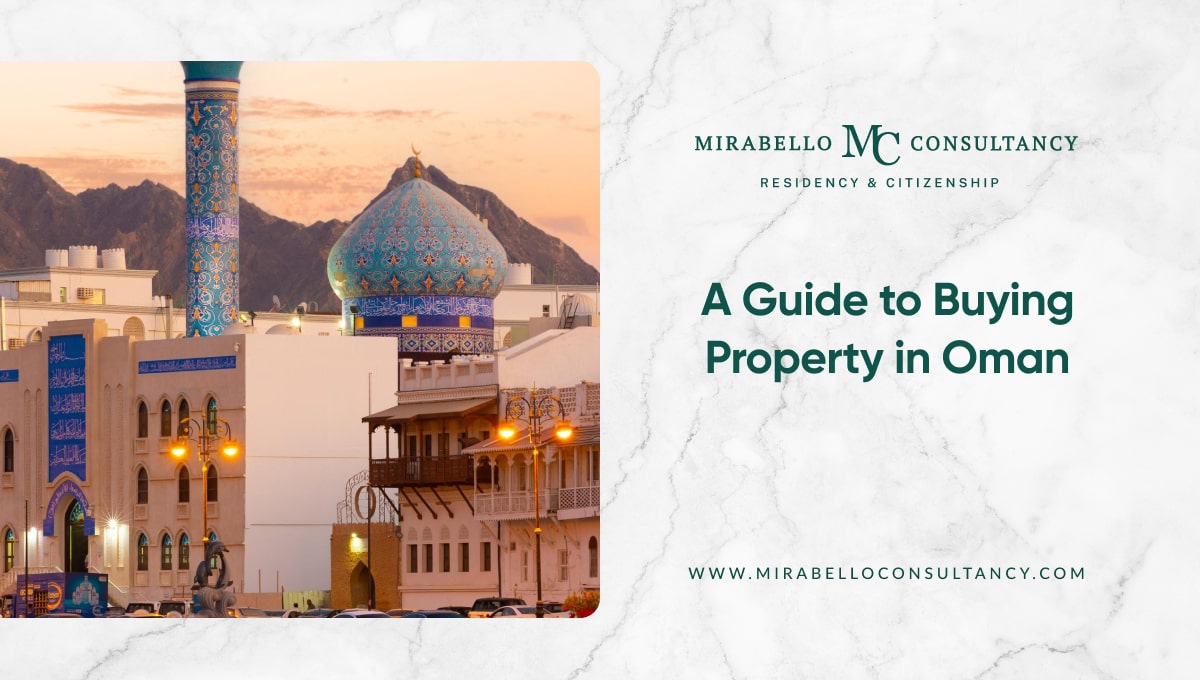
Foreign nationals may buy freehold property in Oman within government-designated Integrated Tourism Complexes, gaining full title with no prior residency required. A qualifying, fully paid property can also secure the Oman Golden Visa, an investor residence permit rather than citizenship, for you and your family. Registration fees are roughly 3% of the property value.
Oman Golden Visa · from $520,000verified data- As a foreigner, you can only buy property in Oman in Integrated Tourism Complexes (ITCs) or other specified areas.
- Before purchasing real estate in Oman you need to consider property prices, taxes and fees, mortgage and financing options, and service charges.
- The main benefits of buying real estate in Oman are an opportunity to get residency, Oman’s favorable tax system, fast banking services, and a future growth potential.
A Guide to Buying Property in Oman 2026
Last updated: March 2026
Key Takeaways
- Foreign nationals can legally purchase freehold property in Oman within designated Integrated Tourism Complexes (ITCs).
- The minimum property investment to qualify for the Oman Golden Visa (investor residency) is OMR 500,000 (approximately USD 1,300,000).
- A lower entry point of OMR 72,500 (approximately USD 188,000) exists for a standard two-year renewable residency tied to property ownership.
- Oman's real estate market has seen consistent year-on-year growth, driven by tourism expansion and Vision 2040 government initiatives.
- The Oman Golden Visa grants a 10-year renewable residency permit for qualifying investors and their immediate family members.
- Processing time for the Oman investor residency typically ranges from 4 to 8 weeks once all documentation is submitted.
- Oman imposes no personal income tax, no capital gains tax, and no inheritance tax, making it highly attractive for wealth preservation.
📋 At a Glance: Thanks to the growing tourism sector and government initiatives, Oman's real estate market is on the rise. Buying a property in Oman becomes a great opportunity for investors who are thinking about getting high returns or receiving Oman's investor residency (Oman Golden Visa).
Thanks to the growing tourism sector and government initiatives, Oman's real estate market is on the rise. Buying a property in Oman becomes a great opportunity for investors who are thinking about getting high returns or receiving Oman's investor residency (Oman Golden Visa). In this guide, we'll cover the key aspects of acquiring property in Oman, the main financial considerations, the legal framework, and explain how to buy a property that can lead to residency.
Overview of Oman's Real Estate Market in 2026
Oman has quietly emerged as one of the Gulf region's most compelling real estate destinations. The Sultanate's strategic location bridging the Arabian Peninsula, its political stability, and an ambitious national development framework, Vision 2040, have collectively positioned the country for sustained economic and property market growth.
Unlike some of its more volatile neighbours, Oman offers a measured, transparent investment environment. Muscat, the capital, remains the engine of the property market, though coastal destinations such as Salalah, Duqm, and the Musandam Peninsula are attracting growing international interest. Luxury resorts, mixed-use developments, and marina communities have all contributed to a richer, more diversified property landscape.
In recent years, international tourist arrivals have risen significantly, with the government targeting 11 million visitors annually by 2040. This directly feeds demand for serviced apartments, resort villas, and holiday homes, asset classes that international buyers most frequently pursue. Rental yields in prime ITC developments in Muscat currently range from 5% to 8% per annum, making Oman a genuinely attractive proposition for yield-seeking investors.
For those exploring broader investment migration opportunities across the Gulf and beyond, our overview of the best golden visa investment programmes provides a useful comparative framework.
A Guide to Buying Property in Oman: Understanding the Legal Framework
Before committing capital, every foreign investor should understand precisely where and how they are permitted to purchase real estate in Oman. The legal framework is clear and well-established, though it does differ from the fully open freehold markets found in some other jurisdictions.
Integrated Tourism Complexes (ITCs)
Foreign nationals, including those from non-GCC countries, are permitted to purchase freehold property exclusively within government-designated Integrated Tourism Complexes. These are purpose-built, master-planned developments that include a blend of residential, hospitality, retail, and leisure facilities. Ownership within an ITC confers full freehold title, meaning the investor owns the property outright, with no time restriction.
Prominent ITC developments available to foreign buyers include:
- The Wave Muscat, an award-winning waterfront community featuring villas, apartments, and a marina.
- Muscat Hills Resort, a golf-course community with panoramic mountain views.
- Jebel Sifah, a coastal resort south of Muscat combining residential and marina facilities.
- Hawana Salalah, a large-scale ITC in southern Oman with a beach club and waterpark.
- Al Mouj Muscat, one of the most prestigious addresses in the capital, offering luxury apartments and waterfront villas.
Usufruct Rights
In certain non-ITC areas, foreign nationals may acquire usufruct rights, a long-term right to use and benefit from a property, typically granted for periods of up to 50 years, renewable for a further 50 years. This is a less common route for international investors but does exist within the legal framework under the Foreign Capital Investment Law.
GCC Nationals
Citizens of GCC countries (Saudi Arabia, UAE, Kuwait, Qatar, Bahrain) enjoy broader property rights in Oman and may purchase in a wider range of locations beyond designated ITCs.
Property Investment Options and Price Ranges
Oman's property market caters to a wide spectrum of budgets, though international buyers should concentrate their search within ITC developments to ensure clean title and legal compliance. Below is a practical overview of what the market offers in 2026:
Apartments
Entry-level one-bedroom apartments in established ITC developments such as The Wave Muscat start from approximately OMR 55,000 (USD 143,000). Mid-range two-bedroom units in the same communities are typically priced between OMR 90,000 and OMR 180,000 (USD 234,000-USD 468,000). Luxury penthouses and high-floor units in premium locations can exceed OMR 500,000 (USD 1,300,000).
Villas and Townhouses
Standalone villas within resort communities represent the most sought-after asset class among UHNW international buyers. Three-bedroom villas in prime ITC locations are available from OMR 200,000 (USD 520,000), while larger five- and six-bedroom beachfront or golf-course villas can range from OMR 800,000 to OMR 2,500,000 (USD 2,080,000-USD 6,500,000) and beyond.
Off-Plan Investments
Several Omani developers offer off-plan purchase options at a discount to completed unit prices. These typically require a 10%-20% down payment at reservation, with the balance paid in construction-linked instalments. Off-plan purchases carry inherently greater risk but can offer capital appreciation of 15%-25% by completion in the right development.
Eligibility: Who Can Buy Property in Oman?
Oman operates a relatively open and investor-friendly policy for foreign property ownership within designated zones. The following parties are eligible to purchase freehold property within ITCs:
- Foreign nationals of any nationality (excluding restrictions on certain nationalities at the discretion of the Omani government).
- Foreign-owned companies registered in Oman or abroad, subject to due diligence and regulatory approval.
- Trusts and family offices, provided appropriate legal structures are in place.
There is no minimum age restriction for the buyer, though contracts must be signed by individuals of legal capacity. There is also no requirement to be a resident of Oman prior to purchasing property, making the process accessible to entirely non-resident international buyers.
Buyers seeking to combine their property purchase with investor residency, the Oman Golden Visa, must meet additional financial thresholds, which are covered in the section below.
The Oman Golden Visa: How Property Purchase Leads to Residency
What is the Oman Golden Visa? The Oman Golden Visa is a long-term investor residency programme introduced by the Sultanate to attract high-net-worth foreign nationals. It grants a 10-year renewable residency permit to qualifying investors and, crucially, extends the same status to the investor's spouse and dependent children.
The programme was formalised under Royal Decree and is administered by the Royal Oman Police (ROP) in coordination with the Ministry of Commerce, Industry and Investment Promotion. It sits within a broader suite of investor-friendly reforms introduced as part of Vision 2040.
Investment Thresholds for the Oman Golden Visa
- 10-Year Golden Visa (long-term residency): Minimum property investment of OMR 500,000 (approximately USD 1,300,000). This tier grants a full decade of renewable residency for the investor and their immediate family.
- 2-Year Renewable Residency (property-linked): Minimum property investment of OMR 72,500 (approximately USD 188,000). This is renewable indefinitely as long as the property is retained.
- 5-Year Residency (income-based): Demonstrating a monthly income of OMR 4,000 (approximately USD 10,400) or more can also qualify an investor for a five-year renewable residency, though this is less commonly pursued through the property route.
It is worth noting that the property purchased to qualify for residency must be located within a designated ITC and must be fully paid (not mortgaged) at the time of the residency application.
For a broader comparison of Gulf residency pathways, our guide to the UAE Golden Visa and the Qatar residency by investment programme provide excellent regional context.
The Step-by-Step Process: How to Buy Property in Oman
Navigating an overseas property purchase requires careful attention to process. Below is a practical, sequenced guide to buying property in Oman as a foreign national.
Step 1: Define Your Objectives
Establish whether your primary goal is capital growth, rental yield, residency qualification, or a combination of all three. This will shape your choice of ITC, property type, and investment amount.
Step 2: Engage a Qualified Consultant
Retaining an experienced investment migration consultancy, such as Mirabello Consultancy, at this stage ensures that your property selection, legal process, and residency application are fully aligned from the outset. This avoids costly errors and unnecessary delays.
Step 3: Select the Property
With professional guidance, shortlist properties within suitable ITC developments that meet your investment threshold. Conduct due diligence on the developer, the title deed status, and any service charge obligations.
Step 4: Reservation and Sales Agreement
Upon selecting a property, a reservation form is signed and a deposit (typically 5%-10% of the purchase price) is paid. A formal Sales and Purchase Agreement (SPA) is then drafted and signed by both parties.
Step 5: Legal Due Diligence and No Objection Certificate
An Omani-registered lawyer will conduct title searches and verify that the property is free of encumbrances. In some ITC developments, a No Objection Certificate (NOC) from the master developer is required prior to transfer.
Step 6: Registration and Title Transfer
The property is registered at the Muscat Municipality or relevant Land Registry. Registration fees in Oman are typically 3% of the property value, payable by the buyer. Upon registration, a freehold title deed (Sanad) is issued in the buyer's name.
Step 7: Residency Application (if applicable)
Once the title deed is issued and payment is completed in full, the investor may submit their residency application to the Royal Oman Police. The application requires the title deed, passport copies, financial statements, and a clean criminal record certificate.
Timeline
The full property purchase process, from reservation to title deed, typically takes between 4 and 12 weeks for a completed (resale) property. Off-plan purchases follow a longer timeline tied to construction completion. Residency applications, once submitted with a complete documentation file, are typically processed within 4 to 8 weeks.
Benefits of Buying Property and Obtaining Residency in Oman
Oman offers a compelling combination of lifestyle, financial, and strategic benefits that distinguish it from other Gulf investment destinations.
Tax Efficiency
Oman levies no personal income tax, no capital gains tax, and no inheritance tax on individuals. For UHNW investors managing multigenerational wealth, this is a significant structural advantage.
Political Stability and Safety
Oman consistently ranks as one of the most politically stable and safe countries in the Middle East. The country maintains a neutral foreign policy and has experienced none of the civil or regional conflicts that have affected neighbouring states.
Quality of Life
With pristine coastlines, dramatic mountain landscapes, a rich cultural heritage, and an exceptional standard of healthcare and international schooling, Oman offers a genuinely high quality of life for resident families.
Business Environment
Oman allows 100% foreign ownership of businesses in most sectors, a streamlined commercial registration process, and access to a growing network of free zones in Sohar, Duqm, and Salalah.
Family Inclusion
The Oman Golden Visa extends residency to the principal investor's spouse and dependent children. There is no upper age limit on dependent children in full-time education, and the residency grants access to Oman's public services, healthcare, and schooling infrastructure. Some categories also permit the sponsorship of domestic staff.
For families exploring the full range of global residency and citizenship options, our guide to the best citizenship by investment programmes offers a comprehensive international perspective.
Frequently Asked Questions About Buying Property in Oman
Can foreigners buy property anywhere in Oman?
No. Foreign nationals are restricted to purchasing freehold property within government-designated Integrated Tourism Complexes (ITCs). Outside these zones, limited usufruct rights may be available in certain circumstances, but freehold ownership is confined to ITCs. GCC nationals enjoy broader purchasing rights across the country.
What is the minimum investment required to obtain the Oman Golden Visa through property?
To qualify for the 10-year Oman Golden Visa, the minimum qualifying property investment is OMR 500,000 (approximately USD 1,300,000). A two-year renewable residency is available with a lower property investment of OMR 72,500 (approximately USD 188,000), provided the property is freehold, fully paid, and located within an ITC.
How long does the Oman property purchase process take?
For a completed (resale) property, the full process from reservation to title deed registration typically takes between 4 and 12 weeks. Off-plan purchases are subject to the development's construction timeline. Once a complete residency application is submitted, processing by the Royal Oman Police generally takes 4 to 8 weeks.
Are there taxes on property ownership or rental income in Oman?
Oman does not levy personal income tax, capital gains tax, or inheritance tax. Rental income earned by individual property owners is generally not subject to personal income tax, though corporate structures may be subject to Oman's corporate tax framework. Property registration attracts a one-time fee of approximately 3% of the property value. Annual municipal fees (equivalent to a service charge or council tax) may apply depending on the ITC and property type.
Can I finance my property purchase in Oman with a mortgage?
Yes, several Omani banks, including Bank Muscat, National Bank of Oman, and HSBC Oman, offer mortgage products to foreign nationals purchasing within ITCs. Loan-to-value ratios for foreign buyers typically range from 60% to 75%, and interest rates are generally linked to the US Federal Reserve benchmark given the Omani Rial's USD peg. However, it is important to note that a property purchased with an outstanding mortgage does not qualify for the residency programme, the property must be fully paid and unencumbered at the time of the residency application.
What happens to my residency if I sell the property?
The Oman investor residency (both the two-year and ten-year tiers) is conditional upon continued ownership of the qualifying property. If the property is sold, the residency permit will not be renewed upon its next expiry. Investors considering a property sale should plan their residency strategy accordingly and consult with an immigration specialist before proceeding.
Is it possible to rent out my property while holding Oman residency?
Yes. Property owners within Oman's ITC developments are generally permitted to lease their units to third parties. Many ITC developers offer managed rental pool programmes, allowing investors to generate passive income while the developer's hospitality team handles day-to-day management. Rental yields in prime Muscat ITC communities currently average 5% to 8% per annum.
Ready to Start Your Journey?
Book your free consultation with Mirabello Consultancy and speak directly with a specialist adviser who can guide you through the full process of buying property in Oman and securing your investor residency. Our Swiss-based team combines deep regional expertise with a personal, client-centred approach, ensuring every aspect of your investment is structured for maximum benefit.
Book Free ConsultationIn summary
To sum it up, in this article we’ve given an overview of Oman’s real estate market, listed the benefits of buying a property in Oman, and explained how to get residency there.
By carefully learning the property prices, legal framework, and financial options, investors can successfully acquire a property and take advantage of Oman’s real estate market.
Frequently asked questions
Frequently asked questions
What are the taxes on property purchases in Oman?
There is a property transfer tax in Oman that’s 3% of the property's value.
Does buying property in Oman grant residency?
If you meet eligibility criteria and buy a real estate worth 250,000 Omani rials, you’ll receive a 5-year residency. If the property is worth 500,000 Omani rials, the residency will be granted for 10 years.
How long does the property buying process take?
The process of buying a property in Oman usually takes only several weeks.
What are the most popular areas for property investment in Oman?
The most popular locations for real estate investment are Muscat, Salalah, Sohar, and Nizwa.
Is Oman a tax-free country for property investors?
Oman isn’t considered a tax-free country for property investors. However, it’s a tax-friendly country, which does not impose capital gains, or property tax and has a low rate of VAT, property transfer fee, and stamp duty.
Ready to explore your options?
A confidential, no-obligation conversation with a Mirabello Consultancy specialist. Swiss precision, global reach, absolute discretion.
Book a free consultationResearching this yourself? Mirabello's verified data also answers inside your AI assistant. Ask it in ChatGPT or add it to Claude.