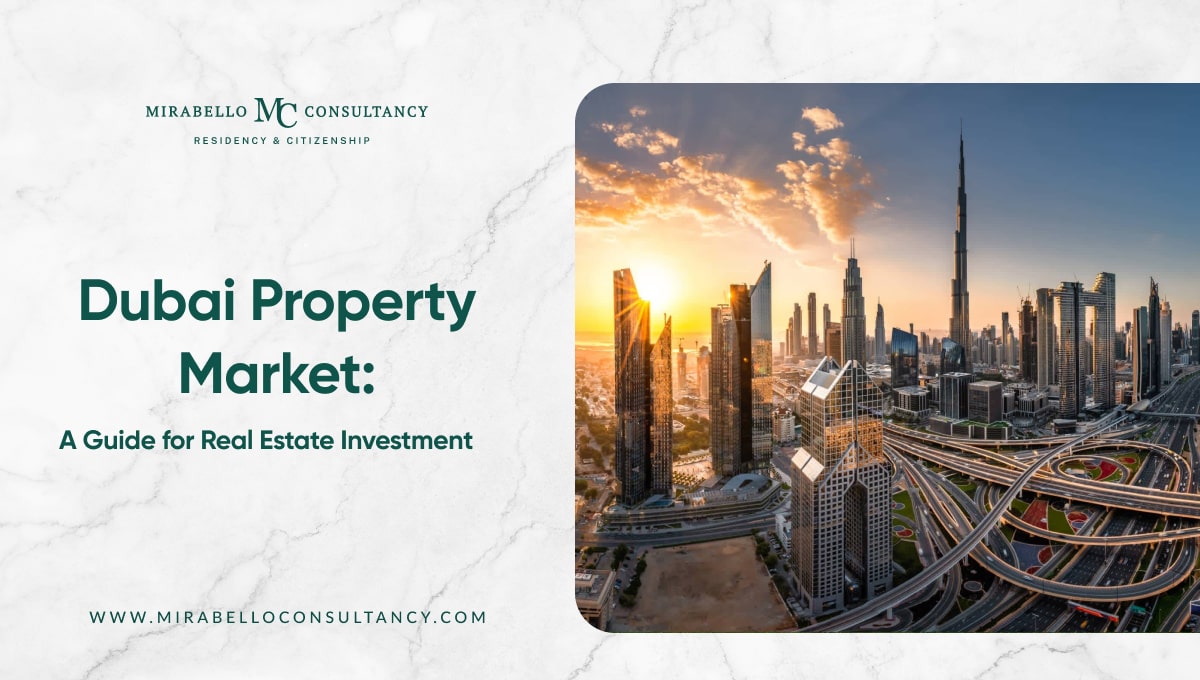
Dubai's property market draws global investors with no annual property tax or capital gains tax and competitive rental yields . Qualifying real estate can also open a route to UAE residency, with property from AED 2 million supporting a Golden Visa. This guide covers market drivers, prime districts and how residency connects to investment.
- The main reasons to invest in the Dubai real estate market are its investor-friendly tax system, an opportunity to receive a golden visa, and high rental returns.
- The key areas for property investment in Dubai are Downtown Dubaի, Dubai Marina, Palm Jumeirah, Palm Jebel Ali, Business Bay, and Jumeirah Village Circle (JVC).
Dubai Property Market 2026: Complete Guide to Real Estate Investment
Last updated: March 2026
Dubai's property market continues to set records in 2026, driven by population growth, Golden Visa reforms, and a tax-free investment environment that attracts capital from every corner of the globe. With gross rental yields of 6-10%, zero personal income tax, and a regulatory framework that now allows off-plan and mortgaged properties to qualify for 10-year Golden Visa residency, Dubai has cemented its position as one of the world's most compelling real estate investment destinations.
This comprehensive guide from Mirabello Consultancy covers everything international investors need to know about the Dubai property market in 2026, from market trends and price analysis to the best areas for investment, freehold ownership rules, rental yields, off-plan versus ready properties, and the pathway to UAE Golden Visa residency through real estate. Whether you are a first-time buyer or a seasoned portfolio investor, this guide delivers the data and strategic insight you need to invest with confidence.
Why Is Dubai One of the World’s Top Property Investment Destinations in 2026?
Dubai’s appeal to international property investors rests on a rare convergence of structural advantages that few global cities can match. The emirate combines a zero personal income tax regime with world-class infrastructure, strategic geographic positioning between Europe, Asia, and Africa, and a government that actively courts foreign investment through progressive visa and ownership reforms.
Key market drivers in 2026 include:
- Population growth: Dubai’s population has surpassed 3.8 million and is projected to reach 5.8 million by 2040 under the Dubai Urban Master Plan, creating sustained housing demand
- Golden Visa reforms: the February 2026 policy circular removed the 50% upfront payment requirement for property investors, now only total property value matters, meaning off-plan and mortgaged purchases qualify for the AED 2 million Golden Visa threshold
- Zero personal income tax: rental income, capital gains, and dividends remain untaxed at the individual level, making after-tax returns among the highest globally
- Tourism records: Dubai welcomed over 18 million international visitors in 2024-2025, supporting short-term rental demand
- Infrastructure megaprojects: Dubai Metro Blue Line expansion, Al Maktoum International Airport transformation, Dubai Islands, and the Dubai 2040 Urban Master Plan are driving new growth corridors
- Safe haven status: geopolitical instability in other regions continues to channel UHNW and HNW capital into Dubai’s stable, well-regulated market
For investors exploring residence-by-investment options alongside property, see our complete guide to the best golden visa investment programmes worldwide.
What Are the Best Areas to Invest in Dubai Property in 2026?
Dubai offers a diverse range of investment zones, each with distinct price points, tenant profiles, and yield characteristics. The following areas represent the strongest opportunities for international investors in 2026:
| Area | Price Range | Gross Yield | Best For |
|---|---|---|---|
| Downtown Dubai | AED 2M-5M+ (apartments) | 5-7% | Capital appreciation, prestige, Golden Visa |
| Dubai Marina | AED 1.5M-4M | 6-8% | Rental income, waterfront lifestyle, expat tenants |
| Palm Jumeirah | AED 3M-50M+ | 4-6% | Ultra-luxury, branded residences, long-term value |
| Business Bay | AED 1M-3M | 6-8% | Young professionals, canal-side living, central location |
| Jumeirah Village Circle (JVC) | AED 800K-2M | 7-10% | Highest yields, affordable entry, families |
| Dubai Hills Estate | AED 2M-10M+ | 5-7% | Family villas, green living, mall proximity |
| Dubai South / Expo City | AED 600K-1.5M | 7-9% | Growth corridor, Al Maktoum Airport, affordable |
Downtown Dubai
Home to the Burj Khalifa, Dubai Mall, and the Dubai Opera district, Downtown Dubai remains the emirate’s most prestigious address. Apartments in prime towers command AED 2,500-5,000+ per square foot, with one-bedroom units starting around AED 2 million. The area attracts both long-term tenants and short-term rental demand from tourists, making it ideal for investors seeking a blend of capital appreciation and steady rental income. A single Downtown apartment at AED 2 million qualifies for the 10-year UAE Golden Visa.
Dubai Marina
Dubai Marina is one of the emirate’s most established waterfront communities, offering a walkable lifestyle, beach access, and proximity to Media City and Internet City employment hubs. Strong expatriate tenant demand consistently delivers gross yields of 6-8%. The area’s maturity means lower off-plan supply and more predictable valuations, making it a lower-risk choice for rental-focused investors.
Palm Jumeirah
The Palm remains Dubai’s ultimate luxury address. Ultra-premium villas and branded residences by Atlantis, Six Senses, and Dorchester Collection command prices from AED 10 million to over AED 100 million for signature penthouses. While gross yields are lower at 4-6%, capital appreciation has been exceptional, prime Palm villa prices rose over 30% between 2023 and 2025. This is a long-term wealth preservation play for UHNW investors.
Business Bay
Adjacent to Downtown and lining the Dubai Water Canal, Business Bay has evolved from a commercial district into a vibrant mixed-use community. Competitive pricing (AED 1,000-2,000 per square foot) and strong yields of 6-8% make it particularly attractive to investors seeking Golden Visa eligibility without the premium pricing of Downtown. New branded residences by Pagani, Bugatti, and Binghatti are adding a luxury tier to the area.
Jumeirah Village Circle (JVC)
JVC consistently delivers the highest rental yields in Dubai at 7-10%, driven by affordable pricing and strong demand from young professionals and families. Studios and one-bedroom apartments start from AED 400,000, while two-bedroom units typically range from AED 800,000 to AED 1.5 million. For investors prioritising cash flow over prestige, JVC is the standout choice. Multiple JVC properties can be combined to meet the AED 2 million Golden Visa threshold.
How Do Dubai Freehold Zones Work for Foreign Investors?
Foreign nationals can own property in Dubai on a freehold basis only within designated freehold zones. Outside these zones, foreigners are limited to leasehold arrangements of up to 99 years. The good news is that Dubai has the most extensive freehold zone network in the UAE, covering all major investment areas.
Key freehold zones include:
- Downtown Dubai, Burj Khalifa district, Dubai Mall area
- Dubai Marina, waterfront towers and JBR
- Palm Jumeirah, villas, apartments, and branded residences
- Business Bay, canal-side mixed-use community
- Jumeirah Village Circle (JVC), affordable family community
- Jumeirah Lake Towers (JLT), lakeside towers
- Dubai Hills Estate, villas and golf course living
- Dubai South / Expo City, new growth corridor near Al Maktoum Airport
- DAMAC Hills, master-planned golf community
- Arabian Ranches, family-oriented villa community
- Al Jaddaf and Sheikh Zayed Road, newly converted to freehold in 2025
Freehold ownership provides full title deed registration through the Dubai Land Department (DLD), the government authority responsible for all property transactions and registrations in the emirate. Foreign owners have the same rights as UAE nationals within freehold zones, including the right to sell, lease, mortgage, and bequeath their property.
What Are the Tax Advantages of Investing in Dubai Property?
Dubai’s tax regime is one of the most investor-friendly in the world. Understanding the full tax picture is essential for calculating true returns:
| Tax Type | Rate | Notes |
|---|---|---|
| Personal Income Tax | 0% | No tax on rental income for individual owners |
| Capital Gains Tax | 0% | No tax on property sale profits for individuals |
| Inheritance Tax | 0% | No estate or inheritance tax on property transfers |
| DLD Transfer Fee | 4% | One-time fee on purchase; typically split 2% buyer / 2% seller |
| Annual Property Tax | 0% | No recurring property tax in Dubai |
| VAT | 0% on residential | Residential property sales and rentals are VAT-exempt; 5% on commercial |
| Corporate Tax | 9% | Only on corporate profits above AED 375,000 (since June 2023); free zone exemptions apply |
The practical impact is significant: an investor earning AED 150,000 per year in rental income from a Dubai property keeps the entire amount, no income tax, no capital gains tax on eventual sale, and no annual property tax. By comparison, the same rental income in London would face up to 45% income tax, and in New York up to 37% federal plus state and city taxes. This tax efficiency is a core reason why Dubai’s property market continues to attract international capital.
How Does the UAE Golden Visa Work Through Property Investment?
One of Dubai’s most powerful investment incentives is the ability to obtain long-term UAE residency through property purchase. The UAE Golden Visa grants 10-year renewable residency to investors who meet the AED 2 million (approximately USD 545,000) property threshold.
Key Golden Visa Property Requirements (2026)
- Minimum value: AED 2,000,000 total property value (one or multiple properties combined)
- Off-plan qualifies: as of February 2026, the total contract value counts, the 50% upfront payment requirement has been removed
- Mortgaged properties qualify: total value matters, not the equity amount
- Holding period: minimum 2 years
- No minimum stay: you can live anywhere in the world and maintain your Golden Visa
- Family inclusion: spouse, children (no age limit for unmarried daughters), and parents
- Self-sponsored: no employer or UAE national sponsor required
- Work rights: full right to work and own businesses in the UAE
The Golden Visa pathway through property is particularly attractive because it combines a tangible, income-producing asset with long-term residency rights in a zero-tax jurisdiction. Applications for property-based Golden Visas are processed through the Dubai Land Department, with fast-track approvals often completed within 2-4 weeks.
Considering a Golden Visa through Dubai property? Book your free consultation with Mirabello Consultancy and let our Dubai-based team guide you through property selection, Golden Visa application, and investment structuring.
Off-Plan vs Ready Properties: Which Is the Better Investment?
One of the most important decisions for Dubai property investors is choosing between off-plan (under construction) and ready (completed) properties. Both have distinct advantages depending on your investment strategy:
| Factor | Off-Plan | Ready |
|---|---|---|
| Entry Price | 10-30% below completed market value | Market price, immediately verifiable |
| Payment Plan | Staged payments (20-80% during construction) | Full payment or mortgage at completion |
| Capital Appreciation | Higher potential (buy below market) | Steady, based on location and demand |
| Rental Income | None until handover (1-3 years) | Immediate rental income from day one |
| Risk | Construction delays, developer risk, market shifts | Lower risk, what you see is what you get |
| Golden Visa | Qualifies (Feb 2026 reform) | Qualifies |
| DLD Fee | 4% (often reduced or waived by developer) | 4% standard |
Off-plan is ideal for investors seeking capital growth and who are comfortable with a 1-3 year timeline before receiving rental income. Developer payment plans (often 60/40 or 70/30 construction-to-handover splits) reduce upfront capital requirements, and the February 2026 Golden Visa reforms mean off-plan buyers now qualify for 10-year residency based on total contract value.
Ready properties suit investors who want immediate rental income and prefer the certainty of an existing asset. They also allow full property inspection before purchase and immediate Golden Visa processing through the Dubai Land Department.
Dubai’s Real Estate Regulatory Agency (RERA), a subsidiary of the Dubai Land Department, regulates all off-plan sales through its escrow account system, providing investor protection against developer defaults. All off-plan projects must be registered with RERA, and buyer payments are held in escrow accounts rather than paid directly to developers.
What Are Current Dubai Property Prices and Market Trends?
Dubai’s property market has experienced sustained growth since 2021, with transaction volumes and values reaching record levels through 2025 and into 2026. Key market data points include:
- Average price per square foot: AED 1,000-3,000 citywide; AED 2,500-5,000+ in premium locations (Downtown, Palm Jumeirah)
- Off-plan dominance: off-plan sales accounted for approximately 60% of all transactions in 2024-2025, reflecting strong investor confidence in future delivery
- Villa segment: prime villa prices have seen the strongest growth, with Palm Jumeirah and Emirates Hills leading at 20-35% appreciation over 2023-2025
- Apartment segment: steady 10-20% appreciation across major areas, with JVC and Business Bay showing the strongest momentum among mid-market communities
While the market is undeniably in a growth cycle, experienced investors recognise that Dubai property is cyclical. The 2008-2011 correction saw prices decline 50%+ in some areas before recovering. Current market fundamentals, population growth, diversified demand sources, stricter RERA regulation, and limited speculative leverage, suggest a healthier cycle than the pre-2008 boom, but prudent investors should maintain a medium-to-long-term horizon of 5-10 years.
What Are the Costs of Buying Property in Dubai?
Beyond the purchase price, investors should budget for the following transaction and ongoing costs:
- DLD Transfer Fee: 4% of property value (typically split 2% buyer / 2% seller, though buyers often bear the full 4% in practice)
- DLD Admin Fee: AED 580 (apartments) or AED 430 (land/villa)
- Trustee Office Fee: AED 4,000 + 5% VAT for properties above AED 500,000
- Mortgage Registration Fee: 0.25% of loan value (if financing)
- Agency Commission: 2% + 5% VAT (standard market rate)
- Annual Service Charge: AED 10-80 per square foot depending on building and area (covers maintenance, common areas, facilities)
- DEWA deposits: AED 2,000 (apartment) or AED 4,000 (villa) for utilities
Total acquisition costs (excluding the purchase price) typically range from 7-8% of the property value. There is no annual property tax, stamp duty, or capital gains tax, keeping ongoing holding costs low compared to most global markets.
How Does Dubai Compare to Other Global Property Markets?
For international investors weighing Dubai against other major property investment destinations, the comparison is compelling:
| City | Gross Yield | Income Tax on Rent | Capital Gains Tax | Residency Pathway |
|---|---|---|---|---|
| Dubai | 6-10% | 0% | 0% | 10-year Golden Visa (AED 2M) |
| London | 3-4% | Up to 45% | Up to 28% | No property-based visa |
| Athens | 4-6% | Up to 44% | 15% | 5-year Golden Visa (€250K-€800K) |
| Lisbon | 3-5% | Up to 48% | 28% | Golden Visa (fund route only) |
| Singapore | 2-3% | Up to 22% | 0% | No property-based visa |
Dubai offers the highest gross yields among major global cities, combined with zero taxation on both rental income and capital gains. When adjusted for tax, Dubai’s net yield advantage over London and European cities is even more pronounced, a 7% gross yield in Dubai equates to roughly 7% net, whereas the same gross yield in London nets closer to 4% after income tax.
What Should International Investors Know Before Buying in Dubai?
While Dubai offers exceptional investment fundamentals, prudent investors should be aware of the following considerations:
- Market cyclicality: Dubai property is cyclical. The 2008-2011 and 2015-2020 corrections demonstrate that prices can decline significantly. Invest with a 5-10 year horizon.
- Service charges: annual service charges of AED 10-80 per square foot can materially impact net yields, particularly in premium developments. Always factor these into your return calculations.
- Currency exposure: the AED is pegged to the USD at a fixed rate of 3.6725, providing stability for dollar-based investors but creating currency risk for EUR, GBP, or other currency holders.
- No rent control for new tenancies: while RERA’s rent calculator provides guidelines for existing tenancies, new lease agreements are market-driven. This benefits landlords in rising markets but offers no floor in downturns.
- Inheritance planning: while there is no inheritance tax, the default succession law in the UAE follows Sharia principles for Muslim owners. Non-Muslim owners should register a DIFC Will to ensure property passes according to their wishes.
- Oversupply risk: Dubai has a large pipeline of off-plan projects scheduled for delivery in 2026-2028. While population growth is absorbing new supply, specific micro-markets may experience temporary oversupply.
How Can Mirabello Consultancy Help with Dubai Property Investment?
At Mirabello Consultancy, our Dubai-based team specialises in combining real estate investment with Golden Visa residency to deliver maximum value for international investors. With over 350 golden visa cases processed, a 99% approval rate, and deep knowledge of the Dubai property market, we provide end-to-end advisory covering:
- Property selection: identifying developments and areas aligned with your investment goals, risk profile, and Golden Visa eligibility
- Golden Visa application: managing the full application process through the Dubai Land Department, from document preparation to visa issuance
- Tax structuring: advising on optimal ownership structures for international investors
- Family inclusion: processing dependent applications for spouse, children, and parents
- Multi-jurisdiction strategies: combining UAE Golden Visa with citizenship by investment programmes for comprehensive global mobility
Frequently Asked Questions About the Dubai Property Market
Can Foreigners Buy Freehold Property in Dubai?
Yes. Foreign nationals of any nationality can purchase freehold property in Dubai within designated freehold zones, which include all major investment areas such as Downtown Dubai, Dubai Marina, Palm Jumeirah, Business Bay, JVC, Dubai Hills Estate, and many more. Full title deed ownership is registered through the Dubai Land Department (DLD).
What Is the Minimum Investment for a Dubai Golden Visa Through Property?
The minimum property value for a 10-year UAE Golden Visa is AED 2,000,000 (approximately USD 545,000). As of February 2026, this is based on total property value, off-plan purchases, mortgaged properties, and combined title deeds all qualify. A lower threshold of AED 750,000 provides a 2-year renewable investor visa.
What Rental Yields Can I Expect in Dubai?
Gross rental yields in Dubai range from 4-10% depending on the area and property type. High-yield areas like JVC and Dubai South deliver 7-10%, while premium areas like Downtown and Palm Jumeirah offer 4-7% with stronger capital appreciation. The citywide average is 6-8%.
Is There Property Tax in Dubai?
No. There is no annual property tax, no capital gains tax on property sales for individuals, and no income tax on rental income. The primary cost is a one-time 4% DLD transfer fee on purchase, plus annual service charges for building maintenance.
Is Off-Plan Property a Good Investment in Dubai?
Off-plan can be excellent for capital growth, as prices are typically 10-30% below completed market value, and developer payment plans reduce upfront capital needs. However, off-plan carries construction delay risk and offers no rental income until handover. RERA’s escrow system protects buyer funds. Off-plan purchases now qualify for Golden Visa based on total contract value (February 2026 reform).
How Do I Start Investing in Dubai Property with Mirabello Consultancy?
Begin with a free, confidential consultation with our Dubai-based investment migration team. We assess your goals, recommend suitable properties and areas, manage the Golden Visa application process, and provide ongoing advisory. With offices in Zurich and Dubai and over 350 successful golden visa cases, Mirabello Consultancy is your trusted partner for Dubai property investment. Book your free consultation today.
Ready to Invest in Dubai Property?
Book your free consultation with Mirabello Consultancy and let our Dubai-based experts guide you through property selection, Golden Visa application, and investment structuring, combining world-class real estate with tax-free residency in one of the world’s most dynamic markets.
In summary
To sum it up, in this article we’ve talked about the property market in Dubai, explained which key areas are considered the best to make a real estate investment and what are the legal considerations for a foreign investor.
Contacting agencies like Mirabello Consultancy helps you simplify the process of making an investment and applying for a Golden Visa.
Ready to Start Your UAE Citizenship Journey?
Mirabello Consultancy has helped over 250 families secure second citizenship with a 99% approval rate. Our IMC-accredited, Swiss-based team provides personalised, end-to-end support, from initial consultation to passport in hand.
Frequently asked questions
Frequently asked questions
What is the UAE Golden Visa and how does it relate to real estate investment?
The UAE Golden Visa grants residency to investors, entrepreneurs, and professionals. For the investors, the main requirement is investing at least AED 2,000,000 (~$545,000) in the Dubai property market.
How much do I need to invest in Dubai property to qualify for the Golden Visa?
If you want to be eligible to apply for a Golden Visa, one of the key steps is showing proof of having sufficient funds. For Dubai, the minimum amount of investment is AED 2,000,000 (~$545,000).
What are the tax benefits of investing in Dubai real estate?
Some of the key benefits of the tax system in Dubai are no income tax rate, no capital gains rate, no inheritance tax, free zones, and 100% ownership.
Can property investment in Dubai lead to citizenship?
No. The UAE does not operate a citizenship-by-investment programme. Property investment of AED 2,000,000 or more qualifies you for the 10-year Golden Visa, which grants renewable long-term residency, not citizenship. Emirati citizenship is a separate, discretionary naturalisation process controlled by the government.
Read more about UAE citizenship
How can I finance my property purchase in Dubai as a foreign investor?
Purchasing a property in Dubai also means that you can apply for a mortgage from Dubai banks. However, as you’re a foreigner, they might have fewer options for you to choose from, and the mortgage terms will be different among different banks.
Ready to explore your options?
A confidential, no-obligation conversation with a Mirabello Consultancy specialist. Swiss precision, global reach, absolute discretion.
Book a free consultationResearching this yourself? Mirabello's verified data also answers inside your AI assistant. Ask it in ChatGPT or add it to Claude.