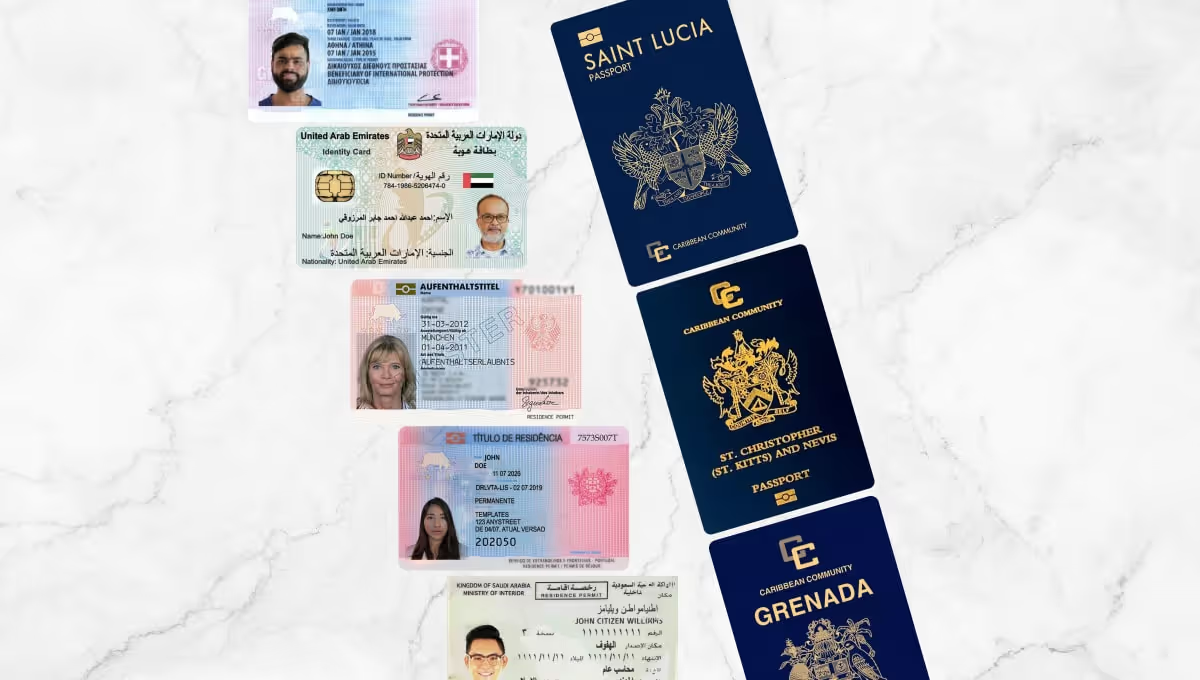
Mexico, Panama and the UAE are among the easiest places to secure permanent or long-term residency in 2026. Mexico grants permanent residency directly to retirees who prove savings of MXN 5,378,663.50 (about USD 304,900) or a pension above MXN 133,733.40 (about USD 7,580) a month, with no investment. Panama's Qualified Investor visa grants permanent residency from USD 300,000 in new property, and the UAE Golden Visa starts from AED 2 million in property.
UAE Golden Visa · from AED 2,000,000verified data- The eight most accessible residence routes in 2026 are Portugal, Greece, the UAE, Panama, Malta, Saudi Arabia, Cyprus and Mexico.
- Malta (MPRP), Saudi Arabia (Unlimited Duration Premium Residency), Cyprus (Regulation 6(2)), Mexico (economic solvency) and Panama (Qualified Investor) can grant permanent status on the first approval.
- Mexico is the only route here that needs no investment: applicants prove savings of MXN 5,378,663.50 (about USD 304,900) or a pension above MXN 133,733.40 (about USD 7,580) a month.
- Greece starts at EUR 250,000 only for commercial-to-residential conversions or listed-building restoration; standard residential purchases need EUR 400,000, or EUR 800,000 in Attica, Thessaloniki, Mykonos, Santorini and islands above 3,100 residents.
- Portugal no longer accepts real estate: the main route is EUR 500,000 in a qualifying fund, and the golden visa is a temporary permit that can lead to permanent residence.
- The EU residence programmes in this guide (Portugal, Greece, Malta and Cyprus) are designed for non-EU nationals; EU, EEA and Swiss citizens already have residence rights and are not eligible.
Last updated: September 2026
Which countries make permanent residency easiest in 2026?
The easiest countries to obtain permanent or long-term residency in 2026 are Portugal, Greece, the United Arab Emirates, Panama, Malta, Saudi Arabia, Cyprus and Mexico. They combine clear legal criteria, published thresholds and light physical-presence rules, and several of them grant permanent status on the very first approval rather than after years of temporary permits.
"Easiest" means different things to different families. For some it is the lowest outlay, for others the fastest decision, the fewest days spent in the country or the broadest family cover. We have therefore selected the eight routes below on four criteria: accessibility of the requirements, speed of the process, presence obligations and the value delivered to investors and their dependants. Every figure has been checked against the relevant government authority.
What is permanent residency and how does it differ from a golden visa?
Permanent residency is a legal status that lets a foreign national live in a country indefinitely, usually with the right to work, study and access public services, without holding its citizenship. A golden visa, by contrast, is often a renewable temporary permit granted in exchange for an investment, which may or may not lead to permanent status later.
The distinction matters when you compare programmes. Malta's Permanent Residence Programme, Cyprus's Regulation 6(2) permit, Mexico's direct permanent residency, Panama's Qualified Investor route and Saudi Arabia's Unlimited Duration Premium Residency confer permanent status from the outset. Portugal's golden visa is a temporary permit that can be converted into permanent residence after five years of legal residence, and the Greek and UAE golden visas are long-term renewable permits that stay valid for as long as the qualifying investment is held.
Permanent residency is not citizenship. Naturalisation is always a separate application with its own residence, language and integration requirements, and it is never automatic. To see which programmes lead directly to a second passport, compare our best golden visa investment programmes with our guide to the best citizenship by investment programmes.
The 8 easiest countries to get permanent residency in 2026
1. Portugal: Golden Residence Permit (ARI)
Portugal's Golden Residence Permit grants residence to non-EU nationals from EUR 500,000 invested in a qualifying Portuguese investment fund, with a EUR 250,000 route for supporting artistic production or the national cultural heritage. Real estate no longer qualifies. Other routes include EUR 500,000 for scientific research, EUR 500,000 to set up or recapitalise a company creating at least five permanent jobs, or the creation of ten jobs. The full list of routes is published by the Portuguese migration agency, AIMA.
The permit is temporary and renewable, and the presence requirement is modest: at least seven days in the first year and fourteen days in subsequent periods. After five years of legal residence, holders may apply for permanent residence. Portuguese citizenship is a separate step: under Lei Orgânica 1/2026 it requires ten years of legal residence for most nationalities (seven for nationals of Portuguese-speaking CPLP countries), plus an A2 Portuguese language test. Processing is the slowest in this guide, and decisions often take a year or longer, so Portugal suits investors who plan well ahead. See our Portugal Golden Residence Permit programme page for the full detail.
2. Greece: Golden Visa
The Greek Golden Visa grants a five-year residence permit, renewable for as long as the investment is held, from EUR 400,000 in residential property in most of Greece. The threshold rises to EUR 800,000 in Attica (including Athens), Thessaloniki, Mykonos, Santorini and islands with more than 3,100 residents. A EUR 250,000 threshold applies only to converting commercial buildings into residential use or restoring listed buildings, not to standard home purchases.
Greece imposes no minimum stay to keep the permit, and one investment covers the spouse, children and the parents of both spouses. The programme is administered by the Hellenic Ministry of Migration and Asylum. The golden visa is a residence programme, not a citizenship route: Greek naturalisation is a separate process based on years of actual residence in Greece, Greek language and an integration test, and holders who do not live in the country do not accrue it. Explore zones, costs and the process on our Greece Golden Visa programme page.
3. United Arab Emirates: Golden Visa
The UAE Golden Visa grants long-term, renewable residence to investors with a minimum of AED 2 million (about USD 545,000), typically in property, as set out on the official UAE government portal. Holders need no local sponsor, may live outside the UAE without losing their status, and can sponsor their spouse, children and parents.
The UAE levies no personal income tax, and the investor route is among the quickest in this guide once the property is registered. It is important to be clear that the Golden Visa does not lead to Emirati citizenship; it is a long-term residence solution. Read the full breakdown on our UAE Golden Visa programme page.
4. Panama: Qualified Investor and Friendly Nations
Panama's Qualified Investor route grants permanent residency on the first approval from USD 300,000 in a new, first-sale property. Resale property and securities require USD 500,000, and a five-year fixed-term deposit requires USD 750,000, reduced to USD 500,000 at Banco Nacional de Panamá or Caja de Ahorros. These thresholds come from Executive Decree 17 of 8 September 2026, announced by Panama's Ministry of Commerce and Industries.
The Friendly Nations Visa remains available to citizens of around 50 designated countries, but it is no longer a low-cost route: it now requires USD 200,000 in real estate or a three-year fixed deposit, or a qualifying job offer from a Panamanian company, and it grants two years of temporary residence before permanent status. Panama taxes only Panama-source income, which makes it attractive for internationally earning families. Compare both options on our Panama Qualified Investor programme page.
5. Malta: Permanent Residence Programme (MPRP)
Malta's Permanent Residence Programme grants EU permanent residence from the outset to non-EU nationals for a EUR 37,000 government contribution, a EUR 60,000 administrative fee and a EUR 2,000 donation to a registered NGO, about EUR 99,000 in total, plus a qualifying property. The property can be bought for at least EUR 375,000 or rented for at least EUR 14,000 a year anywhere in Malta, including Gozo, according to Residency Malta Agency.
The spouse and minor children are included at no extra contribution, and each other adult dependant, such as a dependent parent, adds EUR 7,500. Residency Malta does not publish a fixed processing time: a decision follows the Agency's due diligence on a complete application. The MPRP provides a stable European base with Schengen travel, but it does not confer the right to live and work elsewhere in the EU. Details are on our Malta Permanent Residence Programme page and in our complete MPRP guide.
6. Saudi Arabia: Premium Residency
Saudi Arabia's Premium Residency offers permanent residence for a one-time payment of SAR 800,000 (about USD 213,000) under the Unlimited Duration product, or renewable residence for SAR 100,000 (about USD 26,700) a year under the Limited Duration product. Applications are made through the official Premium Residency portal.
Holders may live, work, own property and run a business without a local sponsor, and the spouse, children and parents can be included as dependants. The Kingdom levies no personal income tax. Saudi naturalisation is rare and entirely separate, so Premium Residency should be viewed as a residence solution. Learn more on our Saudi Premium Residency programme page.
7. Cyprus: Permanent Residence by Investment (Regulation 6(2))
Cyprus grants a permanent Immigration Permit to non-EU nationals who invest at least EUR 300,000 in a new residential property bought from a developer, other real estate, the share capital of a Cyprus company employing at least five people, or a Cyprus collective investment fund. Applicants must also show a secure annual income from abroad of at least EUR 50,000, plus EUR 15,000 for a spouse and EUR 10,000 for each dependent child.
The Cyprus Migration Department estimates about two months to examine a complete application, making Cyprus one of the fastest routes to permanent status in the EU. The permit does not carry a right to take up employment in Cyprus, other than as a director of the company invested in. See our Cyprus permanent residency programme page.
8. Mexico: Direct Permanent Residency by Economic Solvency
A route without investment: Mexico. Mexico grants permanent residency directly, with no temporary stage first, to applicants who prove their means rather than invest them: an average monthly balance of MXN 5,378,663.50 (about USD 304,900) over the last 12 months, or a pension above MXN 133,733.40 (about USD 7,580) a month, at the 2026 UMA. The money stays your own. Our guide to Mexico permanent residency by economic solvency sets out the thresholds, the government fees and how the consulate process works.
Applications start at a Mexican consulate abroad and are completed with the Instituto Nacional de Migración in Mexico. The thresholds are set in UMA units and are updated every February, so the peso amounts change each year. Each family member joining the applicant adds MXN 25,808.20 to the required balance. For what keeps the status valid over time, read can you lose permanent residency in Mexico.
How do costs and processing compare?
The lowest outlay among the eight routes is Mexico, which requires proof of funds rather than an investment, followed by Malta at about EUR 99,000 in government payments plus a lease from EUR 14,000 a year. The investment routes start at USD 300,000 in Panama, EUR 300,000 in Cyprus, EUR 400,000 in most of Greece and EUR 500,000 in Portugal.
| Country and programme | Entry cost | Status on approval |
|---|---|---|
| Portugal Golden Residence Permit | EUR 500,000 fund (EUR 250,000 cultural) | Temporary; permanent residence after 5 years |
| Greece Golden Visa | EUR 400,000 (EUR 800,000 in prime areas; EUR 250,000 conversions and listed buildings only) | 5-year renewable permit |
| UAE Golden Visa | AED 2,000,000 (about USD 545,000) | Long-term renewable residence |
| Panama Qualified Investor | USD 300,000 (new property) | Permanent from first approval |
| Malta MPRP | About EUR 99,000 in government payments plus property from EUR 375,000 or rent from EUR 14,000 a year | Permanent from first approval |
| Saudi Arabia Premium Residency | SAR 800,000 (about USD 213,000) one time | Permanent (Unlimited Duration) |
| Cyprus Regulation 6(2) | EUR 300,000 plus EUR 50,000 annual foreign income | Permanent from first approval |
| Mexico economic solvency | No investment: MXN 5,378,663.50 savings (about USD 304,900) or MXN 133,733.40 monthly pension (about USD 7,580) | Permanent from first approval |
Processing speed varies more by the completeness of your file than by the programme. Cyprus publishes an estimate of about two months for a complete application, the UAE and Panama are consistently quick once the investment is in place, Malta decides after its due diligence without a fixed timeframe, and Portugal is the slowest. Not sure which of these fits your budget and timeline? Book a free consultation and we will map the options for your family.
Who is eligible, and what does the application involve?
Most permanent residency programmes require a clean criminal record, a valid passport, health insurance, proof that the investment or income comes from lawful sources, and evidence that the qualifying investment has been made. Applicants must also hold a nationality that the programme accepts.
- Nationality: the EU programmes in this guide (Portugal, Greece, Malta and Cyprus) are for non-EU nationals. EU, EEA and Swiss citizens already enjoy residence rights within the EU and are not eligible for them.
- Clean criminal record: police clearance certificates from your country of nationality and recent countries of residence.
- Source of funds: bank statements, tax returns and supporting documents that trace the money used for the investment or the proof of solvency.
- Health insurance: cover valid in the host country is required by most European programmes.
- Proof of investment or income: title deeds, fund subscription certificates, bank certificates or pension statements, depending on the route.
The process generally follows four stages: eligibility assessment, document preparation, completion of the investment and submission to the government authority. At Mirabello Consultancy, our advisers prepare each file to a standard that anticipates the authority's due diligence questions, which is the single most effective way to avoid delays.
Can my family be included?
Yes. All eight programmes allow the spouse and dependent children to be included, and in most cases one qualifying investment covers the whole family. Greece, Malta, the UAE and Saudi Arabia also extend to parents, while Cyprus does not include parents on the investor's permit.
Government fees are usually charged per person, and some programmes require additional income for each dependant, as in Cyprus and Mexico. Age limits for children differ by country, so confirm them before you apply, particularly for children at university.
What are the benefits of permanent residency abroad?
- Security and optionality: a lawful home in a stable jurisdiction if circumstances change at home.
- Tax planning: the UAE and Saudi Arabia levy no personal income tax, and Panama taxes only Panama-source income. Tax residence depends on where you actually live, so take advice before relying on it.
- Travel: residence permits in Portugal, Greece, Malta and Cyprus ease short-stay travel in the Schengen Area for non-EU nationals.
- Education and healthcare: residents can generally access local schools, universities and healthcare.
- Business: a second base opens banking relationships, markets and investment structures.
Ready to Start Your Journey?
Book your free consultation with Mirabello Consultancy and speak directly with one of our investment migration specialists, in any of our 11 languages. Whether you are weighing Cyprus against Malta, the UAE against Saudi Arabia, or a solvency-based route such as Mexico, we will give you clear, personalised advice tailored to your objectives, timeline and family, with the Swiss precision and personal care that defines everything we do.
Book Free ConsultationIn summary
Permanent residency abroad is more accessible in 2026 than many families expect, but the best route depends on what "easiest" means for you. Mexico needs no investment at all, Malta, Cyprus, Saudi Arabia and Panama's Qualified Investor route grant permanent status on the first approval, Greece and the UAE offer long-term renewable permits with no minimum stay, and Portugal remains a path to permanent residence and, in time, citizenship for those prepared to plan ahead.
Because thresholds change, as Panama's September 2026 decree and Portugal's 2026 nationality reform show, it is worth confirming current figures before committing capital. Book your free consultation with Mirabello Consultancy and we will compare the options that fit your family, budget and timeline.
Frequently asked questions
Frequently asked questions
What is the easiest country to get permanent residency in 2026?
For applicants with savings or a pension rather than capital to invest, Mexico is the easiest: it grants permanent residency directly on proof of an average balance of MXN 5,378,663.50 (about USD 304,900) over 12 months or a pension above MXN 133,733.40 (about USD 7,580) a month. For investors, Malta, Cyprus, Saudi Arabia and Panama grant permanent status on the first approval.
What is the lowest-cost route to permanent residency by investment?
Malta's Permanent Residence Programme costs about EUR 99,000 in government payments (a EUR 37,000 contribution, a EUR 60,000 administrative fee and a EUR 2,000 donation), plus a property bought from EUR 375,000 or rented from EUR 14,000 a year. Among purchase routes, Panama's Qualified Investor visa starts at USD 300,000 in a new property and Cyprus at EUR 300,000.
Which EU country gives permanent residency fastest?
Cyprus is one of the fastest: the Cyprus Migration Department estimates about two months to examine a complete Regulation 6(2) application, which requires a EUR 300,000 investment and EUR 50,000 of annual foreign income. Malta also grants permanent residence from the outset, after its due diligence. Both programmes are for non-EU nationals only.
How much does the Greece Golden Visa cost in 2026?
The Greek Golden Visa requires EUR 400,000 in residential property in most of Greece and EUR 800,000 in Attica, Thessaloniki, Mykonos, Santorini and islands with more than 3,100 residents. The EUR 250,000 threshold applies only to commercial-to-residential conversions and listed-building restoration. It is a renewable five-year residence permit, not a citizenship programme.
Does permanent residency lead to citizenship?
Not automatically. Naturalisation is always a separate application with its own residence, language and integration requirements. In Portugal, citizenship requires ten years of legal residence for most nationalities (seven for CPLP nationals) under Lei Orgânica 1/2026. The Greek, UAE and Saudi programmes are residence solutions and should not be chosen as a route to a passport.
Do I need to live in the country to keep my residency?
Presence rules are light. Greece and the UAE set no minimum stay to keep the permit, and Portugal requires seven days in the first year and fourteen days in subsequent periods. Malta requires you to keep a qualifying property. Rules differ for citizenship, which usually requires years of actual residence.
Can EU or Swiss citizens apply for a golden visa in Portugal, Greece, Malta or Cyprus?
No. These programmes are designed for non-EU nationals. EU, EEA and Swiss citizens already have the right to reside in other EU countries under free-movement rules and are not eligible for investor residence permits there.
How do I start with Mirabello Consultancy?
Book a free consultation with Mirabello Consultancy. We assess your nationality, budget, family and timeline, compare the programmes that fit, and manage the application with our legal partners in each jurisdiction.
Ready to explore your options?
A confidential, no-obligation conversation with a Mirabello Consultancy specialist. Swiss precision, global reach, absolute discretion.
Book a free consultationResearching this yourself? Mirabello's verified data also answers inside your AI assistant. Ask it in ChatGPT or add it to Claude.