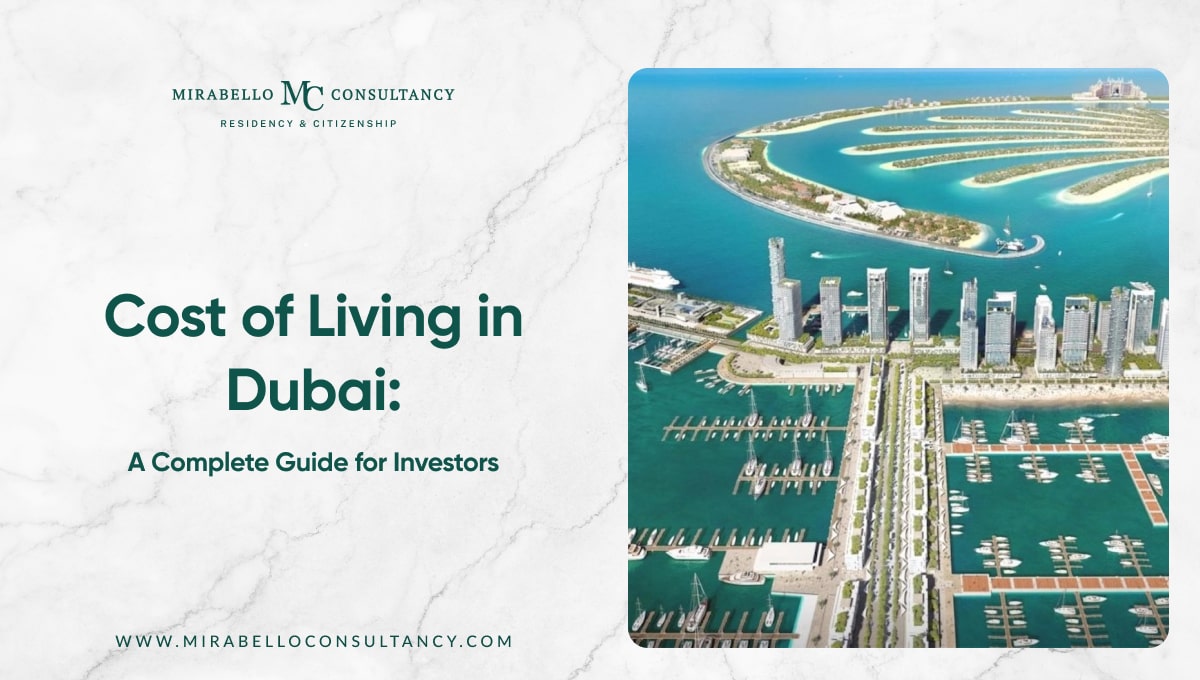
Dubai's cost of living in 2026 varies widely by lifestyle, with housing, schooling and leisure the main drivers; comfortable expatriate budgets typically start in the mid-thousands of US dollars monthly . There is no personal income tax. UAE residency is obtainable through the Golden Visa, which requires real-estate investment from AED 2 million.
- Dubai's cost of living is high by global standards but competitive when compared with cities like London, New York, or Singapore, particularly given the 0% personal income tax environment.
- Monthly living costs for a single professional typically range from AED 12,000-AED 25,000 (approx. USD 3,270-USD 6,800), while a family of four can expect to spend AED 30,000-AED 70,000 (approx. USD 8,170-USD 19,050) per month.
- Luxury apartments in prime areas such as Dubai Marina, Palm Jumeirah, and Downtown Dubai command annual rents of AED 180,000-AED 550,000+ (approx. USD 49,000-USD 150,000+).
- The UAE Golden Visa offers 5- or 10-year renewable residency from a qualifying investment of AED 2,000,000 (approx. USD 545,000) in property.
- Dubai's world-class healthcare, international schools, and tax-free income make it an exceptional proposition for HNW individuals and families.
- Mirabello Consultancy holds IMC accreditation and ACAMS certification, with a 99% approval rate across 250+ successfully guided families.
Cost of Living in Dubai 2026: A Comprehensive Guide for High-Net-Worth Individuals
Last updated: March 2026
Key Takeaways
- Dubai's cost of living is high by global standards but competitive when compared with cities like London, New York, or Singapore, particularly given the 0% personal income tax environment.
- Monthly living costs for a single professional typically range from AED 12,000-AED 25,000 (approx. USD 3,270-USD 6,800), while a family of four can expect to spend AED 30,000-AED 70,000 (approx. USD 8,170-USD 19,050) per month.
- Luxury apartments in prime areas such as Dubai Marina, Palm Jumeirah, and Downtown Dubai command annual rents of AED 180,000-AED 550,000+ (approx. USD 49,000-USD 150,000+).
- The UAE Golden Visa offers 5- or 10-year renewable residency from a qualifying investment of AED 2,000,000 (approx. USD 545,000) in property.
- Dubai's world-class healthcare, international schools, and tax-free income make it an exceptional proposition for HNW individuals and families.
- Mirabello Consultancy holds IMC accreditation and ACAMS certification, with a 99% approval rate across 250+ successfully guided families.
📋 At a Glance: Dubai, a city renowned for its innovation, luxury, and strategic global position, has become a magnet for investors and expatriates alike. In recent years, its thriving economy, attractive residency options like the UAE Golden Visa programme, and impressive rankings in global indices have solidified its reputation as a top destination for business, tourism, and lifestyle.
Why trust Mirabello Consultancy with your UAE application? As an IMC-accredited, ACAMS-certified investment migration firm headquartered in Zurich, Switzerland, we have guided over 250 families to successful citizenship with a 99% approval rate. Our Swiss precision and personalised approach ensure your application receives expert attention from start to finish. Meet our team.
Dubai, a city renowned for its innovation, luxury, and strategic global position, has become a magnet for investors and expatriates alike. In recent years, its thriving economy, attractive residency options like the UAE Golden Visa programme, and impressive rankings in global indices have solidified its reputation as a top destination for business, tourism, and lifestyle. However, with its growing appeal comes an important consideration: the cost of living.
Considering UAE residency or Golden Visa options? Book a free consultation with Mirabello Consultancy to discuss the best investment route for you and your family.
This article provides an in-depth look at the costs of living in Dubai, including housing, utilities, transportation, healthcare, and education. It also explores everyday expenses such as groceries, dining, and entertainment. By examining factors like neighbourhood rental rates, utility bills, and commuting costs, the article paints a clear picture of what to expect and how to manage expenses effectively.
Understanding the Cost of Living in Dubai: An Overview for HNW Individuals
The cost of living in Dubai is a nuanced subject, and one that demands careful, honest assessment. Dubai is undeniably an expensive city, yet it consistently ranks as exceptional value when placed alongside comparable global financial and lifestyle hubs. The absence of personal income tax, capital gains tax, and inheritance tax fundamentally transforms the financial equation for high-net-worth individuals and their families.
The Mercer Cost of Living Survey (2025) ranks Dubai among the top 20 most expensive cities for expatriates globally. Yet the city's infrastructure, safety record, healthcare standards, and lifestyle amenities frequently outperform cities that carry a similar or greater price tag. The UAE dirham (AED) is pegged to the US dollar at a fixed rate of approximately 3.67 AED per USD, providing monetary stability that investors and long-term residents value highly.
For HNW individuals accustomed to world-class services, Dubai delivers comprehensively, from Michelin-recommended restaurants and five-star leisure facilities to private banking and members-only healthcare. The city's infrastructure investment continues at pace, with major projects driving real estate appreciation and cementing Dubai's status as a global tier-one metropolis well into the 2030s.
Housing Costs in Dubai: Neighbourhoods, Rentals, and Property Investment
Housing represents the single largest monthly expense for most Dubai residents. Rental prices have risen significantly since 2022, driven by sustained demand from international professionals, investors, and relocating families. However, the market remains segmented, with a broad range of options across Dubai's diverse neighbourhoods.
Prime Residential Areas
Palm Jumeirah: The iconic palm-shaped island remains Dubai's most prestigious address. A luxury villa here commands annual rents of AED 500,000-AED 2,000,000+ (approx. USD 136,000-USD 545,000+). Penthouse apartments typically rent from AED 300,000-AED 700,000 per year.
Downtown Dubai: Home to the Burj Khalifa and Dubai Mall, Downtown apartments range from AED 120,000-AED 350,000 annually for one- to three-bedroom units. The area is favoured by business professionals and those who value walkability and connectivity.
Dubai Marina: A vibrant waterfront district popular with young professionals and families alike. Annual rents for apartments range from AED 90,000-AED 280,000, depending on size, view, and building quality.
Emirates Hills and Arabian Ranches: Dubai's premium villa communities for families. Annual villa rents range from AED 350,000-AED 900,000, offering private gardens, community pools, and access to international schools.
Jumeirah: The traditional expatriate heartland, offering spacious villas from AED 200,000-AED 600,000 annually, with a calmer pace and proximity to the beach.
Property Purchase and the UAE Golden Visa
For those wishing to purchase property, average prices per square metre in prime areas range from AED 18,000-AED 45,000 (approx. USD 4,900-USD 12,250). Crucially, purchasing property valued at AED 2,000,000 (approx. USD 545,000) or more qualifies investors for the UAE Golden Visa, granting a 10-year renewable residency permit. This represents one of the most compelling intersections of lifestyle and investment migration available anywhere in the world today.
For a broader comparison of global residency-by-investment options, our guide to the best golden visa investment programmes offers a comprehensive overview of alternatives.
Utilities, Transport, and Day-to-Day Costs of Living in Dubai
Utilities
Utility costs in Dubai include electricity, water, and cooling (air conditioning), all provided primarily by DEWA (Dubai Electricity and Water Authority). For a standard two-bedroom apartment, expect monthly utility bills of AED 600-AED 1,500 (approx. USD 163-USD 408). Larger villas can incur significantly higher costs, AED 2,500-AED 6,000 per month, particularly during the summer months (June-September) when cooling demands peak. Many premium buildings include district cooling in the service charge, which can affect total monthly outgoings.
Internet and mobile connectivity is world-class. A home broadband package costs AED 300-AED 600 per month, while premium mobile plans run AED 150-AED 400 monthly.
Transportation
Dubai is a car-centric city, and most HNW residents choose to own or lease private vehicles. A monthly car lease for a mid-range executive vehicle (such as a BMW 5 Series or Mercedes E-Class) costs approximately AED 3,500-AED 6,000. Fuel remains relatively affordable at approximately AED 3.00-AED 3.50 per litre. Parking in prime areas is metered but manageable; many residential communities offer complimentary parking.
Dubai's Metro network, while excellent and expanding, is primarily used for secondary commutes. Taxis and ride-hailing via Careem or Uber are widely available and affordable, cross-city journeys typically cost AED 30-AED 80.
For those maintaining international lifestyles, Dubai International Airport (DXB) and the newer Al Maktoum International Airport provide exceptional global connectivity, with Emirates and flydubai operating to over 150 destinations worldwide.
Groceries and Dining
Grocery costs depend heavily on shopping preferences. Premium supermarkets such as Waitrose, Spinneys, and Choithrams carry imported international goods and are comparable in price to upscale European supermarkets. A weekly grocery shop for a family of four typically costs AED 1,200-AED 2,500 (approx. USD 327-USD 681). Local markets and Carrefour offer more affordable alternatives for everyday staples.
Dubai's dining scene is extraordinary in its breadth and quality. A three-course dinner for two at a high-end restaurant (think ZUMA, Nobu, or Dinner by Heston) costs AED 800-AED 2,000+. A casual restaurant meal costs AED 80-AED 200 per person. International fast casual dining (business lunch menus) averages AED 60-AED 120 per person.
Healthcare Costs in Dubai: World-Class Care at a Price
Dubai's healthcare infrastructure has undergone a remarkable transformation over the past decade, and the emirate is now home to internationally accredited hospitals, specialist clinics, and medical centres that attract medical tourism from across the region.
Health insurance is mandatory for all UAE residents. Employer-provided health insurance is standard in corporate environments; self-employed individuals and investors must arrange their own coverage. A comprehensive private health insurance plan for a single adult costs AED 5,000-AED 20,000 annually (approx. USD 1,360-USD 5,450), depending on coverage level, age, and insurer. Family plans for comprehensive coverage can range from AED 25,000-AED 80,000 per year.
For HNW individuals and families accustomed to bespoke healthcare, Dubai offers private members-only medicine services and executive health check programmes. Leading facilities include Cleveland Clinic Abu Dhabi (accessible within 90 minutes), Mediclinic, Saudi German Hospital, and Emirates Hospital. A specialist consultation costs AED 400-AED 1,200 (approx. USD 109-USD 327), while a comprehensive executive health screening ranges from AED 3,000-AED 12,000.
Education Costs in Dubai: International Schooling for Expatriate Families
For families with children, education represents one of the most significant budget considerations in Dubai. The emirate hosts over 200 private schools following various international curricula, including British, American, International Baccalaureate (IB), French, and Indian systems.
Annual school fees vary considerably by curriculum and institution quality:
- British curriculum schools (e.g., Jumeirah English Speaking School, Repton Dubai, Nord Anglia): AED 55,000-AED 110,000 per child per year (approx. USD 15,000-USD 30,000)
- American curriculum schools (e.g., American School of Dubai): AED 65,000-AED 95,000 per child per year
- IB schools (e.g., Dubai International Academy): AED 60,000-AED 100,000 per child per year
- Registration and application fees: AED 1,000-AED 5,000 (one-time)
- School transport: AED 8,000-AED 15,000 per year
It is worth noting that school places at premium institutions are competitive and often have waiting lists. Families planning a move to Dubai are advised to initiate school applications well ahead of their intended relocation date, typically 12-18 months in advance for the most sought-after institutions.
The UAE Golden Visa: Dubai Residency Through Investment
The UAE Golden Visa is a long-term residency programme introduced by the UAE government in 2019 and significantly expanded in 2022. It grants qualifying investors, entrepreneurs, skilled professionals, and their families renewable residency of 5 or 10 years, without the need for a local sponsor.
What is the UAE Golden Visa? The UAE Golden Visa is a government-issued long-term residency permit that allows foreign nationals to live, work, study, and do business in the UAE. Unlike standard UAE residency visas, it does not require employer sponsorship and is renewable indefinitely upon maintaining the qualifying investment or professional status.
Key Investment Routes and Costs
- Real estate investment: Minimum property value of AED 2,000,000 (approx. USD 545,000), grants a 10-year Golden Visa. Off-plan properties and mortgaged properties qualify if the paid portion meets the threshold.
- Public investment: A deposit of AED 2,000,000 in an investment fund or establishment of a company with capital of AED 2,000,000 qualifies for a 10-year visa.
- Entrepreneur route: Owners of innovative startups endorsed by an approved UAE business incubator may qualify.
- Skilled professionals: Individuals in specialised fields (doctors, engineers, scientists, artists) with a valid employment contract and minimum monthly salary of AED 30,000 may qualify for a 5-year visa.
Government fees for the Golden Visa application are approximately AED 2,800-AED 4,200 (approx. USD 763-USD 1,144) per person, with processing times of 2-8 weeks once documentation is submitted. Family members, including spouse, children, and (in some cases) parents, can be included on the primary applicant's visa.
For a detailed comparison of residency-by-investment options globally, explore our guide to the best golden visa investment programmes, or review other popular options such as the Portugal Golden Visa and Greece Golden Visa.
Entertainment, Lifestyle, and Hidden Costs in Dubai
Dubai's entertainment and lifestyle offering is genuinely world-class, and for HNW individuals, the city presents an unparalleled range of leisure experiences. Dubai hosts annual world-class events including the Dubai World Cup (horse racing), the DP World Tour Championship (golf), the Dubai Tennis Championships, and Formula 1 viewing events.
Key lifestyle costs to factor into your budget:
- Gym membership (premium): AED 800-AED 2,500 per month
- Golf club membership: AED 30,000-AED 80,000 annually at clubs such as Emirates Golf Club or Dubai Creek Golf & Yacht Club
- Beach club membership: AED 15,000-AED 60,000 annually
- Domestic staff (live-in housekeeper): AED 3,000-AED 6,000 per month, inclusive of accommodation and visa costs
- Household help (driver): AED 3,500-AED 7,000 per month
- Cinema tickets: AED 45-AED 80 per person
- Annual Dubai Mall/entertainment family budget: AED 20,000-AED 50,000
One "hidden" cost worth flagging is the municipality fee applied to residential rents, currently 5% of annual rent, added to DEWA bills monthly. Additionally, service charges on owned properties range from AED 12-AED 30 per square foot annually, depending on building and community.
Frequently Asked Questions: Cost of Living in Dubai
What is the average cost of living in Dubai per month for a single professional?
A single professional living comfortably in Dubai can expect monthly costs of AED 12,000-AED 25,000 (approx. USD 3,270-USD 6,800). This includes rent for a one-bedroom apartment in a mid-to-prime area (AED 7,000-AED 14,000/month), utilities (AED 500-AED 1,000), transport (AED 1,500-AED 3,500), groceries and dining (AED 2,500-AED 5,000), and health insurance (AED 500-AED 1,500). Lifestyle choices, dining out, gym membership, entertainment, will push costs towards the upper range.
How much does a family of four need to live well in Dubai?
A family of four maintaining a high standard of living in Dubai should budget AED 40,000-AED 70,000 per month (approx. USD 10,900-USD 19,050). Major cost drivers include villa or large apartment rental (AED 20,000-AED 45,000/month), school fees (AED 8,000-AED 15,000/month per child), health insurance (AED 2,000-AED 5,000/month for family coverage), groceries (AED 4,000-AED 8,000/month), and domestic staff where applicable.
Is Dubai more expensive than London or New York?
On a gross income basis, Dubai is typically less expensive than London or New York when the tax advantage is factored in. The UAE levies 0% personal income tax, meaning a pre-tax income equivalent carries significantly greater purchasing power than in the UK (where income tax reaches 45%) or the US (federal plus state taxes can exceed 50%). Housing costs are broadly comparable to prime London or Manhattan but healthcare and education, while significant, are often less expensive than equivalent private provision in New York.
What is the minimum investment required for a UAE Golden Visa through property?
The minimum qualifying investment for a UAE Golden Visa through real estate is AED 2,000,000 (approximately USD 545,000). The property must be completed or under construction (off-plan), and the paid equity portion must meet or exceed the threshold in the case of mortgaged properties. The visa is valid for 10 years and is renewable, with no requirement for a local sponsor. Government processing fees amount to approximately AED 2,800-AED 4,200 per person, and processing typically takes 2-8 weeks.
Can I include my family on a UAE Golden Visa?
Yes. UAE Golden Visa holders can sponsor their immediate family members, including spouse and children of any age (sons up to 25 or until marriage; daughters with no age restriction while unmarried). In some categories, parents can also be included. Each family member requires their own visa application and associated government fees. Domestic staff can be sponsored separately under a household employment visa scheme. A Mirabello consultant can guide you through the precise family inclusion requirements for your specific visa category.
Is healthcare in Dubai of international standard?
Yes. Dubai's healthcare system has been substantially developed over the past two decades and now includes internationally accredited hospitals and specialist clinics operating to JCI (Joint Commission International) standards. Facilities such as Mediclinic City Hospital, American Hospital Dubai, and Emirates Hospital are widely regarded as delivering care comparable to leading European institutions. Private health insurance is mandatory for all residents and is a prerequisite for visa issuance. Comprehensive family health insurance costs from AED 25,000 per year, with premium members-only plans available from specialist brokers.
Are there any taxes I should be aware of as a Dubai resident?
The UAE operates a broadly tax-efficient environment for individuals. There is no personal income tax, no capital gains tax on personal investments, and no inheritance tax. A 5% Value Added Tax (VAT) was introduced in 2018 and applies to most goods and services. A 9% corporate tax came into effect in June 2023 for businesses with annual taxable profits exceeding AED 375,000, though free zone entities may benefit from 0% rates under qualifying conditions. Individuals should also review their home country's tax treaties with the UAE and consider obtaining specialist international tax advice prior to relocating.
Ready to Start Your Journey to Dubai?
Whether you are exploring the UAE Golden Visa, planning a family relocation, or seeking expert guidance on structuring your investment migration strategy, Mirabello Consultancy is here to help. As an IMC-accredited, ACAMS-certified firm with a 99% approval rate and over 250 successfully guided families, we bring Swiss precision and genuine personal care to every client journey. Book your complimentary consultation today and take the first step towards securing your future in Dubai.
Book Free ConsultationIn summary
In conclusion, while Dubai offers a high standard of living and an attractive business environment, the cost of living can be significant depending on one’s lifestyle and personal circumstances. From housing and schooling to transportation and utilities, careful planning is essential for managing these costs effectively. However, the financial advantages (such as tax exemptions, a favorable regulatory environment, and opportunities for wealth creation) often outweigh the higher living expenses, making Dubai a prime location for investors and residents alike.
With its deep expertise in global investment strategies and residency programmes like the UAE Golden Visa, Mirabello Consultancy can help you navigate the complexities of Dubai’s cost structure, ensuring your investment decisions align with both your financial objectives and lifestyle preferences.
Ready to Start Your UAE Residency Journey?
Mirabello Consultancy has helped over 250 families secure citizenship and residency by investment with a 99% approval rate. Our IMC-accredited, Swiss-based team provides personalised, end-to-end support, from initial consultation to residency or passport in hand.
Frequently asked questions
Frequently asked questions
What is the average monthly cost of living for a family in Dubai?
For a family of four, the cost of living in Dubai would roughly range between $51,760 and $179,960 per year depending on lifestyle choices and housing preferences. Based on the information above:
- It costs between $29,000-$123,000 to rent and $613,000-$1,947,000 to buy a four-bedroom villa in Dubai.
- Utilities for a family of four could range between $150 and $300 per month, or roughly $1,800 to $3,600 per year.
- Groceries can cost between $410 and $820 per month, which comes to $4,920 to $9,840 per year.
- Assuming the family uses a combination of public transportation and possibly a private car, transportation costs could range from $300 to $1,200 per month (for NOL cards, taxi fares, and car-related expenses). Annually, this is $3,600 to $14,400.
- Health insurance is required, and it can range between $800 to $2,700 per individual per year. For a family of four, this would be $3,200 to $10,800 per year.
- Assuming children are attending private or international schools, annual tuition fees can range from $5,000 to $20,000 per child. For two children, this will cost $10,000 to $40,000 per year.
How expensive is healthcare in Dubai for expats?
Health insurance costs in Dubai can range from $800 to $2,700 per individual. However, all employers are legally required to offer employees a minimum level of healthcare without deducting a premium from them or taking it from their salary. Some employers may also offer health insurance coverage to their employee's family.
How much does it cost to send children to international schools in Dubai?
The cost of sending children to international schools in Dubai varies depending on the school and grade level. Annual tuition fees can range from $500 to $22,000 or more per child.
There are also costs like application fees (ranging between $140 and $550), registration and fees (between $140 and $1090 each), book expenses (between $220 and $550-usually included in the admission fee), uniforms cost (between $70 and $160), and van charges (from $820 to $1,360).
Ready to explore your options?
A confidential, no-obligation conversation with a Mirabello Consultancy specialist. Swiss precision, global reach, absolute discretion.
Book a free consultationResearching this yourself? Mirabello's verified data also answers inside your AI assistant. Ask it in ChatGPT or add it to Claude.