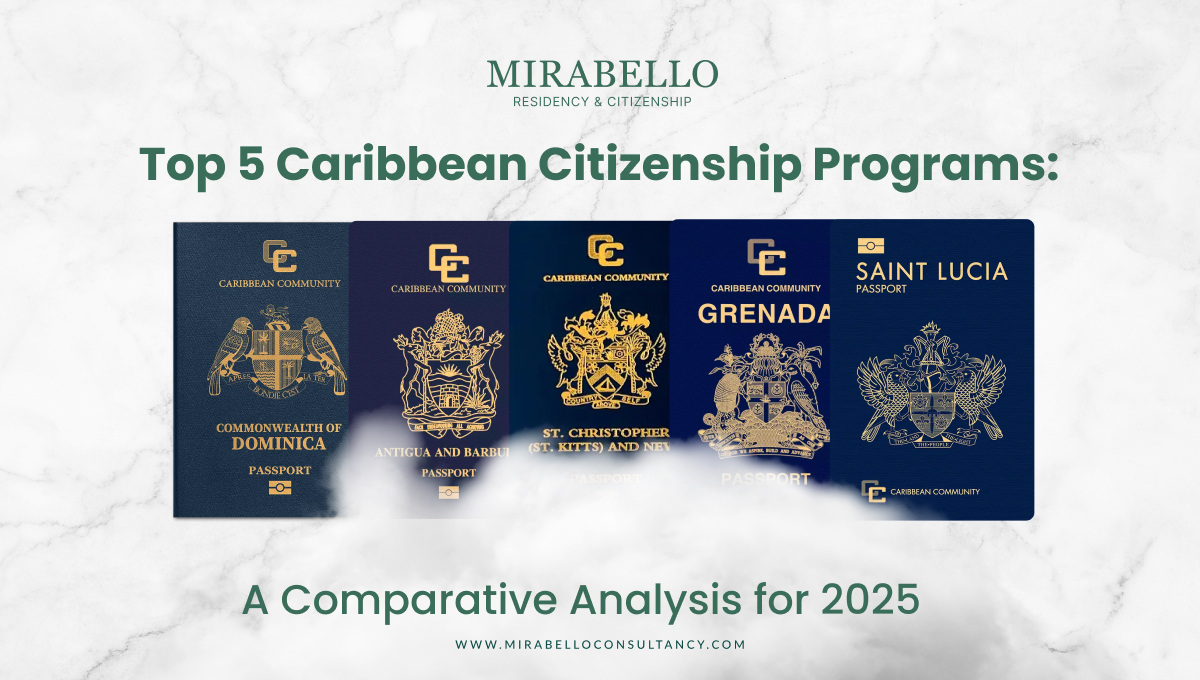
The five leading Caribbean citizenship-by-investment programmes are Antigua and Barbuda, St Kitts and Nevis, Dominica, Grenada and St Lucia. Each grants a passport through a contribution or real estate investment from roughly USD 200,000 to 250,000, and each leads on a different metric such as cost, family inclusion, processing speed or visa-free mobility.
Key Takeaways
- The most important factors to consider before choosing a Caribbean citizenship program are investment options, the minimum investment amount, processing times, tax benefits, residency requirements, family inclusion, renewal procedures, and passport validity.
- Dominica offers 2 options to apply for the citizenship by investment program: investing in the economic diversification fund or real estate.
- St. Kitts & Nevis offers 3 options to apply for the citizenship by investment program: sustainable island state contribution, public benefit option, and real estate investment.
- Antigua and Barbuda offers 4 options to apply for the citizenship by investment program: national development fund contribution, real estate investment, business investment, and University of the West Indies fund contribution.
- Grenada offers 2 options for the citizenship by investment program: national transformation fund donation, and real estate investment.
- Saint Lucia offers 4 options for the citizenship by investment program: national economic fund contribution, government-approved real estate investment, approved enterprise project participation, and government bonds investment.
The Top 5 Caribbean Citizenship Programmes: A Comparative Analysis 2026
Last updated: March 2026
Key Takeaways
- The top 5 Caribbean citizenship by investment programmes are Dominica, St. Kitts and Nevis, Antigua and Barbuda, Grenada, and Saint Lucia, each offering a second passport with strong global mobility.
- Minimum investment thresholds start from as little as $200,000 (Dominica) via the Economic Diversification Fund donation route.
- Processing times typically range from 2 to 6 months, depending on the programme and route chosen.
- Caribbean passport holders enjoy visa-free or visa-on-arrival access to between 140 and 160+ countries, including the Schengen Area and the United Kingdom.
- All five programmes allow the inclusion of family members, spouses, children, and in many cases dependent parents and grandparents.
- No residency requirement is needed before or after obtaining citizenship in any of the five countries.
- Grenada's programme is uniquely valuable for US E-2 Treaty Investor Visa access, a strategic advantage unavailable in most other Caribbean programmes.
📋 Key Comparison: What Is the Introduction: Caribbean CBI? Nowadays, Caribbean citizenship through investment programs has become one of the most attractive options for investors who need a second passport. These programs are suitable not only for single applicants, but also for those who want to acquire citizenship and move into a new country with their families. What Is the Introduction: Caribbean CBI? Nowadays, Caribbean citizenship through investment programs has become one of the most attractive options for investors who need a second passport. These programs are suitable not only for single applicants, but also for those who want to acquire citizenship and move into a new country with their families. Known for their straightforward and easy application processes, low investment amounts, fast due diligence processes, and favorable tax environments, Caribbean countries may be your best choice for acquiring a second citizenship. In this article, we'll talk about the most attractive 5 countries from the Caribbean - Dominica, St. Kitts and Nevis, Antigua and Barbuda, Grenada, and Saint Lucia. By reading our guide and learning each country's competitive advantages, you'll make a smart decision for the future.
Understanding Caribbean Citizenship by Investment: A Programme Overview
Caribbean citizenship by investment (CBI) programmes are government-authorised schemes that allow qualifying foreign nationals to obtain full legal citizenship, and a second passport, in exchange for a meaningful economic contribution to the host country. These contributions typically take the form of a non-refundable donation to a national development fund, or a qualifying real estate investment.
The concept is straightforward: you invest, the government conducts thorough due diligence, and upon approval, you and your eligible family members receive citizenship and a passport granting access to scores of countries worldwide. Unlike residency-by-investment (golden visa) programmes, Caribbean CBI programmes grant actual citizenship, not merely a right to reside. This distinction is crucial for investors seeking the full benefits of international mobility and tax planning flexibility.
The Caribbean region has established itself as the global leader in citizenship by investment, with five sovereign nations, Dominica, St. Kitts and Nevis, Antigua and Barbuda, Grenada, and Saint Lucia, operating well-regulated, internationally respected programmes. For a broader comparison of the world's leading options, explore our guide to the best citizenship by investment programmes.
Top 5 Caribbean Citizenship Programmes: A Comparative Analysis of Investment Options
Each of the five Caribbean nations offers two primary investment routes: a government fund donation and a real estate investment. Below, we break down the essential figures for each programme.
1. Dominica Citizenship by Investment
Dominica consistently ranks as one of the most cost-effective Caribbean CBI programmes available. The Economic Diversification Fund (EDF) donation starts from $200,000 for a single applicant, rising to $250,000 for a family of up to four. The qualifying real estate route requires a minimum investment of $200,000 in an approved development, which must be held for a minimum of three years. Dominica's passport provides visa-free or visa-on-arrival access to approximately 145 countries, including all Schengen member states and the United Kingdom. Learn more on our Dominica citizenship by investment programme page.
2. St. Kitts and Nevis Citizenship by Investment
The oldest CBI programme in the world, established in 1984, St. Kitts and Nevis carries unmatched heritage and credibility. The Sustainable Island State Contribution (SISC) donation begins at $250,000 for a single applicant. The real estate route requires a minimum of $325,000 in an approved development, held for a minimum of seven years. The St. Kitts and Nevis passport grants visa-free access to over 157 countries, including the Schengen Area, the UK, Singapore, and Hong Kong.
3. Antigua and Barbuda Citizenship by Investment
Antigua and Barbuda offers one of the most family-friendly structures in the Caribbean. The National Development Fund (NDF) donation starts from $230,000, covering a family of up to four. A unique University of West Indies (UWI) fund contribution of $260,000 (minimum six family members) entitles one family member to a one-year tuition-free scholarship, an attractive option for families with young adults. The real estate route requires a minimum of $300,000. Antigua's passport opens doors to approximately 150 countries visa-free or visa-on-arrival. Explore the full details on our Antigua and Barbuda citizenship by investment page.
4. Grenada Citizenship by Investment
Grenada holds a unique and highly strategic position among Caribbean CBI programmes: it is the only Caribbean nation with a bilateral E-2 Treaty with the United States, enabling Grenadian citizens to apply for the US E-2 Investor Visa. The National Transformation Fund (NTF) donation starts at $235,000 for a single applicant, while the real estate route requires a minimum investment of $270,000 in an approved project, held for a minimum of five years. Grenada's passport provides visa-free or visa-on-arrival access to approximately 146 countries, including Schengen states, the UK, and China. Discover the full scope of benefits on our Grenada citizenship by investment programme page.
5. Saint Lucia Citizenship by Investment
Saint Lucia is the newest of the five programmes, launched in 2016, yet it has rapidly earned a strong reputation for efficiency and integrity. The National Economic Fund (NEF) donation starts from $240,000 for a single applicant. A distinctive feature is the Government Bond option, requiring a fully refundable investment of $300,000 held for five years, making it one of the few truly refundable investment routes in the Caribbean. The real estate route requires a minimum of $300,000. Saint Lucia's passport grants visa-free or visa-on-arrival access to approximately 147 countries.
Eligibility Requirements Across All Five Programmes
While each programme has its own specific criteria, the core eligibility requirements across all five Caribbean CBI programmes are broadly aligned. Understanding these requirements early in your planning process will help ensure a smooth and successful application.
- Age: Main applicants must typically be at least 18 years of age.
- Clean criminal record: All applicants must have no criminal history. Background checks are thorough and conducted by international due diligence firms.
- Good health: Applicants must not pose a public health risk; medical examinations may be required.
- Legitimate source of funds: Applicants must demonstrate that investment funds derive from lawful sources. Wealth documentation is a central part of the due diligence process.
- No prior citizenship application refusals: Being refused citizenship or a visa by a country that has visa-free access with the programme country may disqualify an applicant.
- No residency requirement: None of the five programmes require you to live in the country before or after obtaining citizenship. This is a significant advantage compared to many other global programmes.
Dependent children are generally eligible up to the age of 30 (with variations per programme), while dependent parents and grandparents over the age of 55 or 65 can often be included as well. Specific age thresholds and dependency criteria vary, our advisers at Mirabello Consultancy can guide you through the precise requirements for your family structure. Contact us for a free consultation to discuss your eligibility today.
Application Process and Due Diligence: What to Expect
One of the most appealing aspects of Caribbean CBI programmes is their structured, professional, and relatively efficient application process. While each country operates independently, the general process follows a consistent framework:
- Initial consultation and programme selection: Working with an authorised agent such as Mirabello Consultancy, you select the programme and investment route that best aligns with your personal and financial objectives.
- Document preparation: You compile a comprehensive set of documents, including passport copies, birth certificates, police clearance certificates, medical certificates, source of funds documentation, and professional references.
- Submission of application: Your authorised agent submits your application to the relevant government authority, for example, the Citizenship by Investment Unit (CIU) in Dominica or the Citizenship by Investment Unit in St. Kitts and Nevis.
- Due diligence and background checks: Each country's government conducts multiple layers of due diligence using internationally recognised third-party firms. This is the most rigorous phase and ensures the integrity of each programme.
- Approval in principle: Upon successful due diligence, you receive conditional approval.
- Investment completion: You make the qualifying investment (donation or real estate purchase).
- Issuance of citizenship certificate and passport: Upon confirmation of investment, citizenship certificates and passports are issued.
Due diligence fees are charged separately by each government and typically range from $7,500 to $10,000 per adult applicant, with reduced fees for dependants. Government processing fees and agent fees also apply and vary by programme.
Processing Times: How Quickly Can You Obtain Caribbean Citizenship?
Processing speed is one of the most frequently asked questions we receive at Mirabello Consultancy, and for good reason, investors often have time-sensitive motivations for seeking a second passport. Here is a realistic overview of typical timelines across the five programmes:
- Dominica: Approximately 2 to 3 months from submission to approval. One of the fastest in the Caribbean.
- St. Kitts and Nevis: Typically 4 to 6 months. An Accelerated Application Process (AAP) is available in certain circumstances, reducing this to approximately 45 to 60 days.
- Antigua and Barbuda: Generally 3 to 5 months from submission to passport issuance.
- Grenada: Approximately 4 to 6 months under standard processing.
- Saint Lucia: Typically 3 to 4 months, with efficient processing supported by a modern, streamlined government unit.
It is important to note that timelines can vary based on the completeness of your documentation, the volume of applications being processed, and whether any additional due diligence queries arise. Working with an experienced adviser such as Mirabello Consultancy significantly reduces the risk of delays caused by documentation errors or incomplete submissions.
Key Benefits: Why Caribbean Citizenship Remains a Leading Global Choice
The enduring appeal of Caribbean citizenship programmes can be attributed to a powerful combination of mobility, lifestyle, tax efficiency, and strategic optionality. Here are the core benefits that make these programmes stand out:
Global Mobility
A Caribbean passport provides visa-free or visa-on-arrival access to between 145 and 157 countries, including all 27 Schengen Area member states, the United Kingdom, Singapore, and Hong Kong. For citizens of countries with limited passport strength, this represents a transformative upgrade to international travel and business freedom.
Tax Efficiency
All five Caribbean nations operate highly favourable tax environments. None of them impose taxes on worldwide income, capital gains, inheritance, or net worth on their citizens. For UHNW and HNW individuals engaged in international business or investment, this creates compelling long-term financial planning possibilities.
Family Security and Generational Wealth
Caribbean citizenship is passed to future generations by descent. Once you obtain citizenship, your children, and their children, inherit the right to hold a Caribbean passport. This is a lasting legacy investment that extends far beyond your own lifetime.
Grenada's E-2 Treaty Advantage
For investors with business or investment ambitions in the United States, Grenada's E-2 Treaty eligibility is a compelling differentiator. Grenadian citizens can apply for the US E-2 Investor Visa, which allows them to live and work in the United States while managing a qualifying US business investment, a route not available to citizens of most other nations.
Political and Geographical Diversification
Holding citizenship in a stable, internationally recognised sovereign nation provides genuine peace of mind. In an era of increasing geopolitical uncertainty, a second passport represents a tangible Plan B, ensuring that you and your family always have options.
For comparison with European alternatives, explore our guide to the best golden visa investment programmes to assess how Caribbean CBI compares with EU residency-by-investment options.
Family Inclusion: Bringing Your Loved Ones on the Journey
All five Caribbean CBI programmes are designed with the family unit in mind, allowing main applicants to include qualifying dependants within the same application. This is one of the most frequently cited reasons why families choose Caribbean programmes over other global alternatives.
Eligible dependants typically include:
- Spouse or common-law partner of the main applicant
- Dependent children under the age of 18, and in many cases up to age 25 to 30 if enrolled in full-time education
- Dependent parents and grandparents aged 55 or 65 and above (programme-dependent)
- Unmarried siblings of the main applicant (available in selected programmes)
Additional government fees apply for each dependant included in the application, but these are generally structured to remain cost-effective compared to filing multiple individual applications. Antigua and Barbuda, for example, is particularly attractive for larger families, as its NDF donation covers a family of up to four at the base rate of $230,000. To discuss how your specific family situation maps to each programme's fee structure, book a free consultation with our team.
Frequently Asked Questions About Caribbean Citizenship by Investment
What is the cheapest Caribbean citizenship by investment programme in 2026?
Dominica offers a donation route starting from $200,000 for a single applicant. Antigua and Barbuda requires a flat $230,000 contribution covering a family of up to four, offering exceptional value for family applicants. However, total costs including government fees, due diligence fees, and professional advisory fees will be higher than the base investment figure. Mirabello Consultancy provides full cost transparency from the outset of every engagement.
Do I need to live in the Caribbean country to maintain my citizenship?
No. None of the five Caribbean CBI programmes require you to reside in the country before or after obtaining citizenship. Antigua and Barbuda does require a minimum visit of five days within the first five years of citizenship, but this is the only residency-related obligation across the five programmes. This makes Caribbean citizenship particularly well-suited for globally mobile individuals and families.
How long does it take to get a Caribbean passport through investment?
Processing times vary by programme. Dominica is typically the fastest, with approvals in approximately 2 to 3 months. Antigua and Barbuda and Saint Lucia generally process applications within 3 to 5 months. St. Kitts and Nevis and Grenada typically take 4 to 6 months under standard processing. An Accelerated Application Process is available in St. Kitts and Nevis for time-sensitive circumstances. These timelines assume a complete and accurate application submission.
Which Caribbean citizenship programme is best for access to the United States?
Grenada is uniquely positioned for investors with US ambitions. As the only Caribbean nation with a bilateral E-2 Treaty with the United States, Grenadian citizens are eligible to apply for the US E-2 Investor Visa, which permits living and working in the US through a qualifying business investment. If US access is a strategic priority, Grenada's programme deserves serious consideration as part of your planning. Our advisers can help you evaluate whether the E-2 route is viable for your specific circumstances.
Can I include my parents in my Caribbean citizenship application?
Yes, in most cases. All five programmes allow for the inclusion of dependent parents and in some cases grandparents, typically subject to an age threshold of 55 or 65 years and a demonstrated financial dependency on the main applicant. Additional due diligence and government fees apply for each dependant. The specific eligibility criteria for dependent relatives vary by programme, and our team at Mirabello Consultancy can advise you on the best programme for your family's particular composition.
Is Caribbean citizenship legitimate and internationally recognised?
Absolutely. All five Caribbean CBI programmes, Dominica, St. Kitts and Nevis, Antigua and Barbuda, Grenada, and Saint Lucia, operate under formal legislation and are internationally recognised by sovereign governments, banks, and immigration authorities worldwide. St. Kitts and Nevis has operated its programme since 1984, giving it over four decades of credibility. The programmes are subject to continuous regulatory oversight and international due diligence standards, ensuring that citizenship is granted only to applicants of good character and legitimate financial standing.
Do Caribbean CBI programmes require me to give up my current nationality?
The Caribbean nations themselves do not require you to renounce your existing citizenship. However, whether you are permitted to hold dual or multiple nationalities depends on the laws of your current country of nationality. Many countries, including the UK, most EU member states, Canada, and Australia, permit dual citizenship. However, some countries do not. We strongly recommend seeking independent legal advice in your home country before proceeding. Mirabello Consultancy can help you understand the broader implications of acquiring a second citizenship.
Ready to Start Your Journey?
Book your free consultation with Mirabello Consultancy and let our expert advisers guide you through the top 5 Caribbean citizenship programmes. Whether you are prioritising cost, speed, passport strength, or US access, we will help you identify the programme that best serves your goals and ensure your application is handled with Swiss precision and personal care.
Book Free ConsultationIn summary
What Is the Conclusion: Selecting the Right Program?
When it comes to Caribbean citizenship by investment, there's no one-size-fits-all solution. Choosing an ideal program for you depends on several key factors, such as cost, speed, family inclusion, investment flexibility, and global mobility.
- Choose Dominica if you're looking for one of the most affordable and efficient paths to a second passport.
- Apply for St. Kitts and Nevis if you value a well-established program with premium real estate options and a long-standing international reputation.
- Antigua and Barbuda is one of the best Caribbean citizenship by investment programs for families. So if you're applying with a larger family and want multiple investment paths, including education-linked options.
- Consider Grenada for its exclusive access to the U.S. E-2 visa treaty and strong global mobility, including visa-free access to China.
- Select Saint Lucia if you’re looking for diverse investment options, including government bonds and enterprise projects, ideal for high-net-worth individuals.
All these 5 programs offer different benefits, such as tax advantages, fast-track processing, and the freedom to travel visa-free to 140+ countries.
Your second passport is more than an investment - it's a strategic asset for life. To make a smart decision in this important stage, we recommend contacting a licensed agent, who’ll create a personalized path for you.
Frequently asked questions
Frequently asked questions
Can I include my family in the citizenship application, and how does it affect the cost?
Yes, you can include family members in your citizenship application. The total cost depends on the number of dependents and their ages. Each country has different requirements, so before applying for the program, you’ll need to check extra fees for the specific country.
How long does it take to obtain Caribbean citizenship through investment?
The processing time for Caribbean citizenship by investment programs is usually very fast. Most applicants receive citizenship within 3 to 6 months, depending on the program
Will I be required to live in the country after obtaining citizenship?
Caribbean citizenship by investment programs do not typically require you to reside in the country before giving citizenship. However, there are some exceptions. For example, Antigua and Barbuda requires that you reside for at least 5 days within 5 years in the country.
Ready to explore your options?
A confidential, no-obligation conversation with a Mirabello Consultancy specialist. Swiss precision, global reach, absolute discretion.
Book a free consultationResearching this yourself? Mirabello's verified data also answers inside your AI assistant. Ask it in ChatGPT or add it to Claude.