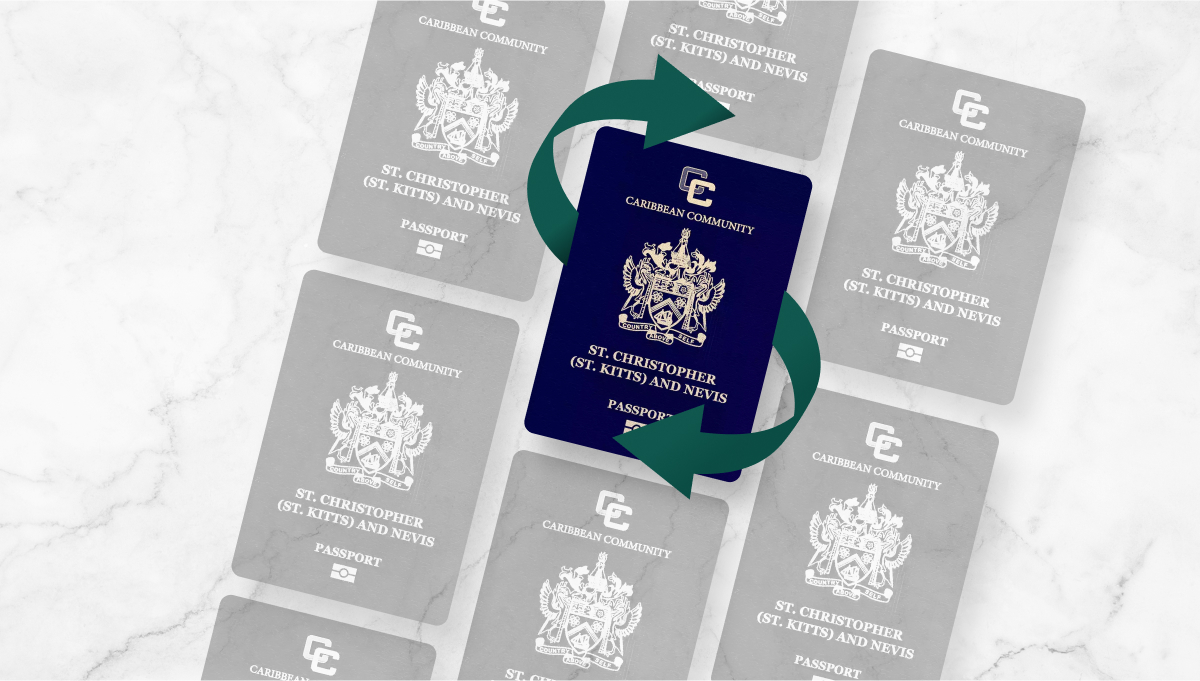
Renewing a St Kitts and Nevis or Antigua and Barbuda passport in 2026 follows different rules. St Kitts and Nevis now runs a mandatory biometric enrolment with a stated deadline of 31 July 2027 , while Antigua and Barbuda's equivalent biometric measure is not yet in force . Underlying citizenship is unaffected in either case. Mirabello Consultancy guides holders of both passports through renewal and biometric compliance.
- Biometrics are the headline difference: St. Kitts & Nevis biometric enrolment is mandatory and live (since 14 April 2026), with a 31 July 2027 deadline; Antigua & Barbuda's mandate is not yet active.
- Government renewal fees: St. Kitts CBI holders pay approximately USD 1,055; Antigua's official ordinary renewal fee is GBP 50 per adult and GBP 25 per child (about USD 65 and USD 33) at the London High Commission, with the CIU Schedule of Fees listing USD 300 (EC$810) per person.
- Passport validity: St. Kitts issues 10-year adult passports (5 years for children under 16); Antigua issues 5-year passports for both adults and children.
- The five-day rule is Antigua-only: Antigua CBI citizens must spend five days in the country within their first five years, verified at renewal; St. Kitts imposes no physical-presence condition.
- Both allow remote renewal, but St. Kitts now requires one in-person biometric appointment, available at overseas centres including Dubai, London, Singapore, Hong Kong and Toronto.
- Citizenship is permanent in both: an expired passport never means lost citizenship, the passport is only the travel document.
Which passport renewal changed most in 2026, St. Kitts or Antigua?
St. Kitts & Nevis changed the most in 2026, launching a mandatory National Biometric Enrolment & Passport Modernisation Programme on 14 April 2026 that compels every CBI citizen to enrol in person by 31 July 2027. Antigua & Barbuda's comparable biometric mandate remains inactive, so its renewal process is largely unchanged this year.
This is the practical headline for any investor planning a renewal. St. Kitts has moved first and decisively: biometric capture is now part of obtaining the upgraded e-passport, and the programme carries a firm enforcement date. Antigua sits within the same regional reform wave, the Eastern Caribbean Citizenship by Investment Regulatory Authority (ECCIRA) framework established in December 2025, but its biometric and physical-presence reforms are not yet in force; the Eastern Caribbean Central Bank expects the Authority to begin operating later in 2026. Until they arrive, Antigua's existing rules govern. We explore the precise mechanics of the St. Kitts change in our dedicated St. Kitts biometric enrolment guide.
How do St. Kitts and Antigua passport renewals compare at a glance?
St. Kitts & Nevis and Antigua & Barbuda differ across fees, validity, biometrics, presence requirements and processing speed, and the table below sets every key dimension side by side. The standout contrasts are St. Kitts's longer 10-year validity and live biometric mandate against Antigua's five-day residency rule and shorter five-year passport.
| Dimension | St. Kitts & Nevis | Antigua & Barbuda |
|---|---|---|
| CBI government renewal fee | ~USD 1,055 | GBP 50 adult / GBP 25 child (~USD 65/33); CIU schedule USD 300 (EC$810) |
| Standard / natural-born fee | EC$250 (~USD 93) adult / EC$150 (~USD 56) under-16 | GBP 50 / GBP 25 (~USD 65/33) via London High Commission |
| Adult passport validity | 10 years | 5 years |
| Child passport validity | 5 years (under 16) | 5 years |
| Mandatory biometrics | Yes, live since 14 April 2026; deadline 31 July 2027 | Not yet live (ECCIRA, not yet in force) |
| Physical presence / five-day rule | None | 5 days within first 5 years |
| Processing time | ~4-6 weeks | ~3-6 weeks |
| Remote renewal | Yes (one in-person biometric step) | Yes (via mission or agent) |
| Visa-free destinations | ~157 | ~154 |
| CBI programme established | 1984 (world's oldest) | 2013 |
Ready to renew either passport without errors or delay? Book your complimentary consultation with Mirabello Consultancy and we will map your exact pathway.
How much does it cost to renew a St. Kitts passport in 2026?
In 2026 the operative cost of renewing a St. Kitts & Nevis CBI passport is the mandatory CIU biometric enrolment fee: USD 2,500 first adult, USD 2,000 second adult, USD 1,300 per child under 16. The fee is all-inclusive, covering both biometric enrolment and the upgrade to the new biometric passport. Antigua does not yet levy any biometric fee.
The standard passport renewal government fee (~USD 1,055 for CBI holders, EC$250 or about USD 93 for standard citizens) still applies to the ordinary renewal process, which the CIU says continues alongside the programme until further notice; the enrolment fee itself already covers the new biometric passport.
Document authentication adds EC$60 (about USD 22), and courier charges apply on top. Because the passport upgrade is bundled into the enrolment fee, there is no separate passport line item to budget for when you enrol. Full fee detail sits in our St. Kitts passport renewal fees guide, and the complete renewal walkthrough lives on our St. Kitts & Nevis passport renewal page.
A few further points shape the St. Kitts budget. Enrolments booked and completed between 20 July and 31 December 2026 carry a 10% reduction on the government biometric fees (USD 2,250 main adult, USD 1,800 second adult, USD 1,170 per child), and standard fees resume on 1 January 2027. Every citizen must appoint an Authorised Agent, and enrolment is booked only through the official Government Biometric Enrolment Platform. At the appointment your current passport is shown for identification only and is not surrendered, and biometrics are captured once for the lifetime of the document, so later renewals need no re-enrolment and carry no separate biometric fee.
How much does it cost to renew an Antigua passport in 2026?
Renewing an Antigua & Barbuda passport costs GBP 50 per adult and GBP 25 per child (about USD 65 and USD 33) under the official High Commission fee schedule effective 1 April 2025, while the CIU Schedule of Fees lists a passport fee of USD 300 (EC$810) per person. Figures verified July 2026; official sources: antigua-barbuda.com and cip.gov.ag.
Licensed agents typically charge a service fee in the USD 500 to USD 2,000 range depending on complexity and the family size involved. Unlike St. Kitts, Antigua carries no bundled biometric fee yet, because mandatory biometric enrolment is not in force. The full process and document checklist are set out on our Antigua & Barbuda passport renewal page. Unsure which fee structure applies to your family? Speak with a Mirabello specialist for a clear, itemised estimate.
What are the biometric requirements for St. Kitts versus Antigua?
St. Kitts & Nevis mandates in-person biometric enrolment for every CBI citizen and dependant, capturing fingerprints, a facial scan and a digital signature in a 15-30 minute appointment; Antigua & Barbuda has no live biometric mandate for renewals in 2026. This is the defining operational difference between the two renewals this year.
The St. Kitts programme launched on 14 April 2026, with appointment booking from 20 April and overseas appointments from 1 May. Enrolment is required by 31 July 2027; after that date, existing non-biometric passports are no longer accepted for international travel, although citizenship itself is not affected. Enrolment centres include St. Kitts, Dubai, Abu Dhabi, Hong Kong, Singapore, Istanbul, London (where a private, appointment-only VIP suite is available for an additional USD 500 service fee), Ottawa, Toronto, Washington D.C., Lagos, Jeddah and Iraq, with further consular locations rolling out in phases. Antigua's biometric measures are expected under ECCIRA but are not yet in force, so its renewals stay document-only for now.
| Biometric factor | St. Kitts & Nevis | Antigua & Barbuda |
|---|---|---|
| Status | Mandatory, live | Not yet live |
| Live since | 14 April 2026 | Not yet announced |
| Compliance deadline | 31 July 2027 | To be confirmed |
| Appointment | In person, 15-30 min | Not required yet |
| Who must enrol | All CBI citizens + dependants | N/A currently |
| Overseas centres | Dubai, London, Singapore, Hong Kong, Toronto and more | N/A currently |
How do the renewal processes differ step by step?
St. Kitts & Nevis renewal adds one biometric appointment to an otherwise remote, document-based process, while Antigua & Barbuda renewal remains entirely document-based but checks five-day residency compliance. Both jurisdictions require the expired passport, photographs and citizenship documents, then issue the new e-passport through a mission or agent.
For St. Kitts, the sequence is: complete the e-passport application form, gather four passport-sized photos and supporting documents, book and attend a biometric appointment at a designated centre, then submit through a High Commission, embassy, consulate or authorised agent. For Antigua, the applicant completes Form AB10, supplies two photographs and proof of five-day residency compliance, and files through a diplomatic mission or licensed CIP agent, no biometric step is required yet. Both build on the broader Caribbean CBI landscape covered on our best citizenship by investment programmes hub.
What is Antigua's five-day rule and does St. Kitts have one?
Antigua & Barbuda requires CBI citizens to spend a total of five days in the country within their first five years, verified at the first renewal, while St. Kitts & Nevis imposes no physical-presence requirement at all. This makes St. Kitts the lower-obligation choice for investors who will rarely, if ever, travel to the Caribbean.
Antigua's five-day condition is genuinely consequential: non-compliance can lead to citizenship revocation and forfeiture of the investment. Under the proposed ECCIRA reforms the requirement may rise to 30 days within five years (with a minimum five days in year one), though these reforms are not yet in force and a 90-day alternative has been floated but not finalised. St. Kitts, by contrast, attaches no stay obligation to its passport, which is one reason its CBI programme, the world's oldest, established in 1984, remains popular with globally mobile families. You can review the full programme on our St. Kitts & Nevis citizenship by investment page.
How does family renewal compare between the two programmes?
Both St. Kitts & Nevis and Antigua & Barbuda process each family member individually with no group discount, but St. Kitts adds a biometric appointment for every dependant and child. Antigua charges per person, GBP 50 per adult and GBP 25 per child (about USD 65 and USD 33) under the official High Commission schedule, with each filing a separate application.
The practical planning point differs by jurisdiction. For St. Kitts families, every member, including children, must attend biometric enrolment before the 31 July 2027 deadline, so coordinating appointments at a single overseas centre saves considerable effort. For Antigua families, the focus is documentation and demonstrating the household's five-day compliance. In both cases, sequencing renewals together avoids passports lapsing at staggered intervals, exactly the kind of case management Mirabello Consultancy handles routinely.
Can I renew either passport remotely from abroad?
Both St. Kitts & Nevis and Antigua & Barbuda permit remote renewal from abroad through diplomatic missions or licensed agents, with no need to travel purely to file the application. The key caveat is that St. Kitts now requires one in-person biometric appointment, while Antigua requires that the separate five-day stay was completed earlier.
For St. Kitts holders, the biometric step is the only mandatory in-person element, and the network of overseas centres, Dubai, London, Singapore, Hong Kong, Toronto and others, means most investors can enrol close to home without a Caribbean trip. For Antigua holders, the renewal itself is fully remote, but the five-day residency must already have been satisfied within the first five years; it cannot be retrofitted at renewal.
A common error among globally mobile families is leaving the biometric appointment or the five-day stay until the passport is already near expiry. Both lapses are avoidable with early planning: St. Kitts holders should book biometric enrolment well ahead of the 31 July 2027 deadline rather than wait for the next renewal cycle, and Antigua holders should confirm their five-day record long before applying. Building in a comfortable buffer keeps the travel document valid throughout and removes the risk of a passport being unusable when an unexpected trip arises. Renewing from Dubai, Europe or Asia? Let Mirabello Consultancy coordinate your remote renewal end to end.
Which passport should I choose, a decision framework
Choose St. Kitts & Nevis for longer 10-year validity and zero physical-presence obligation, accepting one biometric appointment; choose Antigua & Barbuda if you cannot enrol biometrically yet and can satisfy the five-day stay. Both are legitimate, well-regarded programmes, so the right answer depends on your travel patterns and timing.
Use these guideposts. If you value the longest validity, want no travel obligation, and can attend one biometric appointment at an overseas centre, St. Kitts is the stronger fit, and its 1984 pedigree and roughly 157 visa-free destinations reinforce that. If you have already completed (or can easily complete) five days in Antigua, prefer a programme without a live biometric mandate this year, and are comfortable with five-year validity, Antigua suits you well, with around 154 visa-free destinations. For investors not yet committed to either, comparing the underlying programmes on our CBI programmes hub alongside a specialist consultation is the most reliable route. Official requirements for St. Kitts are published by the St. Kitts & Nevis Citizenship by Investment Unit, and the biometric programme detail at the CIU biometrics portal.
Frequently asked questions
St. Kitts or Antigua, which passport is easier to renew?
St. Kitts & Nevis is the simpler renewal in 2026 for those who can attend one biometric appointment, as its remote process and 10-year validity reduce frequency. Antigua & Barbuda is easier for anyone unable to enrol biometrically yet, since its mandate is not live and renewal stays document-only for now.
What is the biometric difference between St. Kitts and Antigua renewals in 2026?
St. Kitts & Nevis requires every CBI citizen and dependant to complete a mandatory in-person biometric enrolment by 31 July 2027, live since 14 April 2026. Antigua & Barbuda's biometric mandate is not yet active; it is expected under the ECCIRA framework, which is not yet in force, so existing renewal rules still apply.
How much does it cost to renew a St. Kitts versus an Antigua passport?
St. Kitts & Nevis CBI holders pay approximately USD 1,055 for a standard renewal; under the biometric programme, the mandatory enrolment fee (USD 2,500 for the main adult) is all-inclusive, covering enrolment and the new biometric passport. Antigua & Barbuda's official ordinary renewal fee is GBP 50 per adult and GBP 25 per child (about USD 65 and USD 33), with the CIU Schedule of Fees listing USD 300 (EC$810) per person. Agent and courier costs are additional in both cases.
Do I have to visit the country to renew either passport?
Neither programme requires a visit purely to renew, as both accept applications through diplomatic missions or licensed agents. St. Kitts & Nevis now needs one in-person biometric appointment, available worldwide. Antigua & Barbuda requires that the separate five-day stay was completed within the first five years, verified at renewal.
How does family renewal work for St. Kitts and Antigua passports?
Both jurisdictions process each family member individually with no group discount. St. Kitts & Nevis requires every dependant and child to complete biometric enrolment, and issues children under 16 a five-year passport. Antigua & Barbuda charges GBP 25 per child and GBP 50 per adult (about USD 33 and USD 65), each filing a separate application.
What is Antigua's five-day residency rule and does St. Kitts have one?
Antigua & Barbuda requires CBI citizens to spend a total of five days in the country within their first five years, with compliance verified at the first renewal; non-compliance risks revocation. St. Kitts & Nevis imposes no physical-presence requirement, so renewal there carries no equivalent travel obligation.
Does an expired St. Kitts or Antigua passport mean I have lost my citizenship?
No expired passport means lost citizenship in either programme, as Caribbean CBI citizenship is permanent and the passport is merely the travel document. Both St. Kitts & Nevis and Antigua & Barbuda allow renewal of an expired passport, though the old document must be surrendered with the application.
How do I start with Mirabello Consultancy?
Starting with Mirabello Consultancy takes one step: book your free consultation and a specialist will confirm your renewal pathway, fees and timing for either passport. With 1,500+ renewals handled and Swiss-precision case management, we coordinate biometrics, missions and agents so your travel document stays valid without disruption.
In summary
St. Kitts & Nevis and Antigua & Barbuda both deliver a strong, durable Caribbean passport, and neither renewal is inherently difficult, but in 2026 they diverge on the points that matter most. St. Kitts demands one biometric appointment before 31 July 2027 in exchange for 10-year validity and no travel obligation; Antigua keeps a document-only renewal for now but enforces its five-day rule and issues five-year passports. The right choice turns on your mobility, your timing and your family's circumstances.
Mirabello Consultancy brings Swiss precision and 1,500+ successful renewals to exactly this decision, confirming fees, coordinating biometrics or mission filings, and keeping your travel document valid without disruption. Book your free consultation with Mirabello Consultancy today, and let our specialists handle your St. Kitts or Antigua renewal with discretion and care.
Frequently asked questions
Frequently asked questions
St. Kitts or Antigua, which passport is easier to renew?
St. Kitts & Nevis is the simpler renewal in 2026 for those who can attend one biometric appointment, as its remote process and 10-year validity reduce frequency. Antigua & Barbuda is easier for anyone unable to enrol biometrically yet, since its mandate is not live and renewal stays document-only for now.
What is the biometric difference between St. Kitts and Antigua renewals in 2026?
St. Kitts & Nevis requires every CBI citizen and dependant to complete a mandatory in-person biometric enrolment by 31 July 2027, live since 14 April 2026. Antigua & Barbuda's biometric mandate is not yet active; it is expected under the ECCIRA framework, which is not yet in force, so existing renewal rules still apply.
How much does it cost to renew a St. Kitts versus an Antigua passport?
St. Kitts & Nevis CBI holders pay approximately USD 1,055 for a standard renewal; under the biometric programme, the mandatory enrolment fee (USD 2,500 for the main adult) is all-inclusive, covering enrolment and the new biometric passport. Antigua & Barbuda's official ordinary renewal fee is GBP 50 per adult and GBP 25 per child (about USD 65 and USD 33), with the CIU Schedule of Fees listing USD 300 (EC$810) per person. Agent and courier costs are additional in both cases.
Do I have to visit the country to renew either passport?
Neither programme requires a visit purely to renew, as both accept applications through diplomatic missions or licensed agents. St. Kitts & Nevis now needs one in-person biometric appointment, available worldwide. Antigua & Barbuda requires that the separate five-day stay was completed within the first five years, verified at renewal.
How does family renewal work for St. Kitts and Antigua passports?
Both jurisdictions process each family member individually with no group discount. St. Kitts & Nevis requires every dependant and child to complete biometric enrolment, and issues children under 16 a five-year passport. Antigua & Barbuda charges GBP 25 per child and GBP 50 per adult (about USD 33 and USD 65), each filing a separate application.
What is Antigua's five-day residency rule and does St. Kitts have one?
Antigua & Barbuda requires CBI citizens to spend a total of five days in the country within their first five years, with compliance verified at the first renewal; non-compliance risks revocation. St. Kitts & Nevis imposes no physical-presence requirement, so renewal there carries no equivalent travel obligation.
Does an expired St. Kitts or Antigua passport mean I have lost my citizenship?
No expired passport means lost citizenship in either programme, as Caribbean CBI citizenship is permanent and the passport is merely the travel document. Both St. Kitts & Nevis and Antigua & Barbuda allow renewal of an expired passport, though the old document must be surrendered with the application.
How do I start with Mirabello Consultancy?
Starting with Mirabello Consultancy takes one step: book your free consultation and a specialist will confirm your renewal pathway, fees and timing for either passport. With 1,500+ renewals handled and Swiss-precision case management, we coordinate biometrics, missions and agents so your travel document stays valid without disruption.
Ready to explore your options?
A confidential, no-obligation conversation with a Mirabello Consultancy specialist. Swiss precision, global reach, absolute discretion.
Book a free consultationResearching this yourself? Mirabello's verified data also answers inside your AI assistant. Ask it in ChatGPT or add it to Claude.