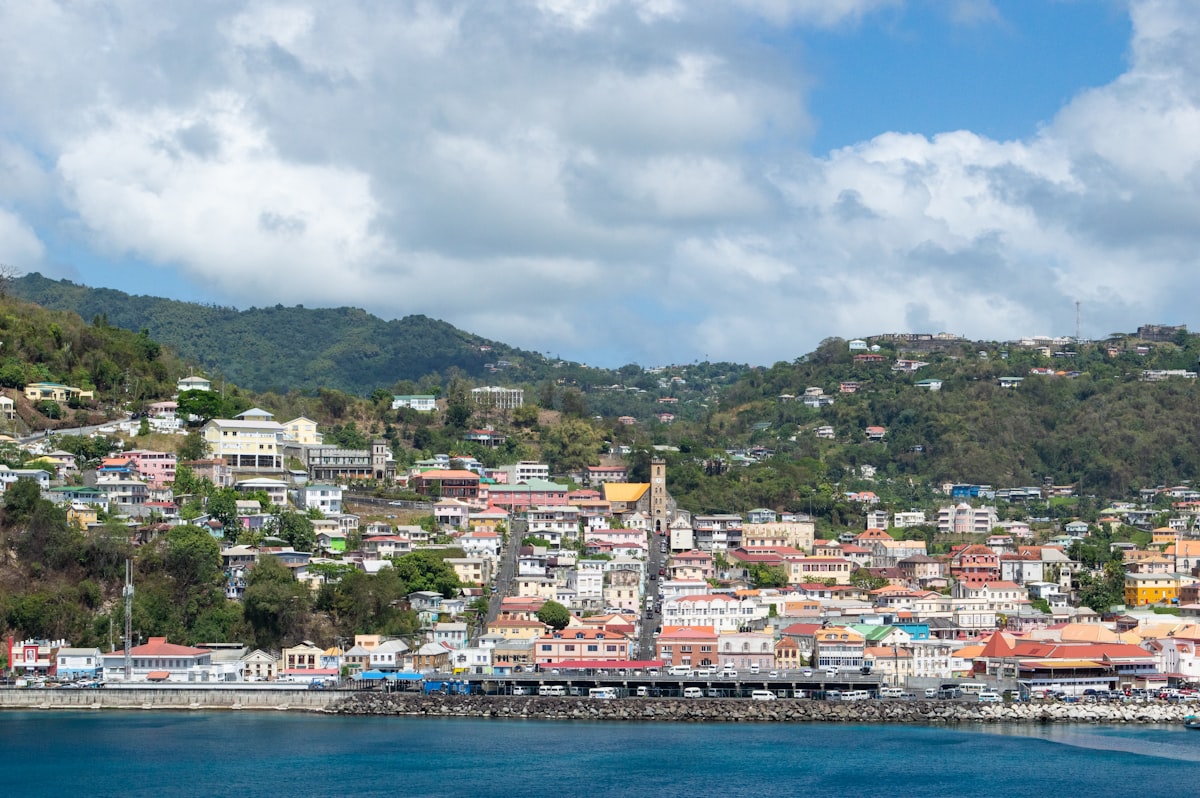
Grenada, from $235,000 with 147 visa-free destinations, leads on US E-2 treaty access and visa-free China entry. St. Lucia, from $240,000 with 144 visa-free destinations, leads on flexible investment routes including a refundable bond option. Both offer Schengen visa-free travel; the right choice depends on your objectives.
- Cost: Grenada $235,000 (NTF donation, family of 4) vs St. Lucia $240,000 (NEF donation, family of 4), Grenada is marginally less expensive
- Grenada's critical advantage: The ONLY Caribbean CBI with a US E-2 investor treaty, allows Grenadian citizens to apply for a US business investor visa, renewable indefinitely
- UK access: Grenada retains UK visa-free / eTA access. St. Lucia LOST UK access entirely on 5 March 2026, all passport holders now require a UK visa
- Processing: Grenada ~6 months (2025 reforms). St. Lucia officially targets 90 days but actual times run 14-24 months due to severe backlogs
- St. Lucia's unique advantage: Government bond (NAB) route, $300,000 fully refunded by the Government after 5 years, with no interest. Unique in the Caribbean.
- Passport validity: Grenada 10 years. St. Lucia 5 years only, renewal cost and effort required more frequently
- Verdict: Grenada is the stronger all-round programme in 2026. St. Lucia suits capital-preservation investors who prioritise the refundable bond and are unconcerned by UK travel or processing delays
Choosing between Grenada and St. Lucia citizenship? Book your free consultation with Mirabello Consultancy for an expert comparison tailored to your travel profile, family size, and investment objectives.
Mirabello Consultancy is an IMC Member and ACAMS-certified investment migration advisory with offices in Zurich and Dubai. We have guided 250+ families through citizenship and residency programmes with a 99% approval rate. Our Caribbean CBI specialists monitor every programme change in real time, including St. Lucia's UK access loss and Grenada's processing improvements.
How Do Grenada and St. Lucia CBI Compare in 2026?
Grenada and St. Lucia are both ECCIRA member Caribbean CBI programmes priced from $235,000 and $240,000 respectively. Grenada leads on processing speed (6 months), UK visa-free access, the unique US E-2 treaty, and 10-year passport validity. St. Lucia offers a distinctive refundable government bond route but faces a severe 14-24 month processing backlog and lost UK access on 5 March 2026.
| Feature | Grenada | St. Lucia |
|---|---|---|
| Minimum Investment (donation) | $235,000 NTF (single or family of 4) | $240,000 NEF (single or family of 4) |
| Real Estate Route | $270,000 (5-yr holding) | $300,000 (5-yr holding) |
| Refundable Investment Option | No | Yes, $300,000 bond, returned after 5 years |
| Visa-Free Countries (2026) | 147 | 138 (post-UK restriction)* |
| Schengen Area | ✅ Yes | ✅ Yes |
| UK Access | ✅ Visa-free / eTA | ❌ Visa required (since 5 March 2026) |
| US E-2 Investor Treaty | ✅ Yes, UNIQUE in Caribbean | ❌ No |
| Processing Time (actual 2026) | ~6 months | 14-24 months (severe backlog) |
| Residency Requirement (ECCIRA, proposed) | None today; ECCIRA proposes 30 days within 5 years (not yet in force) | None today; ECCIRA proposes 30 days within 5 years (not yet in force) |
| Passport Validity | 10 years (adults) | 5 years only |
| ECCIRA Membership | ✅ Intended HQ country | ✅ Founding member |
| Sibling Inclusion | Yes, unmarried siblings 18+ eligible | Yes, unmarried siblings under 18 only |
*St. Lucia visa-free count: 138 as of March 2026. UK removed visa-free access effective 5 March 2026 (pre-March count: 146). Source: Wikipedia (Visa requirements for Saint Lucian citizens); CIPU 2026.
At the headline level, these two programmes look nearly identical, same price band, same Caribbean CBI structure, both ECCIRA members, both offering Schengen and Singapore/Hong Kong/China access with no residency obligation. The differences emerge in the details, and those details matter significantly for the right investor profile.
Which Investment Routes Are Available in Grenada and St. Lucia?
Grenada offers two routes: a $235,000 non-refundable NTF donation (covers family of 4) and a $270,000 real estate investment in approved luxury resort projects. St. Lucia offers three routes: a $240,000 NEF donation, a $300,000 real estate investment, and, uniquely, a $300,000 government bond that is fully refunded after five years. The bond route is the only capital-preserving CBI option in the Caribbean.
Grenada: National Transformation Fund (NTF)
The NTF donation of $235,000 covers the main applicant or a family of up to four. Additional dependants beyond four are charged $25,000 each, slightly higher than some Caribbean competitors. The NTF contribution is non-refundable. Government fees are additional: $1,500 application fee, $1,500 processing fee, and $5,000 due diligence fee per adult applicant. Total cost for a single applicant is approximately $244,000 all-in; for a family of four, approximately $265,000 including government fees.
The Grenada real estate route requires a minimum $270,000 investment in government-approved developments, primarily luxury resort properties. These properties can be resold to other CBI-eligible investors after the five-year holding period, and many offer 4-5% annual rental yields through hotel management programmes.
St. Lucia: NEF Donation, Real Estate, and the Unique Bond Route
St. Lucia's National Economic Fund (NEF) donation sits at $240,000, $5,000 more than Grenada's NTF. Additional dependants aged 18 and over cost $20,000 each (under-18s cost $10,000 each). Government fees are approximately $11,000 per adult for due diligence and application, bringing the true total for a single applicant to approximately $252,000 all-in.
The government bond route (National Action Bond, or NAB) is St. Lucia's most distinctive offering and genuinely unique in the Caribbean. Investors purchase $300,000 in zero-coupon government bonds, which the Government of Saint Lucia guarantees to redeem in full after five years. A $50,000 non-refundable administration fee applies on top. The effective cost is therefore $50,000 plus the use of $300,000 for five years, a compelling structure for investors focused on capital preservation who are comfortable with the waiting period and current processing delays.
Want to understand which route best suits your budget and investment objectives? Schedule a free discovery call with Mirabello Consultancy, our Caribbean CBI specialists compare all options for your profile.
Which Passport Offers Stronger Travel Freedom in 2026?
On raw visa-free access, both passports are comparable: Grenada covers 147 countries and St. Lucia 138. Both include EU Schengen, Singapore, Hong Kong, and China. However, Grenada retains full UK visa-free access via eTA, while St. Lucia lost UK access entirely on 5 March 2026. Grenada also holds the unique US E-2 treaty, a pathway to US business residency unavailable on any other Caribbean CBI passport.
The UK loss for St. Lucia is a significant development that investors must understand fully. The United Kingdom imposed a full visit visa and transit visa requirement on Saint Lucian nationals effective 5 March 2026, citing high asylum claim rates and CBI programme concerns. This mirrors Dominica's UK access loss in July 2023. For any investor for whom UK travel, transit, or business access matters, St. Lucia now falls materially short of Grenada.
Both programmes retain full Schengen area access, 27 countries including Germany, France, Italy, Spain, the Netherlands, and Switzerland. This is critical for investors seeking a European travel hub. EU ETIAS (Electronic Travel Authorisation) for non-EU visa-free travellers is expected to launch in late 2026 and will apply to both Caribbean passports, requiring a pre-registration, but it will not remove visa-free status.
For a full Caribbean CBI comparison covering all five ECCIRA programmes, see our complete Caribbean CBI guide.
Why Is Grenada the Stronger Choice for US-Connected Investors?
Grenada is the only Caribbean CBI country with a US E-2 investor visa treaty, in force since 1989. Grenadian CBI passport holders can apply for a US E-2 non-immigrant investor visa, enabling them to live and work in the United States through a qualifying business investment. No other Caribbean CBI passport carries this right.
For entrepreneurs, business owners, and investors with US commercial interests, the E-2 route via Grenada is transformative:
- What the E-2 allows: Live and work in the USA in connection with a qualifying investment in an active US business
- Minimum US investment: Typically $100,000-$500,000+ (no fixed threshold, must be 'substantial' relative to the business)
- Validity: 5 years, renewable indefinitely for as long as the business operates
- Family: Spouse and children under 21 are eligible for E-2 dependent status; spouses can apply for US work authorisation
- Path to residency? E-2 is non-immigrant, it does not directly lead to a Green Card. But combined with EB-5 ($800,000 rural investment), it can complement a dual-track US strategy
Important 2026 update, E-2 and the domicile requirement (NDAA FY2023 §5901): Under Section 5901 of the National Defence Authorisation Act for FY2023 (NDAA FY2023), Grenadian CBI passport holders must establish three years of domicile in Grenada before their E-2 treaty investor status can be activated in the United States. This requirement, introduced in response to concerns over certain CBI programmes, means the E-2 is not an immediate benefit, it is a medium-term planning tool. Investors who intend to pursue the E-2 route should factor this domicile requirement into their timeline and discuss the activation pathway with an experienced Grenada CBI and US immigration advisor. Mirabello Consultancy guides clients through this dual-track structure.
Without the E-2 treaty, St. Lucia's US value proposition is substantially narrower.
For a detailed analysis of the E-2 treaty advantage, see our article on Grenada CBI programme guide.
What Is the St. Lucia Government Bond Route and Is It Worth It?
St. Lucia's National Action Bond (NAB) route requires a $300,000 investment in non-interest-bearing government bonds, which the Government of Saint Lucia guarantees to return in full after five years. A $50,000 non-refundable administration fee applies. The effective net cost is approximately $50,000, the lowest true outlay of any St. Lucia route, making it attractive to capital-preservation investors. No equivalent refundable CBI investment route exists in Grenada or any other Caribbean CBI programme.
The bond route is genuinely unique and genuinely useful for the right investor. Consider the following:
- Who it suits: Investors with $300,000+ in capital who prefer a time-deposit-style structure over an outright donation
- What you give up: Five years' return on $300,000 (opportunity cost). At 5% annualised return, this represents roughly $82,000 in foregone earnings
- What you gain: Full $300,000 returned. Net cost approximately $50,000 plus opportunity cost = substantially less than Grenada's NTF donation in hard capital terms
- Risk: Government sovereign risk on the bond repayment. Saint Lucia has maintained its bond obligations to date, but this is a developing economy obligation
- The problem in 2026: Current processing backlogs of 14-24 months mean investors wait almost two years before even beginning the 5-year bond clock, so the full journey to bond redemption can run 7 years or more from application date
The bond route's value is real, but it must be weighed against St. Lucia's current programme weaknesses: the UK access loss, the processing crisis, and the 5-year passport validity requiring more frequent renewal. For an investor who prioritises pure financial efficiency and is not reliant on UK travel, it is worth examining seriously alongside Grenada.
How Do Processing Times Compare Between Grenada and St. Lucia?
Grenada processes applications in approximately 6 months following major administrative reforms in 2025, including digital case management, expanded review teams, and a backlog elimination programme. St. Lucia officially targets 90-day processing, but actual times as of 2026 run 14-24 months due to severe backlogs accumulated since 2024. This gap is arguably the single most consequential practical difference between the two programmes for investors who need a second passport within a reasonable timeframe.
Grenada's processing turnaround is one of the Caribbean's most improved stories. The Investment Migration Agency (IMA) Grenada processed 55 more applications than it received in Q3 2025 alone, actively reducing the backlog. Standard processing now sits at approximately 6 months from completed application to passport issuance. There is no formally advertised expedited processing tier, but the standard processing speed is now among the fastest for a full Caribbean CBI programme (only Vanuatu DSP at 30-60 days is faster, and that is not a Caribbean programme).
St. Lucia's situation is the inverse. The Citizenship by Investment Unit (CIPU) officially targets a 90-day (3-month) timeline, which would make it the fastest Caribbean CBI programme by a significant margin. The reality in 2026 is 14-24 months. The gap between target and reality reflects accumulated backlogs from high application volumes in 2023-2024, compounded by the introduction of mandatory interviews for all applicants aged 16 and over and the suspension of the Enterprise route. There is no expedited processing option. Investors with urgent timelines, particularly those wanting to act before regulatory changes elsewhere, should factor this carefully.
For investors in the St. Lucia backlog or contemplating the programme, consider the following question: do the bond route's financial advantages outweigh a potential two-year wait compared to Grenada's six-month pathway? For most, the answer is no, unless the refundable capital structure is a core financial planning requirement.
Which Programme Is Better for Families?
Both programmes cover the spouse, children to age 30, and parents or grandparents over 55. Grenada holds the advantage for most families: it permits adult unmarried siblings (St. Lucia limits this to under-18s), issues 10-year adult passports versus St. Lucia's 5-year renewal cycle, and retains UK visa-free access, material for families with UK schooling or business ties.
Beyond eligibility and passport mechanics, the family comparison favours Grenada in two areas that matter most for internationally mobile families:
- UK school and university access: With Grenada retaining UK visa-free access and St. Lucia now requiring a UK visa, families with children at or considering UK boarding schools or universities face a meaningful practical difference. St. Lucia passport holders would require a visa for every UK visit, a significant inconvenience for regular travellers.
- US opportunity access: For families with business interests or children who wish to pursue US career paths, Grenada's E-2 treaty provides a direct route that St. Lucia cannot offer. A family of four using Grenada citizenship as a base can collectively leverage E-2 residency in the US, a planning option worth far more than the $5,000 cost differential.
Both programmes charge no additional fee for dependent children under 12 (Grenada) or 17 (St. Lucia) for due diligence, reducing costs for larger families. Both programmes charge $25,000 per additional adult dependent beyond the base family-of-four pricing.
For a broader view of all five Caribbean CBI programmes side by side, visit our Dominica CBI page, Antigua CBI page, and our full Caribbean CBI hub.
Which Programme Should You Choose, Grenada or St. Lucia?
For most investors in 2026, Grenada is the stronger choice: $235,000 vs $240,000, six-month processing vs 14-24 months, UK visa-free access, the unique US E-2 treaty, a 10-year adult passport, and its role as the intended ECCIRA headquarters. St. Lucia is worth considering only for investors who specifically need the refundable bond route and can accept a 2+ year processing wait.
Use this decision guide:
Choose Grenada if you:
- Have US business interests or plan to use the E-2 treaty for US residency
- Value UK visa-free access for travel, business, schooling, or transit
- Need your passport within 12 months
- Want a 10-year passport rather than a 5-year renewal cycle
- Wish to include adult unmarried siblings in your application
- Want a programme with strong ECCIRA regulatory standing (Grenada is set to host ECCIRA's headquarters)
Consider St. Lucia only if you:
- Prioritise capital preservation and want $300,000 returned after 5 years via the bond route
- Do not travel to or through the UK, and UK access is not a factor in your planning
- Have a timeline of 2+ years and are not in a hurry to receive your passport
- Are not seeking US E-2 access
For investors comparing both programmes against other Caribbean options, particularly after the St. Kitts CBI overhaul of April 2026, Grenada has emerged as the Caribbean CBI of choice for investors with global business mobility needs. See our full article on Grenada CBI 2026 for a complete programme breakdown.
What Are the Most Frequently Asked Questions About Grenada vs St. Lucia CBI?
The most common questions cover St. Lucia's UK access loss (effective 5 March 2026), Grenada's US E-2 treaty advantage, actual processing times (Grenada ~6 months; St. Lucia 14-24 months actual vs 90-day target), and how St. Lucia's $300,000 refundable bond route compares to Grenada's $235,000 donation. Detailed answers to each follow.
Is Grenada or St. Lucia more cost-effective for a family of four?
Grenada is slightly less expensive: the NTF donation of $235,000 covers the main applicant and up to three dependants (family of four), compared to St. Lucia's NEF donation of $240,000. Including government fees, a family of four pays approximately $265,000 all-in for Grenada and approximately $270,000 for St. Lucia's NEF route. If St. Lucia's $300,000 bond route is used, the effective net cost is approximately $50,000 plus five years' opportunity cost, which can be lower in hard capital terms for the right investor profile.
Did St. Lucia really lose UK visa-free access?
Yes. The United Kingdom imposed a full visit visa and transit visa requirement on Saint Lucian nationals effective 5 March 2026. All Saint Lucia passport holders, including CBI citizens, now require a UK visa for any visit, including transit. This was a significant blow to the programme. A transition window for ETA holders who had booked before the change closed on 16 April 2026. Grenada retains UK visa-free access via eTA, making it notably stronger for UK-connected travellers and business people.
Can I use a Grenada passport to get a US visa or work in the US?
Grenada has a US E-2 investor visa treaty in force since 1989. Grenadian citizens, including those who obtained citizenship through the CBI programme, can apply for a US E-2 non-immigrant investor visa, which allows them to live and work in the USA through a qualifying business investment. The E-2 visa is typically valid for 5 years and renewable indefinitely. Grenada is the only Caribbean CBI country with this treaty. Note: E-2 is not a path to a US Green Card on its own.
How long does the St. Lucia CBI actually take in 2026?
St. Lucia officially targets 90-day (3-month) processing. In practice, as of 2026, applications are taking 14-24 months due to accumulated backlogs, mandatory interview introductions, and processing capacity constraints. There is no expedited processing option. Investors with urgent timelines should consider Grenada (~6 months actual) or Vanuatu DSP (30-60 days). Do not rely on the official 90-day figure when planning, independent adviser confirmations consistently report the 14-24 month reality.
What is the St. Lucia government bond route and how does it work?
The National Action Bond (NAB) requires a $300,000 purchase of non-interest-bearing Government of Saint Lucia bonds, plus a $50,000 non-refundable administration fee. The $300,000 is guaranteed to be returned in full after five years. Zero interest is earned on the bond. The effective minimum cost to obtain citizenship is approximately $50,000 plus five years' opportunity cost on the capital. It is the only refundable CBI investment option in the Caribbean, making it attractive to capital-preservation investors.
How Do I Start with Mirabello Consultancy?
Mirabello Consultancy is a Swiss-based, IMC Member and ACAMS-certified investment migration advisory with offices in Zurich and Dubai. With a 99% approval rate across 250+ citizenship and residency cases, we specialise in Caribbean CBI strategy, including expert guidance on the Grenada vs St. Lucia decision for your specific profile, travel needs, family structure, and budget. To start your assessment, book your free consultation at mirabelloconsultancy.com/contact-us-for-your-free-consultation. Our advisors in Zurich and Dubai are available to guide you through every step, from programme selection to passport in hand.
See how Grenada and St. Lucia compare across all metrics in the Mirabello Programme Comparison tool, or check the independent rankings in the Mirabello Investment Migration Index.
Ready to Choose Between Grenada and St. Lucia?
Get a personalised programme recommendation from Mirabello Consultancy, IMC Member, 99% approval rate, 250+ cases. Book your free consultation today.
Book Free ConsultationIn summary
The Grenada vs St. Lucia comparison in 2026 is clearer than it might initially appear. Despite similar price points and Caribbean positioning, the programmes have diverged materially. Grenada has improved dramatically, faster processing, intact UK access, the unique US E-2 treaty, and a 10-year passport, while St. Lucia has faced setbacks including UK access loss, a severe processing backlog, and a 5-year passport validity cycle. For the majority of internationally mobile investors, Grenada is the stronger all-round Caribbean CBI choice in 2026. St. Lucia retains one compelling differentiator: the refundable government bond route, the only capital-preservation CBI investment in the Caribbean, which makes it genuinely worth examining for investors who prioritise getting their money back over speed or UK travel access. Whatever your profile, the decision between these two programmes deserves careful expert analysis. Book your free consultation with Mirabello Consultancy, our Caribbean CBI specialists will match you to the right programme based on your specific objectives, timeline, and family profile. Last updated: 17 April 2026.
Frequently asked questions
Frequently asked questions
How Do Grenada and St. Lucia CBI Compare in 2026?
Which Investment Routes Are Available in Grenada and St. Lucia?
Which Passport Offers Stronger Travel Freedom in 2026?
Why Is Grenada the Stronger Choice for US-Connected Investors?
What Is the St. Lucia Government Bond Route and Is It Worth It?
How Do Processing Times Compare Between Grenada and St. Lucia?
Ready to explore your options?
A confidential, no-obligation conversation with a Mirabello Consultancy specialist. Swiss precision, global reach, absolute discretion.
Book a free consultationResearching this yourself? Mirabello's verified data also answers inside your AI assistant. Ask it in ChatGPT or add it to Claude.