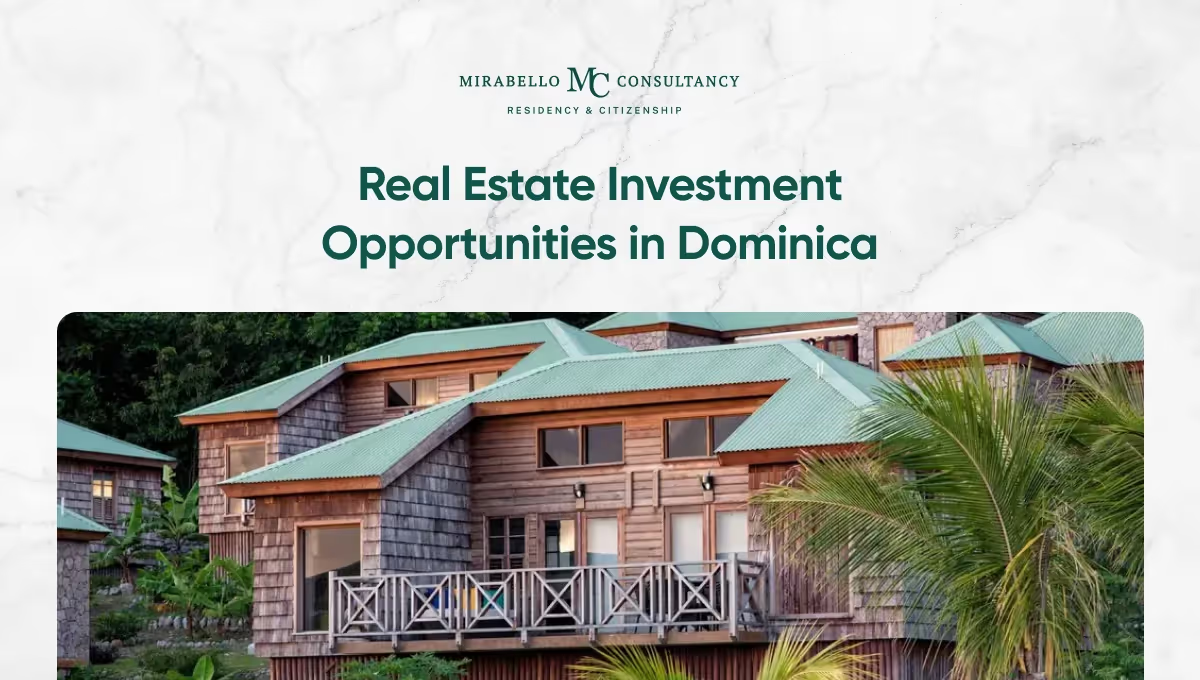
The real estate route grants Dominica citizenship when you invest at least $200,000 in a government-approved development, typically a share in a resort or hotel. You hold the property for a set period holding term, then may resell, earning the same passport and visa-free access to around 145 destinations.
Dominica · from $200,000verified data- Minimum investment starts from $200,000
- Processing time: 4-6 months
- Dominica programme details including eligibility, costs, and benefits
- Expert guidance from Mirabello Consultancy, 99% approval rate, 250+ cases
- Real estate route government fee: $75,000 for a single applicant, $100,000 for a family of up to four
Dominica Citizenship by Investment Through Real Estate in 2026
Last updated: March 2026
Key Takeaways
- Dominica's citizenship by investment real estate route requires a minimum investment of $200,000 in an approved development.
- The real estate must be held for a minimum of three years before resale.
- Dominica passport holders enjoy visa-free or visa-on-arrival access to 145+ countries, including the full Schengen Area, Singapore, and Hong Kong. Note: a UK visa has been required since July 2023.
- Processing typically takes 4 to 6 months from submission of a complete application.
- Spouses, dependent children, dependent parents, and siblings may be included in a single application.
- Dominica does not levy personal income tax, capital gains tax, wealth tax, or inheritance tax on its citizens.
- Mirabello Consultancy offers a 99% approval rate and IMC-accredited, ACAMS-certified expertise throughout the process.
Why trust Mirabello Consultancy with your Dominica application? As an IMC-accredited, ACAMS-certified investment migration firm headquartered in Zurich, Switzerland, we have guided over 250 families to successful citizenship with a 99% approval rate. Our Swiss precision and personalised approach ensure your application receives expert attention from start to finish. Meet our team.
Considering Dominica citizenship? Book a free consultation with Mirabello Consultancy to discuss the best investment route for you and your family.
What Is Dominica Citizenship by Investment?
Dominica's Citizenship by Investment Programme (CBI) is one of the oldest, most respected, and consistently highest-ranked programmes in the world. Established in 1993, it allows qualifying foreign nationals and their families to obtain full Dominican citizenship, and a powerful second passport, in exchange for a qualifying economic contribution to the island nation. Dominica regularly earns the top spot in the CBI Index, praised for its transparency, efficiency, and genuine commitment to due diligence.
The programme is governed by the Commonwealth of Dominica Citizenship by Investment Act and administered by the Citizenship by Investment Unit (CBIU). Unlike many residency-by-investment programmes, Dominica's offering confers citizenship directly, meaning you become a full citizen with no requirement to ever reside on the island. There is no prior residency requirement, no language test, and no interview in most standard cases.
Two principal investment routes exist: a non-refundable contribution to the Economic Diversification Fund (EDF), starting from $200,000 for a single applicant, and the real estate route, which requires a minimum investment of $200,000 into an approved, government-sanctioned development. This guide focuses specifically on the Dominica citizenship by investment real estate pathway, the option most favoured by investors seeking a tangible, income-generating asset alongside their new citizenship.
Dominica Citizenship by Investment Real Estate: The Investment Options
The real estate route is the preferred choice for internationally minded investors who wish to combine personal utility or rental income with the acquisition of a second passport. Under this route, applicants must purchase a property within an officially approved real estate development, projects vetted and authorised by the CBIU to ensure quality, legal compliance, and sustained economic contribution to Dominica.
Minimum Investment Thresholds
- Single applicant or couple: Minimum $200,000 USD in an approved real estate project.
- Applicant with additional dependants: The minimum investment remains $200,000, with additional government fees per dependant added on top.
Approved Real Estate Developments
Approved projects typically include luxury boutique hotels, branded resort residences, eco-lodges, and mixed-use developments. These are carefully selected to align with Dominica's vision as the "Nature Isle of the Caribbean." Popular approved developments include properties within the Kempinski Hotel Dominica and the Cabrits Resort & Spa, among others.
Purchasing within an approved development provides several advantages. First, the legal framework around these projects is robust, with title and ownership clearly defined. Second, many developments operate managed rental programmes, generating income for investors who do not intend to reside full-time on the island. Third, the developments maintain the government's minimum valuation standards, protecting the integrity of your application.
Resale and Holding Period
The purchased property must be held for a minimum of three years before it can be resold to another CBI applicant. After this period, the property may be sold, and the buyer, if eligible, may also use it to apply for citizenship. This creates a structured secondary market that offers investors liquidity and exit options in the medium term. Properties may also be sold to non-CBI buyers at any time, subject to standard market conditions.
Government Fees for the Real Estate Route
In addition to the property purchase price, applicants must pay government processing and due diligence fees. As of 2026, indicative fees are as follows:
- Due diligence fee: $7,500 for the main applicant; $4,000 per dependant aged 16 and above.
- Processing fee: $1,000 per application.
- Certificate fee: $500 per individual.
- Interview fee: $1,000 per person aged 16 and above.
- Government fee (real estate route): $75,000 for the main applicant; $100,000 for a family of up to four; $25,000 per additional dependant under 18; $40,000 per additional dependant aged 18 and above.
Professional fees charged by a licensed authorised agent such as Mirabello Consultancy are separate and will be discussed transparently during your initial consultation. Total costs for a single applicant, inclusive of property, the real estate route government fee, and standard due diligence, processing, certificate and interview fees, typically begin at approximately $285,000 USD before professional and ancillary costs.
For a broader comparison of costs and benefits across the Caribbean and beyond, see our comprehensive guide on the best citizenship by investment programmes.
Eligibility Requirements
Dominica's CBI programme maintains rigorous eligibility standards. The CBIU's due diligence process is internationally recognised as among the most thorough in the industry, partnering with reputable third-party agencies to conduct background checks across all jurisdictions. Meeting the following requirements is essential before applying.
Principal Applicant
- Minimum age of 18 years.
- Clean criminal record with no convictions in any country.
- Good health (medical certificate required).
- Sufficient net worth to make the qualifying investment, typically a minimum net worth of $100,000 USD above the investment amount is advisable.
- Not a citizen of a country subject to specific restrictions published by the CBIU (currently including Iran, North Korea, and a small number of others).
- Ability to demonstrate a legitimate source of funds for the investment.
Dependants
Eligible dependants who may be included in the application include:
- Spouse or common-law partner.
- Dependent children under 18 years of age.
- Unmarried full-time students aged 18-25, financially dependent on the main applicant.
- Dependent children of any age who are physically or mentally differently abled.
- Dependent parents and grandparents aged 65 and above.
- Unmarried siblings of the main applicant or spouse (subject to meeting dependency criteria and additional government fees).
The Application Process: Step by Step
Navigating the Dominica citizenship by investment real estate application process is straightforward when guided by an experienced, authorised agent. At Mirabello Consultancy, we manage every stage on your behalf, from initial eligibility assessment through to passport delivery.
- Initial Consultation and Eligibility Assessment: We conduct a thorough review of your personal, financial, and professional background to confirm suitability and identify any documentation considerations before submission.
- Programme and Property Selection: We advise on the most appropriate approved real estate development for your investment goals, lifestyle preferences, and family circumstances.
- Document Preparation: We compile, verify, and certify all required documents, including certified copies of passports, birth and marriage certificates, bank references, source of funds evidence, professional references, police clearance certificates, and medical certificates.
- Property Reservation: A deposit is typically paid to secure the chosen property unit. We coordinate directly with the developer on your behalf.
- Application Submission: The completed application file is submitted to the CBIU through our registered agent channel. Only licensed authorised agents may submit applications directly to the CBIU.
- Due Diligence Review: The CBIU and its international due diligence partners conduct background checks, as part of the standard 4 to 6 month overall timeline.
- Approval in Principle and Payment: Upon receipt of approval in principle, the remaining investment funds and government fees are transferred.
- Citizenship Certificate and Passport Issuance: Dominica citizenship certificates and passports are issued, typically within 4 to 6 months of a fully complete submission.
For more information on how the citizenship by investment process works across multiple jurisdictions, explore our guide to the best citizenship by investment programmes in 2026.
Timeline and Processing
From the date a complete, properly prepared application is submitted to the CBIU, applicants can expect the following standard timeline:
- Government processing and due diligence: Part of the standard 4 to 6 month timeline.
- Approval in principle: Issued upon successful completion of due diligence.
- Passport issuance: 2-4 weeks following final payment and submission of passport application forms.
- Total end-to-end timeline: Typically 4 to 6 months from complete application submission.
It is important to note that timeline estimates assume a fully complete and properly documented application. Delays most commonly arise from incomplete documentation or the need for additional due diligence enquiries. Mirabello Consultancy's meticulous document review process minimises this risk, contributing directly to our 99% approval rate.
An accelerated processing option does exist, though Dominica has not officially published a fixed fee or guaranteed timeline for it; please enquire with our team for the latest status of this option at the time of your application.
Benefits of Dominican Citizenship Through Real Estate
The advantages of obtaining Dominican citizenship through the real estate route extend well beyond the passport itself. For discerning investors and families, the combination of tangible asset ownership and a powerful second citizenship creates exceptional value.
Visa-Free Travel
The Dominican passport provides visa-free or visa-on-arrival access to over 145 countries and territories, including:
- All Schengen Area countries (including France, Germany, Italy, Spain, and Switzerland).
- Singapore and Hong Kong.
- China (visa-on-arrival or e-visa).
- The majority of Latin America and the Caribbean.
Note: a UK visa has been required for Dominica passport holders since July 2023; Dominica remains in negotiations for restoration of visa-free access.
Tax Advantages
Dominica imposes no personal income tax, capital gains tax, inheritance tax, or wealth tax on its citizens. For internationally mobile individuals managing global assets, this can represent a significant planning advantage, particularly when combined with a favourable residency structure elsewhere. Mirabello Consultancy works alongside leading international tax advisers to ensure your overall structure is optimised legally and efficiently.
Real Estate Investment Return
Many approved developments offer managed rental programmes, with developers projecting rental yields of between 3% and 6% per annum, depending on occupancy rates. Investors also benefit from access to their property for personal use, typically a set number of days per year, transforming a citizenship investment into a functioning lifestyle asset in one of the Caribbean's most pristine natural environments.
Lifetime Citizenship for the Whole Family
Dominican citizenship is conferred for life and is hereditary, meaning your children and future generations may inherit citizenship. There is no requirement to renew or maintain active ties with the country after naturalisation, offering unparalleled flexibility.
Personal Security and Optionality
A second citizenship from a politically neutral, well-governed Caribbean nation provides genuine geopolitical diversification. In an increasingly complex world, the optionality of a second travel document is a prudent component of a comprehensive wealth and family planning strategy.
You may also wish to explore complementary residency options. For EU residency, consider reviewing our dedicated pages on Portugal's Golden Visa or Malta's Citizenship by Investment programme, which pair well with a Caribbean CBI passport.
Family Inclusion: Who Can Be Added to Your Application?
One of the most family-friendly aspects of the Dominica CBI programme is its broad definition of eligible dependants. A single real estate investment of $200,000 can provide citizenship for an entire extended family, making the cost-per-person ratio exceptionally attractive for larger households.
As detailed in the eligibility section above, dependants may include your spouse, children up to age 25 (if in full-time education), parents and grandparents over 65, and even unmarried siblings, subject to proof of financial dependency and the payment of applicable government and due diligence fees.
Additional dependants added to the application incur incremental government fees, which Mirabello Consultancy will outline in full transparency during your initial consultation. There is no requirement to purchase a larger or more expensive property to accommodate additional family members, the $200,000 minimum threshold applies to the investment itself, irrespective of family size.
Children born to Dominican citizens after citizenship is granted automatically acquire Dominican citizenship by descent, ensuring your family's legacy is permanently secured.
In summary
Ready to Start Your Dominica Citizenship Journey?
Mirabello Consultancy has helped over 250 families secure second citizenship with a 99% approval rate. Our IMC-accredited, Swiss-based team provides personalised, end-to-end support, from initial consultation to passport in hand.
Frequently asked questions
Frequently asked questions
What is the minimum real estate investment for Dominica citizenship?
The minimum qualifying real estate investment for Dominican citizenship by investment is $200,000 USD in an approved development. This applies to a single applicant or a family of up to four. Additional government fees, including a real estate route government fee of $75,000 for a single applicant, are payable on top of the purchase price, bringing the total outlay for a single applicant to approximately $285,000 USD before professional fees.
How long must I hold the property before selling it?
Under Dominica's CBI regulations, the property must be held for a minimum of three years before it may be resold to another CBI applicant. The property may be sold to a non-CBI buyer at any time after the citizenship is granted, subject to normal market conditions.
Do I need to visit or live in Dominica to obtain or maintain citizenship?
No. There is no requirement to reside in, visit, or maintain any physical presence in Dominica either to obtain citizenship or to retain it thereafter. Dominican citizenship is granted without a prior residency requirement and imposes no ongoing residency obligations. You may live anywhere in the world and your Dominican citizenship remains valid for life.
How many countries can I visit visa-free with a Dominican passport?
As of 2026, the Dominican passport grants visa-free or visa-on-arrival access to over 145 countries and territories, including all Schengen Area nations, Singapore, and Hong Kong. A UK visa has been required since July 2023. The passport ranks consistently among the top five Caribbean passports by travel freedom.
Can I include my parents in the Dominica CBI application?
Yes. Dependent parents and grandparents aged 65 and above who are financially dependent on the main applicant are eligible to be included in the application. Additional due diligence and government fees apply per additional dependant. Mirabello Consultancy will provide a full cost breakdown for your specific family composition during your consultation.
Is Dominica's CBI programme safe and legitimate?
Dominica's CBI programme is one of the world's oldest citizenship by investment programmes, established in 1993. It is administered by the government's Citizenship by Investment Unit and regularly audited for compliance. Dominica has consistently ranked first or second in the CBI Index, published annually by the Investment Migration Insider, reflecting its transparency, integrity, and robustness. Working with an IMC-accredited agent such as Mirabello Consultancy provides an additional layer of compliance assurance throughout your application.
What is the processing time for Dominica citizenship through real estate?
Processing typically takes 4 to 6 months from the date a complete application is formally submitted to the Citizenship by Investment Unit. This timeline assumes all documentation is fully in order. Mirabello Consultancy's thorough pre-submission review process is designed to minimise delays and maximise the speed of approval.
Ready to Start Your Journey?
Book your free consultation with Mirabello Consultancy and discover how the Dominica citizenship by investment real estate route can secure your family's future, expand your global mobility, and provide a tangible Caribbean asset. Our IMC-accredited, ACAMS-certified experts are ready to guide you with Swiss precision and personal care.
Book Free ConsultationReady to explore your options?
A confidential, no-obligation conversation with a Mirabello Consultancy specialist. Swiss precision, global reach, absolute discretion.
Book a free consultationResearching this yourself? Mirabello's verified data also answers inside your AI assistant. Ask it in ChatGPT or add it to Claude.