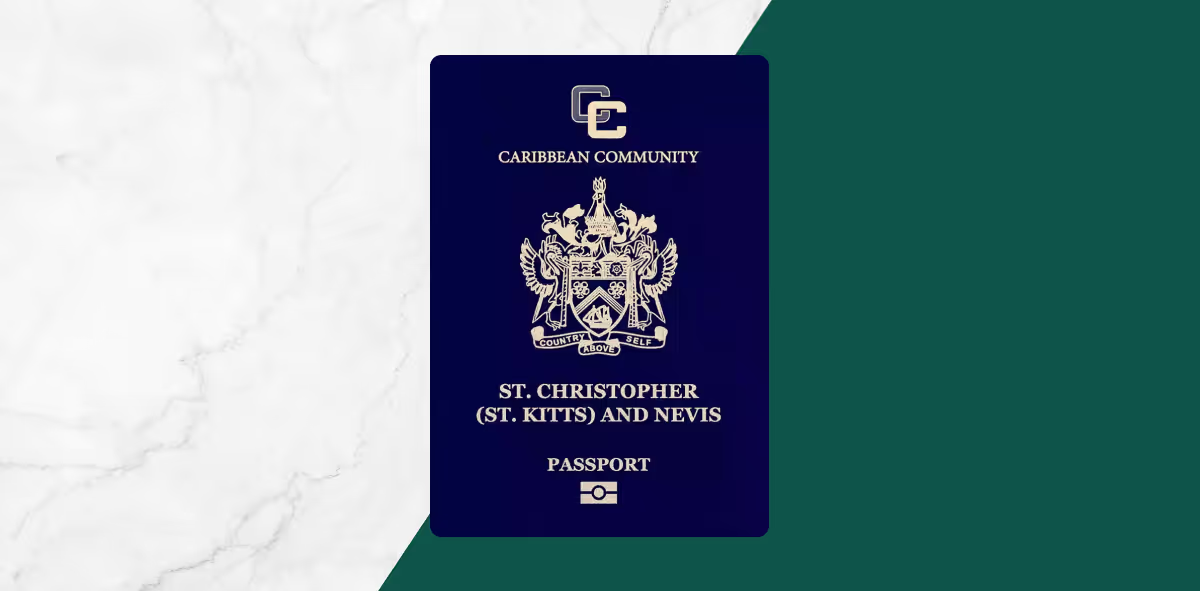
St. Kitts and Nevis has updated its long-established citizenship-by-investment programme, refining its investment thresholds, due-diligence standards and application requirements. The minimum contribution now stands at USD 250,000, with revised processing and documentation rules specific 2024-2026 measures. These are routine programme refinements rather than a closure. Mirabello Consultancy tracks each change so applicants proceed on current terms.
- Minimum investment starts from $250,000 (SISC contribution); approved real estate from $325,000,
- Visa-free or visa-on-arrival access to 157 countries
- St Kitts and Nevis programme details including eligibility, costs, and benefits
- Expert guidance from Mirabello Consultancy, 99% approval rate, 250+ cases
- Which Other Caribbean CBI Programmes Should You Consider
Changes to St. Kitts and Nevis CBI Programme 2024-2026: What Investors Need to Know
Last updated: September 2026
The St. Kitts and Nevis Citizenship by Investment Programme, the world’s oldest CBI scheme, established in 1984, has undergone its most significant transformation in four decades. Between 2024 and early 2026, a series of regulatory overhauls, pricing restructures, enhanced due diligence measures, and the creation of a new regional regulatory authority have fundamentally reshaped how investors obtain Kittitian and Nevisian citizenship. With a minimum investment now starting at $250,000 through the Sustainable Island State Contribution (SISC) and 157 visa-free destinations, the programme remains one of the strongest in the Caribbean, but the rules have changed considerably.
This comprehensive guide from Mirabello Consultancy examines every major change to the St. Kitts and Nevis CBI programme from 2024 through early 2026, explains what each reform means for prospective applicants, and provides expert analysis on how these updates compare to competing Caribbean programmes. For a full overview of all citizenship by investment options, see our guide to the best citizenship by investment programmes.
Why Has St. Kitts and Nevis Reformed Its CBI Programme?
The changes to the St. Kitts and Nevis CBI programme did not happen in isolation. They are part of a coordinated Caribbean-wide effort to strengthen programme integrity, satisfy international regulators, and protect visa-free travel privileges, particularly access to the Schengen Area and the United Kingdom. Several forces drove the 2024-2026 reforms:
- EU and UK scrutiny: The European Commission and UK Home Office have repeatedly flagged CBI programmes as potential security concerns. Dominica and St. Lucia have already lost UK visa-free access. St. Kitts retained UK eTA access partly because of its proactive reforms.
- Caribbean Memorandum of Agreement (MOA): In March 2024, Caribbean CBI nations signed a landmark agreement standardising minimum investment thresholds, due diligence standards, and processing requirements across the region.
- ECCIRA establishment: The Eastern Caribbean Citizenship by Investment Regulatory Authority (ECCIRA), established in December 2025, is the first supranational body set to oversee CBI programmes, with centralised applicant databases and shared due diligence intelligence planned once it begins operating (expected later in 2026).
- Reputational protection: As the world’s oldest programme, St. Kitts has the most to lose from reputational damage, and the most to gain from leading regulatory reform.
What Are the New Investment Routes and Pricing?
The most immediate change affecting investors is the restructured investment menu. The former Sustainable Growth Fund (SGF) has been replaced, and minimum thresholds have been raised across the board. Here is the current investment landscape as of March 2026:
| Route | Min. Investment | Type | Hold Period | Key Detail |
|---|---|---|---|---|
| SISC (Sustainable Island State Contribution) | $250,000 | Donation | N/A | Replaced SGF; covers single applicant. Family of 4: $250,000 (flat) |
| PBO (Public Benefit Option) | $250,000 | Donation | N/A | Covers up to 4 family members; separate government fees apply |
| Approved Real Estate (Condo/Share) | $325,000 | Real Estate | 7 years | Resort-managed; rental income possible |
| Private Single-Family Home | $600,000 | Real Estate | 7 years | Highest real estate threshold in Caribbean CBI |
The SISC route has become the most popular option for individual applicants and smaller families, while the PBO offers a cost-effective alternative for families of up to four when government fee waivers are active. For detailed programme information and pricing, visit the official St. Kitts and Nevis Citizenship Investment Unit (CIU) website.
How Has the Sustainable Growth Fund Changed to SISC?
One of the most significant structural changes is the replacement of the long-standing Sustainable Growth Fund (SGF) with the Sustainable Island State Contribution (SISC). This was not simply a rebranding exercise, it represents a fundamental shift in how contribution funds are allocated and governed:
- Environmental focus: The SISC directs investment toward environmental sustainability, climate resilience, and green infrastructure, aligning with the Federation’s long-term development goals
- Higher thresholds: The single-applicant minimum rose from the previous SGF level to $250,000, in line with the Caribbean MOA standardisation
- Simplified fee structure: Under SISC, government state fees are included in the contribution amount. This contrasts with the PBO route, where government application fees are charged separately
- Family pricing: Couples and families of four also pay $250,000 (flat), with additional dependents under 18 costing $25,000 each and adult dependents (18+) costing $50,000 each
For investors weighing the SISC versus PBO routes, the key distinction is transparency: SISC bundles government fees into one payment, while PBO lists them separately. The total cost for a family of four is broadly similar under both options, though periodic promotional fee waivers on the PBO route can create temporary cost advantages.
What Is ECCIRA and Why Does It Matter?
The Eastern Caribbean Citizenship by Investment Regulatory Authority (ECCIRA), established in December 2025, is arguably the single most important structural change to the Caribbean CBI landscape in decades. St. Kitts and Nevis is a founding member alongside Antigua and Barbuda, Dominica, Grenada, and St. Lucia.
ECCIRA is not yet operating and none of its measures is in force; the Eastern Caribbean Central Bank expects it to begin operating later in 2026. Once it does, it is set to bring several capabilities that directly affect investors:
- Centralised applicant database: All five Caribbean CBI nations are set to share a unified database of applicants, ending the practice of “jurisdiction shopping”, where an applicant rejected by one programme would simply apply to another
- Standardised minimum investments: The MOA-mandated floor of $200,000 (Dominica) to $250,000 (St. Kitts) ensures no race-to-the-bottom pricing
- Shared due diligence intelligence: Enhanced background checks are set to draw on collective intelligence from all member states, strengthening security screening
- Coordinated EU/UK engagement: Caribbean CBI nations are set to present a unified front through ECCIRA when dealing with European and British regulators concerned about programme integrity
For legitimate investors, ECCIRA is overwhelmingly positive: it is set to strengthen the credibility and long-term viability of the St. Kitts passport. For anyone with adverse background issues, the new system, once operating, will make it significantly harder to obtain Caribbean citizenship. This is by design, and it protects the value of every passport issued under the programme.
What Enhanced Due Diligence Measures Have Been Introduced?
Due diligence reforms represent the most consequential changes for applicant experience and processing timelines. St. Kitts and Nevis has introduced or strengthened several layers of scrutiny since 2024:
| Measure | Date | Impact |
|---|---|---|
| Caribbean MOA standardisation | March 2024 | Minimum investment floors, shared DD standards across region |
| ECCIRA established (centralised database planned) | December 2025 | Set to end jurisdiction shopping through shared applicant records; operations expected later in 2026 |
| Mandatory biometric collection | 14 April 2026 | Fingerprinting and facial recognition for all applicants |
| Physical residency requirement | Announced Jan 2026 | Genuine-link obligation; details pending official gazette |
| Restricted nationality screening | Ongoing | Russia/Belarus suspended; Iran, Afghanistan, North Korea restricted |
The due diligence fee structure reflects the depth of these checks: $10,000 for the main applicant and $7,500 per dependent aged 16 and above. Bank due diligence adds $200 for the main applicant, $100 per adult dependent, and $50 per minor. These fees are non-refundable and payable upon application submission.
How Does the New Residency Requirement Work?
Perhaps the most discussed reform is the introduction of a physical residency requirement, a first for the St. Kitts and Nevis CBI programme, which previously had no obligation for citizens to visit or reside in the Federation. Announced on 8 January 2026 as part of a broader CBI overhaul, the requirement introduces a “genuine-link” obligation combining physical presence, economic activity, and civic engagement.
What we know as of March 2026:
- Reported structure: Sources indicate 5-7 days within the first 2 years, plus 30 days within the first 5 years (similar to ECCIRA's proposed 30-day rule)
- Not yet gazetted: The specific day counts and enforcement mechanisms have not been officially published in the government gazette as of March 2026
- Genuine-link concept: The requirement goes beyond simple physical presence, it may include economic ties (opening a bank account, establishing a business) or civic engagement (community activities, property ownership)
- Passport renewal linkage: Compliance with the residency requirement is expected to become a condition for passport renewal
This reform follows a regional trend. Antigua and Barbuda requires 5 days within the first five years; a July 2026 bill proposing 30 days has not become law, and ECCIRA's proposed 30-day rule for all five member programmes is not yet in force. The St. Kitts requirement, once gazetted, will bring the programme into alignment with emerging Caribbean standards. For investors, this means planning at least a brief visit to the Federation during the first years of citizenship, hardly onerous for those who have invested in Caribbean real estate.
How Do the Changes Affect Real Estate Investment Options?
Real estate remains a compelling route for investors seeking both citizenship and potential returns. The 2024-2026 reforms have refined but not fundamentally altered the real estate pathway:
- Approved condo/development shares: The minimum threshold of $325,000 applies to purchases within government-approved resort and tourism developments. Properties participate in managed rental pools, offering potential income
- Private single-family homes: At $600,000, this is the highest real estate threshold in the Caribbean CBI sector, but it offers direct ownership of a residential property rather than a share in a development
- Seven-year holding period: Both real estate routes require a mandatory seven-year hold, the longest in the Caribbean. By comparison, Antigua and Barbuda requires five years and Dominica requires three years for resale to a subsequent CBI applicant
- Government fees: Real estate investors pay the same schedule of government application fees as PBO applicants, $25,000 for the main applicant, $15,000 for a spouse, and $10,000-$15,000 per dependent
The real estate route is particularly attractive for investors who value tangible assets and potential rental income over a pure donation. With St. Kitts’ growing luxury tourism sector and limited land supply, resort properties in well-managed developments can generate meaningful returns while simultaneously securing one of the Caribbean’s strongest passports.
Considering St. Kitts and Nevis citizenship? Book your free consultation with Mirabello Consultancy and let our Swiss-based experts guide you through the reformed programme, from route selection to application submission.
How Does St. Kitts Compare to Other Caribbean CBI Programmes After the Reforms?
With all five Caribbean CBI nations now founding members of ECCIRA, how does St. Kitts and Nevis stack up against its regional competitors? The answer depends heavily on what matters most to each investor:
| Programme | Min. Donation | Visa-Free | UK Access | E-2 Treaty |
|---|---|---|---|---|
| St. Kitts & Nevis | $250,000 | 157 | eTA (maintained) | No |
| Antigua & Barbuda | $230,000 | 154 | eTA | No |
| Dominica | $200,000 | 145 | Visa required | No |
| Grenada | $235,000 | 147 | eTA | Yes |
| St. Lucia | $240,000 | 144 | Visa required | No |
St Kitts and Nevis commands a premium within the Caribbean for good reason: the strongest passport (157 visa-free destinations), maintained UK eTA access (a critical advantage over Dominica and St Lucia, which now require full UK visas), and the credibility that comes with 40+ years of programme operation. Investors for whom passport strength and UK access are paramount will find the $250,000 SISC represents excellent value. Those prioritising US E-2 treaty investor visa access should consider Grenada, which remains the only Caribbean CBI nation with this treaty benefit.
What Is the Current Processing Timeline?
Standard processing for St. Kitts and Nevis CBI applications runs 4-6 months, and the programme has maintained a reputation for relatively efficient processing compared to some competitors. As of early 2026, there are no significant published backlogs.
Key processing details:
- Standard timeline: 4-6 months from submission of a complete application
- No expedited tier: Unlike some programmes, St. Kitts does not currently offer a formal fast-track option with additional fees
- Interview requirements: While mandatory interviews have not been widely advertised as of March 2026, applicants should be prepared for potential interview requirements as part of the ongoing 2026 reforms
- Biometric collection: Mandatory fingerprinting and facial recognition can be completed at designated collection centres without travelling to St. Kitts
- No in-person visit during processing: Applicants are not required to visit St. Kitts during the application phase
Who Can Apply? Updated Eligibility Criteria
The eligibility framework has been tightened under the 2024-2026 reforms, though the core requirements remain accessible for legitimate investors:
- Main applicant: Must be at least 18 years old with a clean criminal record and verifiable source of funds
- Spouse: Eligible as a dependent
- Children: Up to age 30, provided they are unmarried and financially dependent on the main applicant. Children aged 18-30 must demonstrate full-time enrolment in education or financial dependence
- Parents/grandparents: Aged 55 and above, financially dependent on the main applicant
- Restricted nationalities: Russia and Belarus are currently suspended. Nationals of Iran, Afghanistan, and North Korea face enhanced restrictions
- Biometric requirement: Mandatory fingerprinting and facial recognition for all applicants from 14 April 2026
Nationals of restricted countries may still qualify if they emigrated before the age of majority and have maintained permanent residence in an approved jurisdiction (Canada, UK, USA, Australia, New Zealand, Saudi Arabia, or the UAE) for at least 10 consecutive years, with no substantial economic ties to the restricted country.
What Do the Reforms Mean for Existing Citizens?
Investors who obtained St. Kitts and Nevis citizenship before the 2024-2026 reforms may be affected by the new residency requirement once it is gazetted. While the government has not issued a formal statement on retroactive application, the expectation within the industry is that the genuine-link requirement will apply to all citizens, both new and existing, at passport renewal time.
For existing citizens, this means:
- Plan a visit: If you have not visited St. Kitts and Nevis since obtaining citizenship, consider planning a trip before your next passport renewal
- Monitor CIU announcements: The official gazette publication will clarify exactly how many days are required and over what period
- Passport renewal: St. Kitts passports are valid for 10 years. Compliance with the residency requirement is expected to be a condition for renewal
- Value protection: The reforms strengthen the programme’s reputation, which protects the long-term value and travel utility of your passport
What Should Prospective Investors Do Now?
The 2024-2026 reforms have made the St. Kitts and Nevis CBI programme more robust, more credible, and more secure, but also more demanding and more expensive than in previous years. For investors considering an application, here is our expert advice:
- Apply sooner rather than later: Additional reforms are expected throughout 2026, potentially including interview requirements and further fee adjustments. Locking in under current terms is prudent
- Choose your route carefully: For solo applicants, the $250,000 SISC offers the simplest all-inclusive pricing. For families of four, compare total costs between SISC ($250,000) and PBO ($250,000 plus separate government fees) to identify the best value
- Prepare thorough documentation: Enhanced due diligence means more rigorous source-of-funds verification. Ensure your financial documentation is comprehensive from the outset
- Use an authorised agent: Applications must be submitted through a licensed CBI agent. Working with an experienced advisory firm like Mirabello Consultancy ensures your application meets all current requirements and avoids costly delays
In summary
However, applying for the CBI programmes can be a tedious process, especially considering the implementation of some changes regarding regulations and requirements. That’s why it’s important to apply for the programme with the help of specialized consultancy. With the help of experts, you’ll be aware of all the latest changes, making sure that every part of your application is completed accurately and efficiently. Mirabello Consultancy can also help you in finding the appropriate investment opportunities, increasing the chance of success.
Ready to Start Your St Kitts Citizenship Journey?
Mirabello Consultancy has helped over 250 families secure second citizenship with a 99% approval rate. Our IMC-accredited, Swiss-based team provides personalised, end-to-end support, from initial consultation to passport in hand.
Related reading
Frequently asked questions
Frequently asked questions
How Much Does St. Kitts Citizenship Cost in 2026?
The minimum investment is $250,000 through the SISC (Sustainable Island State Contribution) route for a single applicant. Couples and families of up to four also pay $250,000 (the contribution is flat). Real estate options start at $325,000 for approved developments. Additional government and due diligence fees apply depending on the route and family size.
Is UK Visa-Free Travel Still Available with a St. Kitts Passport?
Yes. St. Kitts and Nevis passport holders can enter the UK with an Electronic Travel Authorisation (eTA), which costs £10 and is valid for two years with multiple entries. This is a significant advantage over Dominica and St. Lucia, which now require full UK visas.
What Is ECCIRA and How Does It Affect My Application?
ECCIRA (Eastern Caribbean Citizenship by Investment Regulatory Authority) is a supranational body established in December 2025 to oversee all five Caribbean CBI programmes. It is not yet operating; the Eastern Caribbean Central Bank expects it to begin later in 2026. Once operating, it is set to maintain a centralised applicant database, meaning a rejection from one Caribbean programme would be visible to all others. For legitimate applicants, ECCIRA is set to strengthen the credibility and long-term value of Caribbean citizenship.
Do I Need to Live in St. Kitts After Getting Citizenship?
A physical residency requirement was announced in January 2026 but has not yet been formally gazetted. Reports suggest 5-7 days within the first 2 years and 30 days within the first 5 years. The exact requirements will be confirmed once the legislation is officially published. Previous citizens had no residency obligation.
Can I Still Invest in Real Estate for St. Kitts Citizenship?
Yes. Approved real estate investments start at $325,000 for condominium or development shares and $600,000 for private single-family homes. Properties must be in government-approved developments, and a seven-year mandatory holding period applies.
How Long Does the St. Kitts CBI Application Take?
Standard processing is 4-6 months from submission of a complete application. There is no formal expedited option. Thorough preparation of documentation can help avoid delays caused by requests for additional information.
Ready to Explore St. Kitts and Nevis Citizenship?
The reformed CBI programme offers one of the strongest passports in the world, 157 visa-free destinations, maintained UK access, and the credibility of the world’s oldest citizenship by investment scheme. Book your free consultation with Mirabello Consultancy and let our Swiss-based team of 250+ CBI case veterans guide your application from start to finish.
Ready to explore your options?
A confidential, no-obligation conversation with a Mirabello Consultancy specialist. Swiss precision, global reach, absolute discretion.
Book a free consultationResearching this yourself? Mirabello's verified data also answers inside your AI assistant. Ask it in ChatGPT or add it to Claude.