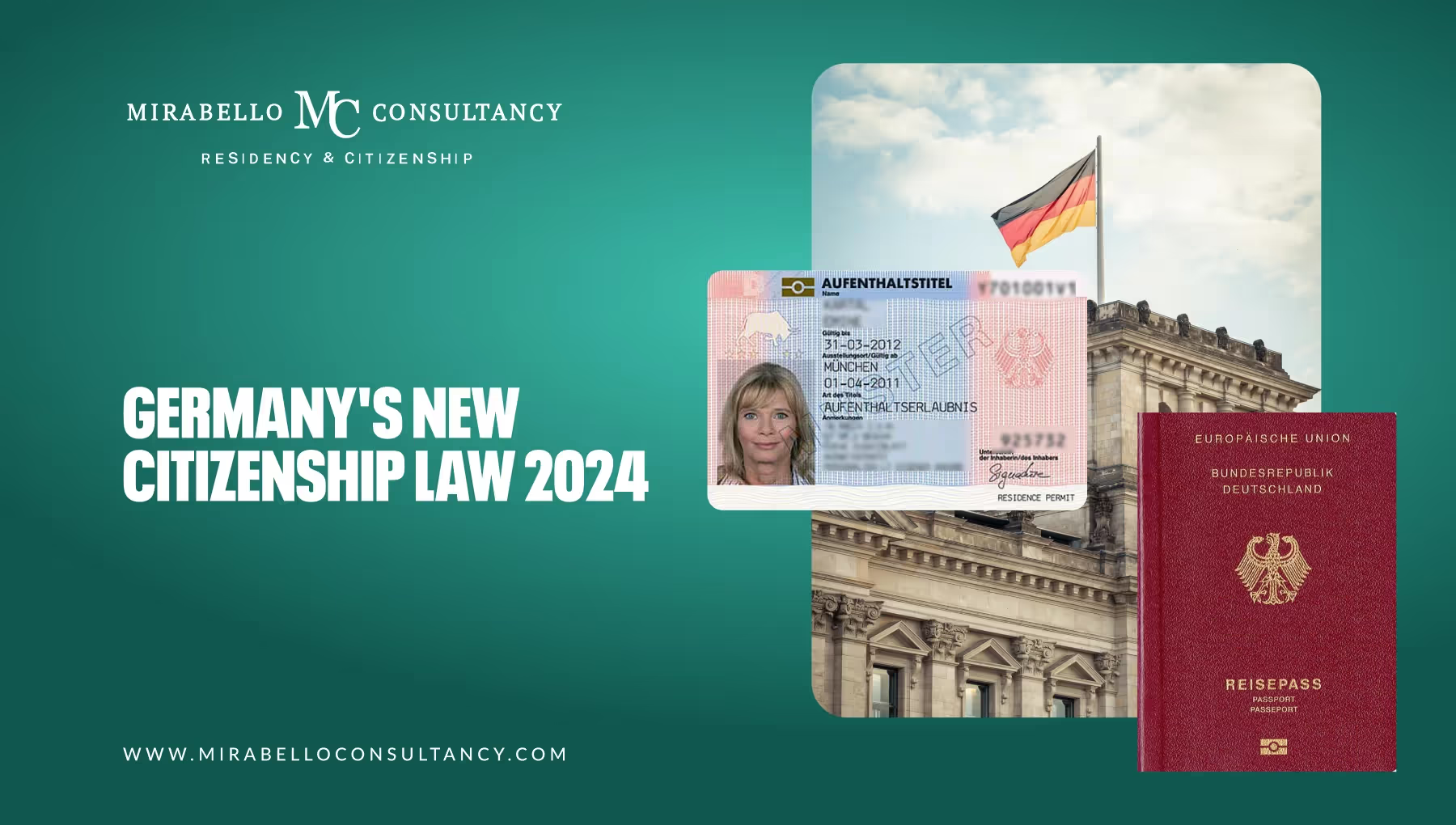
Germany's reformed citizenship law, in force since 27 June 2024, allows dual (multiple) citizenship for the first time in decades and shortens the standard residency requirement for naturalisation from eight years to five, with three years possible in exceptional cases of outstanding integration . Applicants must generally meet language, self-sufficiency and integration criteria. The reform makes naturalisation faster and removes the previous requirement to renounce a prior nationality .
- Expert guidance from Mirabello Consultancy, 99% approval rate, 250+ cases
- What Is the General changes
- What Are the Main Requirements
- What Is Dual citizenship
Last updated: March 2026
Key Takeaways
- Germany's new citizenship law, effective 27 June 2024, now permits dual and multiple nationality for the first time in decades.
- The standard residency requirement has been reduced from eight years to five years; exceptional contributors can qualify in as little as three years.
- A German passport currently grants visa-free or visa-on-arrival access to 190+ countries, making it one of the world's most powerful travel documents.
- Children born in Germany to foreign parents now have an easier path to citizenship, even if the parents hold temporary residence.
- Applicants must demonstrate financial self-sufficiency, language proficiency (B1 level), and a clean criminal record.
- Mirabello Consultancy's 99% approval rate means your application is supported by specialists who know exactly what German authorities expect.
Germany's new citizenship law represents one of the most significant reforms to German nationality legislation in a generation. For UHNW and HNW individuals, business owners, and globally mobile families, this change opens a compelling new pathway to one of Europe's most respected passports, without the requirement to abandon your current nationality. Whether you are already residing in Germany, planning to relocate, or simply exploring your long-term options, understanding Germany's new citizenship law in full detail is the essential first step. This guide covers every stage, from eligibility and documentation to timelines and the outstanding lifestyle benefits a German passport confers.
What Is Germany's New Citizenship Law? An Overview
The Staatsangehörigkeitsgesetz (StAG) reform, which came into force on 27 June 2024, fundamentally modernises how Germany grants nationality. For most of the post-war era, Germany required applicants to relinquish their existing citizenship as a condition of naturalisation, a significant deterrent for international business people, investors, and diaspora communities who had built lives and assets across multiple jurisdictions.
The 2024 law reverses this position. Germany now formally recognises dual and multiple nationalities for naturalised citizens, aligning the country with the majority of its European neighbours. The reform also shortens the standard naturalisation period from eight years of lawful ordinary residence to five years, and introduces an accelerated three-year route for individuals who demonstrate "special contributions" to German society, in areas such as voluntary service, professional distinction, or cultural achievement.
Crucially, this is not a citizenship by investment (CBI) programme in the traditional sense, Germany does not offer a direct passport-in-exchange-for-investment route. Instead, the pathway is residency-based and meritocratic. However, for investors who are already operating businesses in Germany or who are in a position to relocate and establish genuine ties, the reformed law creates a faster, more attractive route than ever before. You can also explore how this compares to dedicated investment migration routes via our overview of the best citizenship by investment programmes globally.
Key Changes Under Germany's New Citizenship Law 2024
Understanding precisely what has changed, and what has not, is critical for planning your application effectively. Below are the most consequential reforms:
- Dual nationality permitted: Applicants no longer need to renounce their existing citizenship. This is the headline change and the one with the broadest impact for international families.
- Reduced residency period: The standard requirement drops from eight years to five years of lawful ordinary residence in Germany.
- Accelerated three-year route: Available to those who demonstrate outstanding voluntary engagement, special professional achievements, or other "special integration performances."
- Children born in Germany: Children born on German soil to at least one parent who has been lawfully and ordinarily resident in Germany for five years (down from eight) now acquire German citizenship at birth.
- "Mitbürger" (fellow citizen) provisions: Longstanding foreign residents, those who arrived as guest workers ("Gastarbeiter") and their descendants, benefit from simplified rules recognising decades of contribution to German society.
- Language requirements remain: A minimum B1 level of German proficiency (Common European Framework of Reference) is still required for most applicants.
- No welfare dependency: Applicants must demonstrate they can support themselves and dependants without drawing on public funds (with limited exceptions for circumstances beyond personal control).
Eligibility Requirements: Who Qualifies Under the New Law?
Before embarking on an application, it is essential to confirm that you meet all statutory eligibility criteria. German immigration authorities are thorough, and incomplete or inaccurate submissions are the primary cause of delays. The core requirements are:
Residency
You must hold a valid residence permit and have been lawfully and ordinarily resident in Germany for at least five years prior to the date of application. Certain absences are permissible, but extended periods outside Germany can interrupt the residency count. Temporary or study visas typically do not qualify unless converted to an ordinary residence permit.
Financial Self-Sufficiency
You, and any dependants, must be able to support yourselves without recourse to social assistance benefits. For investors and business owners, demonstrating this through company accounts, tax returns, or investment income statements is usually straightforward, provided documentation is prepared correctly.
Language Proficiency
A minimum B1 German language certificate (from a recognised provider such as Goethe-Institut or telc) is required. For individuals who have been educated in German or can demonstrate equivalent proficiency through employment, alternative evidence may be accepted.
Clean Criminal Record
Serious criminal convictions will disqualify an applicant. Minor traffic offences or sentences below a specified threshold are generally disregarded, but any conviction in Germany or abroad must be declared and assessed.
Renunciation of Anti-Constitutional Activities
Applicants must affirm that they do not support, and have not supported, organisations hostile to the German constitutional order. This includes extremist political movements of any persuasion.
Civic Knowledge
A naturalisation test covering German history, society, culture, and the rule of law is required. The test consists of 33 questions drawn from a published catalogue of 310 questions. A pass mark of 17 correct answers is required. Most well-prepared applicants find this manageable with structured study over four to six weeks.
The Application Process: Step by Step
Germany's new citizenship law has not simplified the administrative process dramatically, the documentation requirements remain substantial. Here is the complete sequence:
- Preliminary eligibility assessment: Before gathering a single document, conduct a thorough review of your personal circumstances, residency history, income, criminal record, and language level. Mirabello Consultancy offers a complimentary initial assessment as part of our free consultation service.
- Language certification: If you do not already hold a recognised B1 certificate, enrol in a course and schedule your examination. Lead times for Goethe-Institut examinations can be four to eight weeks.
- Document compilation: Core documents include a valid passport, birth certificate (officially translated and apostilled), marriage certificate (if applicable), proof of residence, proof of income (tax assessments, payslips, business accounts), existing criminal record certificates from Germany and any country of prior residence, and your language certificate.
- Naturalisation test: Register for the Einbürgerungstest at a recognised testing centre. Results are issued on the day and are valid for an extended period.
- Formal application submission: Applications are submitted to the relevant Staatsangehörigkeitsbehörde (citizenship authority) in your municipality. In larger cities such as Berlin, Munich, Hamburg, or Frankfurt, this is typically the local citizens' office (Bürgeramt) or a dedicated naturalisation office.
- Biometric data and interview: You will be called to provide biometric data and, in some cases, attend a short interview confirming the details of your application.
- Decision and ceremony: Successful applicants receive a Einbürgerungsurkunde (naturalisation certificate) at a formal ceremony, which is now a legal requirement under the 2024 reforms, a reflection of the significance Germany places on citizenship.
Processing Times and Realistic Timelines
One of the most frequent questions Mirabello Consultancy receives concerns how long the process takes. Honest expectations are important here. Processing times vary significantly by municipality:
- Berlin: Currently 18-24 months from submission due to high application volumes.
- Munich / Bayern: Typically 12-18 months.
- Frankfurt / Hessen: Approximately 12-15 months.
- Smaller municipalities: As few as 6-9 months in some cases.
The total end-to-end timeline, from beginning document preparation to receiving your naturalisation certificate, is realistically 12 to 30 months, depending on your municipality and the completeness of your initial submission. Incomplete applications are returned and restart the queue, which is why professional preparation is so valuable. Government fees for the application are set at €255 per adult applicant and €51 per child included in the same application.
For non-EU family members who fall outside this naturalisation route, our guides to the best golden visa investment programmes may provide a complementary residence option worth considering.
Benefits of German Citizenship: Why It Matters
Germany's passport consistently ranks among the world's most powerful, and for good reason. Here is what a German passport delivers:
- Visa-free or visa-on-arrival access to 190+ countries, including the United States, Canada, Australia, Japan, Singapore, and all Schengen zone territories.
- Full EU citizenship rights: the freedom to live, work, study, and do business anywhere across all 27 European Union member states, a profound advantage for internationally mobile families and entrepreneurs.
- Access to Germany's world-class healthcare system, one of the most comprehensive in Europe.
- World-ranked educational institutions: German universities regularly appear in global top-100 rankings, and many programmes are offered free of tuition fees for EU citizens.
- Political stability and rule of law: Germany's constitutional framework, independent judiciary, and democratic institutions provide one of the most stable environments for long-term wealth planning and family security.
- Inheritance and estate planning benefits: EU residency and citizenship status can be highly advantageous for structuring cross-border estates.
- Dual nationality protection: Now that Germany permits dual nationality, you retain your existing passport's advantages while adding all of the above.
Family Inclusion: Bringing Your Family With You
One of the most valued aspects of the German naturalisation pathway, particularly for families, is how spouses and children are treated under the law.
Spouses and registered civil partners of German citizens can apply for naturalisation after just three years of lawful ordinary residence, provided they have been married to or in a civil partnership with the German citizen for at least two years. This represents a further acceleration of the standard five-year route.
Minor children can be included in a parent's naturalisation application at a significantly reduced fee of €51 per child. Children who are naturalised alongside a parent do not need to independently satisfy the residency or language requirements, a critical advantage for younger family members.
Children born in Germany to at least one foreign parent who has been lawfully and ordinarily resident for five or more years automatically acquire German citizenship at birth, down from the previous eight-year threshold. This change has significant implications for families planning long-term residence in Germany.
If you have non-EU family members who will not qualify for citizenship under this naturalisation route, our consultants can walk you through options such as the Portugal Golden Visa or the Greece Golden Visa, both of which offer robust family inclusion provisions for non-EU nationals.
How Mirabello Consultancy Supports Your German Citizenship Application
Navigating German bureaucracy is notoriously demanding, even for those who speak German fluently. For international applicants, the complexity multiplies: foreign documents must be translated and apostilled to exacting standards, residency calculations must be verified carefully, and the correct municipal authority must receive the correct version of every form. A single error can set an application back by many months.
Mirabello Consultancy's specialist immigration team has supported clients from over 40 nationalities through European residency and citizenship processes. Our 99% approval rate reflects a meticulous preparation methodology: we leave nothing to chance. From your initial eligibility assessment through to the naturalisation ceremony, we manage the process on your behalf, liaising with German authorities, coordinating translations, and ensuring your application file is complete and compelling.
We also take a holistic view of your mobility strategy. Germany may be your primary goal, or it may be one element of a broader portfolio approach that includes a second residence in the UAE, a Caribbean CBI passport for visa-free flexibility, or a European golden visa for a non-EU family member. Book your free consultation and we will map the optimal route for your specific circumstances.
Frequently Asked Questions About Germany's New Citizenship Law
Can I keep my current nationality when naturalising as a German citizen?
Yes. Since 27 June 2024, Germany officially permits dual and multiple nationalities for all naturalised citizens. You are no longer required to renounce your existing citizenship as a condition of German naturalisation. This applies regardless of your country of origin.
How long do I need to live in Germany before applying for citizenship?
The standard requirement under Germany's new citizenship law is five years of lawful ordinary residence. An accelerated three-year route is available for applicants who demonstrate "special integration performances," such as exceptional voluntary engagement or professional distinction. Spouses and registered civil partners of German citizens may also qualify after three years of residence.
How much does the German citizenship application cost?
The government application fee is €255 per adult applicant and €51 per child included in the same application. Additional costs include official document translations, apostilles, language course fees (if required), and the naturalisation test registration fee of approximately €25. Professional consultancy fees are separate and depend on the complexity of your case.
How long does it take to receive German citizenship after applying?
Processing times vary significantly by municipality. In high-demand cities such as Berlin, applicants currently wait 18 to 24 months from the date of formal submission. In Munich and Frankfurt, timelines are typically 12 to 18 months. Smaller municipalities may process applications in as little as 6 to 9 months. Total end-to-end timelines, including preparation, are realistically 12 to 30 months.
Does Germany offer a citizenship by investment programme?
Germany does not offer a direct citizenship by investment (CBI) route, there is no programme through which a passport can be obtained purely through a financial contribution. German citizenship is granted through residency-based naturalisation. However, investors who establish genuine business operations and residence in Germany can leverage the reformed naturalisation law to obtain citizenship faster than was previously possible. For dedicated CBI options, explore our guide to the best citizenship by investment programmes.
What German language level is required for naturalisation?
Applicants must demonstrate German language proficiency at a minimum of B1 level on the Common European Framework of Reference (CEFR). Accepted certificates include those from the Goethe-Institut, telc, ÖSD, or equivalent recognised providers. Applicants who were educated in German or can demonstrate equivalent proficiency through professional experience may be able to provide alternative evidence.
Can my children obtain German citizenship with me?
Yes. Minor children can be included in a parent's naturalisation application for a fee of €51 per child. They do not need to independently satisfy the residency or language requirements. Additionally, children born in Germany to at least one foreign parent who has been lawfully resident for five or more years automatically acquire German citizenship at birth under the 2024 reforms.
Ready to Start Your Journey?
Book your free consultation with Mirabello Consultancy and discover exactly how Germany's new citizenship law applies to your personal circumstances. Our specialist team has guided clients from over 40 nationalities through complex European immigration processes, with a 99% approval rate that speaks for itself. Whether your goal is a German passport, a residence option for non-EU family members, or a comprehensive global mobility strategy, we are here to make it happen.
Book Free ConsultationIn summary
Investment migration continues to attract discerning investors seeking global mobility, tax efficiency, and security for their families. With the right guidance, the process is straightforward and rewarding.
Ready to take the next step? Book your free consultation with Mirabello Consultancy. Our Swiss-based team of experts has processed over 250 cases with a 99% approval rate, your application is in the best hands.
Ready to explore your options?
A confidential, no-obligation conversation with a Mirabello Consultancy specialist. Swiss precision, global reach, absolute discretion.
Book a free consultationResearching this yourself? Mirabello's verified data also answers inside your AI assistant. Ask it in ChatGPT or add it to Claude.