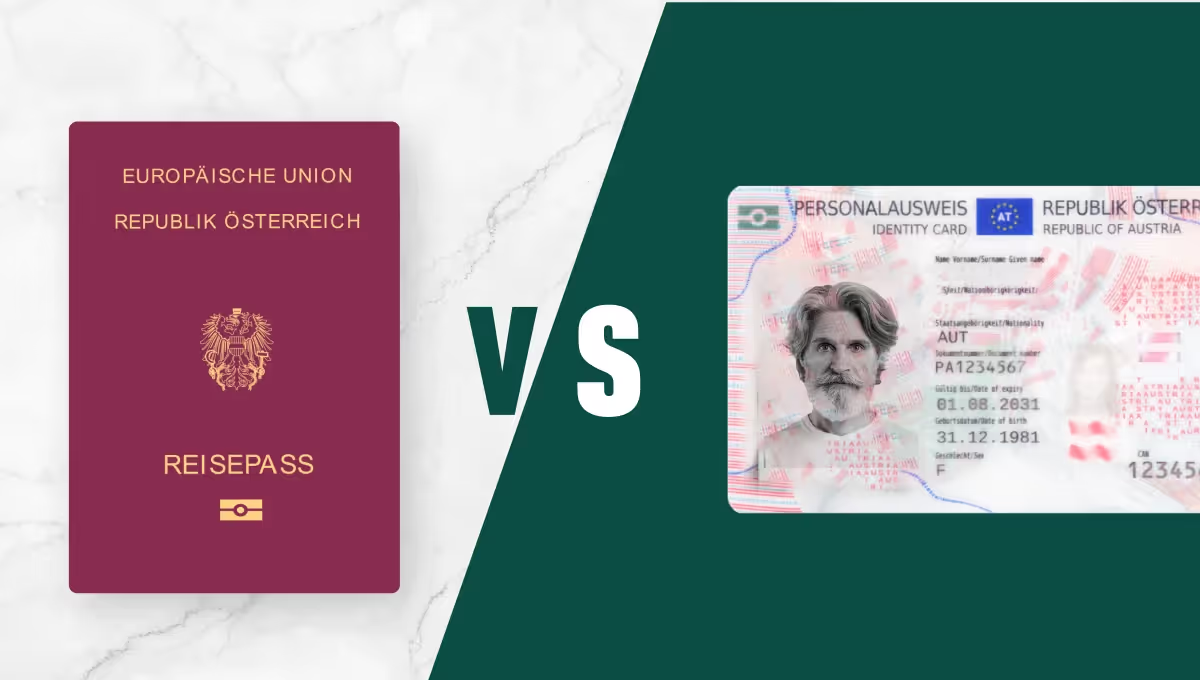
Residency grants the legal right to live in a country, typically renewable and revocable, without a passport or nationality. Citizenship confers full nationality, a passport and permanent rights that pass to descendants. Golden Visas grant residency, not citizenship; only citizenship-by-investment programmes deliver a second passport directly.
- This comparison covers investment requirements, processing times, visa-free access, tax benefits, and family inclusion
- Both programmes offer zero income tax, capital gains tax, and inheritance tax
- Mirabello Consultancy provides expert guidance to choose the right programme for your family
Residency versus Citizenship: Understanding Your Investment Migration Options in 2026
Last updated: March 2026
Key Takeaways
- Residency by investment (golden visa) programmes typically require lower minimum investments, from €250,000, while citizenship by investment programmes generally start from $100,000.
- Citizenship programmes grant a passport and full visa-free travel benefits immediately; golden visas require several years of residency before naturalisation is possible.
- Processing times differ significantly: citizenship by investment can take as little as 3-6 months, whereas residency programmes may take 2-12 months depending on the jurisdiction.
- Both pathways can include a spouse, dependent children, and in many cases dependent parents or siblings.
- Tax advantages, estate planning, and global mobility are key drivers for UHNW families choosing investment migration in 2026.
- Professional guidance from a licensed consultancy is essential to navigate due diligence, compliance, and programme-specific requirements.
Choosing the right citizenship or residency by investment programme is one of the most important decisions for your family's future. This detailed comparison breaks down the key differences, including investment requirements, processing times, visa-free travel, and tax benefits, so you can make an informed choice.
Residency vs Citizenship by Investment: An Overview
The global investment migration landscape has evolved considerably over the past decade, and in 2026 it offers more options, and more complexity, than ever before. At its core, the decision comes down to two distinct pathways: residency by investment (commonly known as a golden visa) and citizenship by investment (CBI). Understanding the fundamental difference between these two routes is the essential first step in planning your family's future.
Residency by investment grants you the right to live, work, and study in a particular country. You become a legal resident, not a citizen, and you receive a residence permit that must typically be renewed periodically. After fulfilling a minimum physical presence requirement over several years, you may eventually qualify to apply for permanent residency or naturalisation as a citizen. Popular golden visa destinations in 2026 include Portugal, Greece, the UAE, and Malta.
Citizenship by investment, by contrast, grants you full citizenship and a second passport in exchange for a qualifying investment, without any prior residency requirement in most cases. You gain the same rights as a natural-born citizen, including the right to pass that citizenship on to future generations. Leading CBI jurisdictions include St Kitts & Nevis, Antigua & Barbuda, Grenada, Malta, and Vanuatu.
Both pathways serve distinct strategic objectives, and the right choice depends entirely on your personal circumstances, long-term goals, and the jurisdictions that align best with your lifestyle and financial profile. Explore our comprehensive guide to the best citizenship by investment programmes for a deeper dive into specific options.
Investment Requirements: How Much Does Each Pathway Cost?
One of the most immediate considerations when comparing residency vs citizenship by investment is the financial commitment required. The good news is that both pathways can offer significant long-term value relative to their entry costs.
Citizenship by Investment: Investment Thresholds
- St Kitts & Nevis: From $250,000 via the Sustainable Island State Contribution (SISC) for a single applicant, or from $300,000 for a family of four.
- Antigua & Barbuda: From $230,000 via the National Development Fund for a family of up to four persons.
- Grenada: From $235,000 via the National Transformation Fund, or from $270,000 via approved real estate.
- Malta: the MEIN investor-citizenship route is closed (repealed July 2025 following CJEU Case C-181/23). Malta’s remaining citizenship route is discretionary citizenship by merit (Article 10(9), Legal Notice 159 of 2025), which has no set investment figure. The MPRP remains available for residency.
- Vanuatu: From $130,000 via the Development Support Programme, one of the world's most cost-effective CBI options.
Residency by Investment: Investment Thresholds
- Portugal Golden Visa: From €500,000 via approved investment funds or cultural donations from €250,000 (real estate routes are no longer available as of 2024).
- Greece Golden Visa: From €250,000 in real estate in designated regions, rising to €800,000 in prime Athens districts and major islands.
- UAE Golden Visa: From AED 2 million (approximately $545,000) in real estate, or via employment/business criteria.
- Malta Permanent Residence Programme: From €99,000 in government fees plus a qualifying property, purchase from €375,000 or lease from €14,000 a year.
While the headline figures suggest golden visas can be more accessible from an entry-level perspective, it is important to factor in renewal fees, physical presence costs, and the longer timeline to a passport when calculating total lifetime value. Discover the full spectrum of options in our best golden visa programmes guide.
Eligibility Criteria: Who Qualifies?
Both citizenship by investment and residency by investment programmes maintain rigorous eligibility standards, reflecting a global commitment to due diligence and compliance. Whilst specific requirements vary by jurisdiction, the following criteria are broadly applicable across most programmes.
Common Eligibility Requirements
- Clean criminal record: Applicants must provide police clearance certificates from all countries of residence over the past ten years.
- Proof of legitimate source of funds: All investment migration programmes require comprehensive documentation confirming that funds are legally derived. This is non-negotiable.
- Minimum age: Lead applicants are typically required to be 18 years of age or older.
- Health requirements: Many programmes require proof of good health, including a medical examination, and some mandate health insurance coverage.
- No sanctions or adverse media: Applicants must not appear on international sanctions lists or have a history of reputational concerns.
Key Differences in Eligibility
Citizenship by investment programmes, particularly in the Caribbean, do not require any prior residency, physical presence, or language proficiency. Malta is an exception, it requires 12 or 36 months of residency prior to citizenship approval, depending on the investment tier chosen.
Golden visa programmes, by contrast, are primarily residency-based. Most do not require language proficiency at the initial residency stage, but naturalisation, should you choose to pursue it, will typically require language testing, cultural integration, and a minimum physical presence of 183 days per year or more.
Application Process and Due Diligence
The application process for both residency vs citizenship by investment routes involves multiple stages, each requiring precise documentation and professional oversight. Working with an authorised consultancy such as Mirabello ensures your application is structured correctly from the outset, reducing the risk of delays or rejections.
Citizenship by Investment: Application Steps
- Initial consultation and eligibility assessment, Mirabello evaluates your profile, recommends the most suitable programme, and outlines the required documentation.
- Document preparation, Comprehensive document collection, including certified translations, apostilles, financial statements, and background checks.
- Government due diligence, Authorities conduct multi-tier background checks, often engaging third-party international agencies.
- Approval in principle, The government issues conditional approval, at which point the qualifying investment is made.
- Investment completion and final approval, Upon confirmation of the investment, passports and citizenship certificates are issued.
Residency by Investment: Application Steps
- Programme selection and eligibility review, Your consultant assesses which golden visa route aligns with your goals.
- Investment completion, Unlike CBI, many golden visa programmes require the investment to be made before or alongside the application.
- Residency permit application, Documents are submitted to the relevant immigration authority.
- Biometrics and in-country appointment, Most European golden visa programmes require at least one visit to collect biometric data.
- Permit issuance, A residence card is issued, typically valid for one to five years and renewable.
Our team at Mirabello manages every stage of this process on your behalf. Book a free consultation today to receive a personalised assessment.
Processing Times: How Quickly Can You Obtain Status?
For many of our clients, processing time is a critical factor, particularly for those facing geopolitical instability, business pressures, or imminent family considerations. Here is a realistic overview of current processing timelines across leading programmes in 2026:
| Programme | Type | Typical Processing Time |
|---|---|---|
| St Kitts & Nevis | Citizenship | 3-6 months (Accelerated: 45-60 days) |
| Antigua & Barbuda | Citizenship | 3-6 months |
| Grenada | Citizenship | 4-6 months |
| Vanuatu | Citizenship | 30-60 days |
| Malta (citizenship by investment, CLOSED 2025) | Citizenship | 12-36 months |
| Portugal Golden Visa | Residency | 6-12 months |
| Greece Golden Visa | Residency | 2-4 months |
| UAE Golden Visa | Residency | 2-8 weeks |
If speed is paramount, Vanuatu's citizenship programme, which processes applications in as little as 30 days, or the UAE golden visa, issued within weeks, represent the most efficient options. Learn more about the Vanuatu citizenship by investment programme or the UAE golden visa on our dedicated programme pages.
Visa-Free Travel and Global Mobility Benefits
Global mobility is one of the most compelling reasons UHNW families pursue investment migration. A second passport or a strong residency permit can dramatically expand your travel freedom and business reach.
Citizenship by Investment: Passport Strength
- St Kitts & Nevis passport: Visa-free or visa-on-arrival access to approximately 157 countries, including the UK, EU Schengen Area, and Singapore.
- Antigua & Barbuda passport: Access to approximately 150 countries, including the UK and Schengen Zone.
- Grenada passport: Access to approximately 144 countries, with the unique benefit of eligibility for the US E-2 Investor Visa.
- Malta passport (EU): Access to 186+ countries as a full EU citizen, including the United States, Canada, and Australia.
- Vanuatu passport: Visa-free access to approximately 100 countries.
Residency by Investment: Travel Benefits
Golden visa holders do not receive a new passport, they receive a residence permit. However, a Portuguese or Greek golden visa grants you an EU residence permit, which enables visa-free travel within the Schengen Area. After fulfilling residency and presence requirements, you may apply for permanent residency (typically around 5 years) and, in due course, naturalisation, Portugal now requires 7 years of legal residence for EU/CPLP nationals or 10 years for others (Lei Orgânica 1/2026), and Greece requires 7 years, at which point you would receive an EU passport.
The UAE golden visa grants a 10-year renewable residence permit, offering access to world-class infrastructure and strategic positioning between Europe, Asia, and Africa, without conferring UAE citizenship or a UAE passport.
Tax Benefits and Financial Planning Considerations
Tax optimisation is a significant, and entirely legitimate, motivation for investment migration. Both residency and citizenship by investment can offer meaningful financial planning advantages, though the specifics depend heavily on your existing tax residency, domicile, and the laws of the receiving jurisdiction.
- Portugal (Non-Habitual Resident regime): Whilst the NHR regime has been reformed, Portugal's golden visa holders who establish tax residency may benefit from flat-rate taxation on certain foreign-source income for a defined period. Professional tax advice is essential.
- UAE: The UAE levies no personal income tax, capital gains tax, or inheritance tax. This makes it an exceptionally attractive base for entrepreneurs and investors. The UAE golden visa enables full tax residency establishment.
- Caribbean CBI jurisdictions: Countries such as St Kitts & Nevis, Antigua, and Grenada do not impose income tax on foreign-sourced income, making them attractive for individuals seeking a second citizenship without disruptive lifestyle changes.
- Malta: Malta's participation exemption regime and favourable holding company structures make it attractive for corporate structuring alongside residency.
We always recommend engaging a specialist international tax adviser alongside your investment migration consultant. Mirabello works alongside trusted tax and legal partners to ensure your migration strategy is holistically structured.
Family Inclusion: Who Can You Bring Along?
For most of our clients, protecting and empowering their entire family is the primary objective. Both citizenship and golden visa programmes accommodate family members, though the definitions and conditions vary.
Most CBI programmes allow the main applicant to include:
- A spouse or legally recognised partner
- Dependent children (typically up to age 26-30 if in full-time education)
- Dependent parents and grandparents (subject to age and financial dependency criteria)
- Dependent siblings in some jurisdictions (e.g., Antigua & Barbuda)
Golden visa programmes similarly accommodate spouses and dependent children, with some, such as the Portugal golden visa, also permitting dependent parents. The Greece golden visa extends to a spouse, children up to age 21 (extendable to 24 for students), and dependent parents of both spouses.
Family members included in the application receive the same status as the main applicant, residency permit or citizenship, simultaneously. This is a particularly valued feature for families seeking unified protection and mobility.
To discuss your specific family situation, contact our team for a confidential consultation.
Frequently Asked Questions: Residency vs Citizenship by Investment
What is the main difference between residency by investment and citizenship by investment?
Residency by investment (golden visa) grants you the legal right to live in a country as a resident, with the possibility of eventually applying for citizenship after meeting physical presence and other requirements. Citizenship by investment grants you full citizenship and a passport immediately upon approval, with no prior residency required in most cases. The key distinction is that citizenship confers a passport and lifelong status, whereas residency requires ongoing renewal and future naturalisation if a passport is desired.
How much does citizenship by investment cost in 2026?
Citizenship by investment costs vary significantly by programme. Entry-level options include Vanuatu from $130,000, Antigua & Barbuda from $230,000, Grenada from $235,000, and St Kitts & Nevis from $250,000 for a single applicant. Malta no longer offers a citizenship-by-investment option at any price, the MEIN route was repealed in July 2025 after CJEU Case C-181/23. Additional government fees, due diligence charges, and professional fees apply across all programmes.
How long does it take to get a second passport through citizenship by investment?
Processing times range from as little as 30-60 days (Vanuatu) to 3-6 months for most Caribbean programmes such as St Kitts & Nevis, Antigua, and Grenada. Malta no longer offers citizenship by investment. Its remaining citizenship-by-merit route is discretionary and has no published processing timeline, because each case is assessed individually on its merits. An accelerated processing option is available in St Kitts & Nevis, typically completing in 45-60 days for an additional fee.
Can I obtain EU citizenship through investment?
Not directly, not any more. Malta's investor-citizenship route (MEIN) closed after the Court of Justice of the European Union ruled on 29 April 2025 (Case C-181/23) that it breached EU law; it was repealed in July 2025. No EU member state now operates a citizenship-by-investment programme. Malta retains a discretionary citizenship by merit route under Article 10(9) of the Maltese Citizenship Act (Legal Notice 159 of 2025), granted for exceptional service or contribution to Malta. It is assessed case by case by an Evaluation Board that recommends to the Minister, carries no fixed investment threshold, and cannot be purchased. Malta also retains the Permanent Residence Programme (MPRP) for residency, and ordinary naturalisation after a qualifying period of lawful residence. Portugal's golden visa can lead to EU citizenship after seven years of residency for EU and CPLP nationals, or ten years for other nationalities (under Lei Orgânica 1/2026, in force since May 2026), and meeting naturalisation requirements, including language proficiency. Greece's golden visa follows a similar path, with naturalisation possible after seven years of legal residency. Both Portugal and Greece require physical presence and integration steps before naturalisation.
Do I need to live in the country to maintain my golden visa or citizenship?
Requirements vary by programme. Most Caribbean CBI programmes impose no physical presence requirement, your citizenship is maintained regardless of where you live. The UAE golden visa requires periodic visits (typically every 6 months) to maintain validity. Portugal's golden visa requires only 7 days of physical presence in the first year and 14 days in subsequent two-year periods, making it extremely flexible. Greece's golden visa imposes no minimum stay requirement for the residency permit itself, though naturalisation will require longer presence.
Is citizenship by investment legal and legitimate?
Yes. Citizenship by investment and golden visa programmes are fully legal sovereign offerings established and regulated by national governments. They are recognised under international law and long-standing diplomatic precedent. Programmes in St Kitts & Nevis, Malta, Portugal, and other jurisdictions operate within transparent regulatory frameworks with rigorous multi-tier due diligence processes. Working with a licensed, authorised consultancy such as Mirabello Consultancy ensures your application is handled with full compliance and integrity.
Which programme is best for global mobility in 2026?
For the broadest global mobility, Malta's citizenship by investment programme offers the strongest outcome, an EU passport granting visa-free or visa-on-arrival access to 186+ countries, including the United States, Canada, and Australia. Among Caribbean passports, St Kitts & Nevis offers the widest travel access at approximately 157 countries. Grenada's passport is unique in enabling access to the US E-2 Investor Visa treaty. For residency-based mobility within the Schengen Area, Portugal and Greece golden visas offer strong EU travel access without immediate full citizenship.
Ready to Start Your Journey?
Book your free consultation with Mirabello Consultancy and speak directly with one of our investment migration specialists. Whether you are exploring a Caribbean passport, a European golden visa, or a UAE residency, we will provide a personalised, confidential assessment tailored to your family's goals, with the Swiss precision and personal care that defines everything we do.
Book Free ConsultationIn summary
Both programmes offer compelling advantages for investors and their families. The right choice depends on your priorities, whether that's visa-free travel, tax optimisation, processing speed, or family inclusion.
Need help deciding? Book your free consultation with Mirabello Consultancy. Our experts will analyse your specific situation and recommend the ideal programme for your goals.
Ready to explore your options?
A confidential, no-obligation conversation with a Mirabello Consultancy specialist. Swiss precision, global reach, absolute discretion.
Book a free consultationResearching this yourself? Mirabello's verified data also answers inside your AI assistant. Ask it in ChatGPT or add it to Claude.