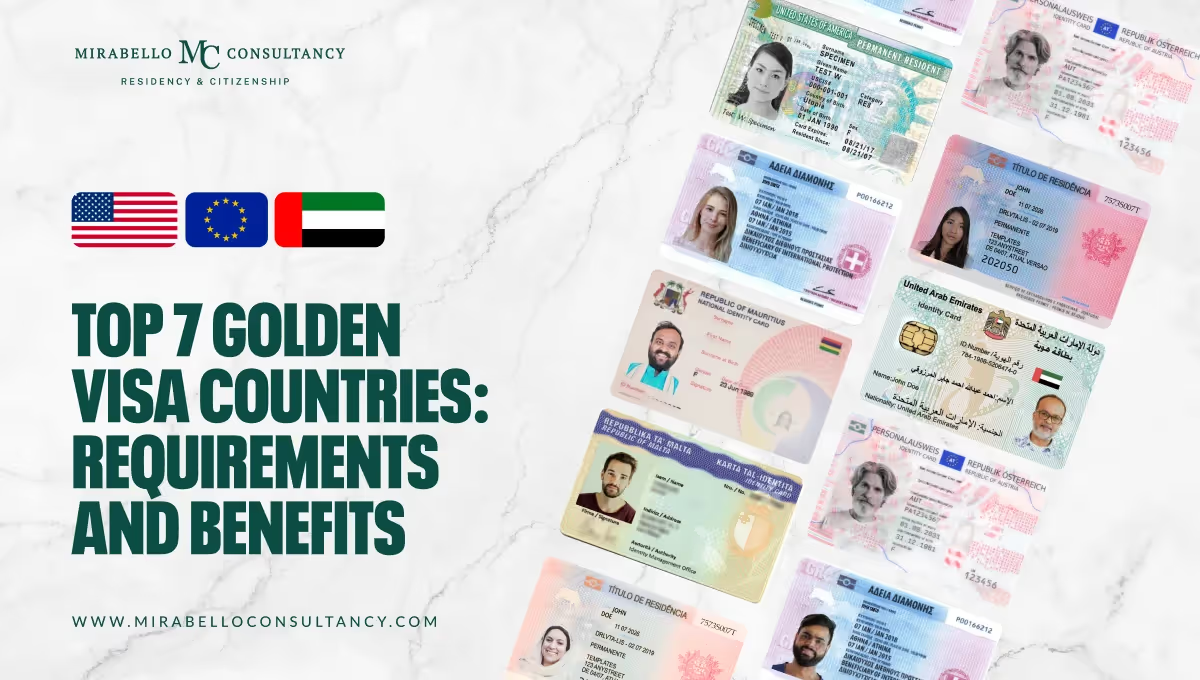
Golden visa countries grant renewable residency (not citizenship) in exchange for qualifying investment. Greece leads on price with residency from EUR 250,000, Portugal on its route toward eventual citizenship, the UAE on tax efficiency, and the US EB-5 on green-card access. No country wins outright; the best fit depends on your budget and goals.
- Golden Visa Programs are immigration schemes offered by various countries to attract wealthy investors by granting residency rights in exchange for significant financial investments.
- Several countries offer Golden Visa programs, each with distinct requirements and benefits, making them attractive to a diverse range of investors.
- Golden Visa programs provide multiple advantages like visa-free travel, access to better healthcare and education systems, tax benefits, and opportunities for real estate investment.
- Investors also face challenges including legal complexities, market fluctuations, strict background checks, and possible changes in regulations.
- Mirabello Consultancy will guide you through the entire application process, ensuring that you select the Golden Visa program that best aligns with your specific needs and preferences.
Golden Visa Countries: A Comprehensive Guide for 2026
Last updated: March 2026
Key Takeaways
- More than 20 countries worldwide currently offer golden visa or residency by investment programmes, giving investors a wide range of options.
- Minimum investment thresholds range from approximately €250,000 in some European countries to over $1,000,000 in certain premium destinations.
- Processing times vary widely, from as little as 1-2 months in the UAE to 12-24 months in some European jurisdictions.
- Most golden visa programmes extend residency rights to a spouse, dependent children, and in some cases parents and in-laws.
- A golden visa is not the same as citizenship, but many programmes offer a pathway to naturalisation after a defined period of residency.
- Due diligence, documentation, and professional guidance are critical to a successful application in every golden visa country.
📋 At a Glance: Want a second home in a new country? Golden visa countries make it easily happen for investors. More than just granting residency, these programs, already available in more than 20 countries, open up a world of possibilities. This comprehensive guide explores various countries with golden visas, as well as the benefits and challenges that come with these programs.
Want a second home in a new country? Golden visa countries make it easily happen for investors. More than just granting residency, these programs, already available in more than 20 countries, open up a world of possibilities. This comprehensive guide explores various countries with golden visas, as well as the benefits and challenges that come with these programs.
Whether you are a business owner looking to expand your international footprint, a family seeking greater security, or an investor aiming to diversify your portfolio, a golden visa could be the most consequential financial and lifestyle decision you make this decade. At Mirabello Consultancy, we have guided hundreds of clients through this journey, and in this guide, we share everything you need to know for 2026.
What Is a Golden Visa? Understanding Residency by Investment
A golden visa, formally known as a residency by investment (RBI) programme, is an arrangement through which a foreign national obtains the legal right to live, work, and sometimes study in a country in exchange for a qualifying economic contribution. That contribution typically takes the form of real estate purchases, capital deposits, government bonds, or direct investment in local businesses.
Unlike a standard work or family visa, a golden visa does not require the holder to have a job offer, a local sponsor, or family ties in the host country. The investment itself is the qualifying criterion. Once granted, residency status is usually renewable as long as the investment is maintained, and most programmes include provisions for family members to be included on the same application.
It is important to distinguish a golden visa from citizenship by investment. A golden visa grants residency, the right to live in the country. Citizenship, with its accompanying passport, typically comes later, after a minimum period of physical presence or after holding residency for a defined number of years. Some countries, such as Portugal, operate a pathway to citizenship after a period of legal residency, now seven years for EU and CPLP nationals, or ten years for other nationalities, under Portugal's 2026 naturalisation reform. Greece's programme is not directly linked to a defined citizenship timeline, and countries such as the UAE do not automatically offer a route to naturalisation via their golden visa.
For a broader look at programmes that grant immediate citizenship, visit our guide to the best citizenship by investment programs.
The Best Golden Visa Countries in 2026: An Overview
The golden visa landscape has evolved considerably in recent years. Portugal reconfigured its programme in 2023, removing direct residential real estate as a qualifying route in many areas. Greece, Spain, and the UAE have all adjusted their thresholds. New entrants such as Greece's enhanced tier and Italy's updated Investor Visa have attracted fresh attention. Below is a comparative overview of the leading golden visa countries for 2026.
Portugal Golden Visa
Portugal remains one of the most sought-after golden visa destinations worldwide, even after its programme reforms. The current qualifying routes include investment fund contributions from €500,000, investment in qualifying real estate in low-density areas from €500,000, capital transfers of €1,500,000, and job creation requirements of a minimum of ten jobs. Portugal's golden visa is particularly attractive because it requires only seven days of physical presence per year to maintain residency status, and leads to eligibility for Portuguese citizenship, and therefore an EU passport, after seven years for EU and CPLP nationals, or ten years for other nationalities (Lei Orgânica 1/2026, in force 19 May 2026). Learn more on our dedicated Portugal Golden Visa page.
Greece Golden Visa
Greece offers one of Europe's most competitively priced golden visa programmes, with real estate investment starting from €250,000 in lower-demand regions (rising to €800,000 in Athens, Thessaloniki, Mykonos, and Santorini following 2024 threshold increases). There is no minimum stay requirement, making this an ideal option for investors who do not wish to relocate full-time but still want European residency. Greek golden visa holders can apply for citizenship after seven years. Explore details on our Greece Golden Visa page.
UAE Golden Visa
The United Arab Emirates' golden visa programme grants long-term residency of 5 or 10 years, renewable upon meeting ongoing investment criteria. Real estate investment of at least AED 2,000,000 (approximately $545,000) qualifies for a five-year visa, while investors, entrepreneurs, and specialised talents may qualify for a 10-year visa. The UAE golden visa is especially popular for its zero income tax environment, world-class infrastructure, and strategic location between Europe and Asia. Discover more on our UAE Golden Visa page.
Spain Golden Visa
Spain's golden visa, introduced in 2013, grants residency to investors who purchase real estate worth at least €500,000 (unencumbered by mortgage). However, as of early 2025, the Spanish government has announced intentions to phase out the real estate route in certain major cities. Investors should seek current advice before proceeding. Alternative qualifying routes include capital investment of €1,000,000 in Spanish companies or bank deposits, or €2,000,000 in Spanish government bonds. Spain grants access to the Schengen Area and a pathway to citizenship after ten years of residency.
Italy Investor Visa
Italy's Investor Visa offers residency in exchange for investments starting from €250,000 in innovative start-ups, €500,000 in existing Italian companies, €1,000,000 in philanthropic projects, or €2,000,000 in Italian government bonds. Italy also offers a highly attractive flat-tax regime for new residents, a lump sum of €100,000 per year on foreign-sourced income, making it a compelling choice for globally mobile HNW individuals.
Malta Permanent Residence Programme
Malta's programme grants permanent residency, not temporary residency, from the outset. Costs include a €60,000 administration fee, a €37,000 government contribution and a €2,000 charity donation, plus a property rental of at least €14,000 per year or a purchase of at least €375,000. Malta is an EU member state, and permanent residents benefit from freedom of movement across the Schengen Area. Residency Malta publishes no fixed processing time: a decision follows the Agency's due diligence checks.
Other Notable Golden Visa Countries
Beyond the flagship programmes, several other jurisdictions deserve consideration in 2026:
- Hungary: Re-launched its guest investor programme in 2024, with real estate fund investment from €250,000 and property purchase from €500,000.
- New Zealand: The Active Investor Plus Visa requires investment from NZD 5,000,000 in qualifying New Zealand assets.
- Singapore: The Global Investor Programme requires investment of at least SGD 2,500,000 into business entities or qualifying funds.
- Turkey: Citizenship, not just residency, is available through real estate investment of at least $400,000, making it an attractive hybrid offering.
- Jordan, Egypt, and Saudi Arabia have introduced or expanded residency-by-investment schemes, reflecting a growing trend across the Middle East and North Africa.
For a curated comparison of the most competitive programmes currently available, see our guide to the best golden visa investment programs.
Investment Options and Minimum Thresholds at a Glance
One of the most important factors when evaluating golden visa countries is the nature and size of the qualifying investment. Broadly speaking, there are five categories of qualifying investment found across most programmes:
- Real estate purchase: Buying residential or commercial property above a minimum value threshold. Common in Greece (from €250,000), Portugal (from €500,000 in eligible areas), UAE (from AED 2,000,000), and Spain (from €500,000).
- Investment funds: Subscribing to a government-approved fund. Portugal requires a minimum of €500,000. This route is growing in popularity as it offers portfolio diversification without the responsibilities of direct property ownership.
- Capital transfer / bank deposit: Placing a defined sum in a local bank or government bond. Thresholds are generally higher, Portugal requires €1,500,000, and Spain requires €2,000,000 in government bonds.
- Business investment and job creation: Investing directly in a local business or creating a set number of local jobs. Portugal offers this route with a requirement of ten jobs.
- Philanthropy and donations: Some programmes, such as Malta, incorporate a non-refundable government contribution or charitable donation as part of the overall qualifying investment package.
When assessing total cost of a golden visa, investors should account not only for the qualifying investment but also for government fees (typically €5,000-€15,000), professional advisory fees, due diligence charges, and where applicable, property transfer taxes and legal fees. Portugal's total out-of-pocket fees, exclusive of the investment, are typically in the range of €15,000-€25,000 for a family application.
Eligibility Requirements: Who Qualifies for a Golden Visa?
While specific criteria vary by country, most golden visa programmes share a common set of baseline eligibility requirements:
- Age: Applicants must typically be 18 years of age or older.
- Clean criminal record: All adult applicants must provide police clearance certificates from their country of residence and country of origin.
- Source of funds: Applicants must demonstrate that the investment funds have been obtained through lawful means. Comprehensive documentation of wealth origin is required in virtually every jurisdiction.
- Health insurance: Most countries require applicants to hold valid health insurance covering the host country.
- No prior immigration violations: A history of visa overstays, deportation, or immigration fraud will typically disqualify an applicant.
- Minimum investment: The qualifying investment must meet the programme's current threshold and be made prior to, or concurrent with, the application.
Citizens of certain countries may face additional scrutiny or may be ineligible for specific programmes. For example, nationals of countries under EU sanctions have faced restrictions in some European programmes. It is essential to obtain current, jurisdiction-specific advice before investing. Contact our team for a personalised eligibility assessment.
The Application Process: Step by Step
While each golden visa country has its own administrative procedures, most applications follow a broadly similar sequence:
- Initial consultation and programme selection: Identify the programme that best matches your lifestyle goals, budget, tax situation, and long-term citizenship aspirations.
- Due diligence and background screening: Your advisory team conducts a preliminary background check to identify any issues that could affect your application. Reputable consultancies will not proceed unless they are satisfied the application is viable.
- Document preparation: Gather all required documents, passport, birth certificates, marriage certificates, police clearances, proof of funds, bank statements, and tax records. Documents typically require notarisation and apostille.
- Investment execution: Make the qualifying investment, whether through property purchase, fund subscription, or capital transfer. This step often requires opening a local bank account and engaging local legal counsel.
- Application submission: Submit your completed application to the relevant government authority, along with supporting documentation and government fees.
- Biometrics and interview (where required): Some countries require in-country attendance for biometric enrolment. Portugal, Greece, and Spain each require at least one in-country visit during the process.
- Approval and residency card issuance: Upon approval, you receive your residency permit or golden visa card, typically valid for 2-5 years and renewable.
- Renewal and pathway to citizenship: Maintain your investment and meet any minimum stay requirements to renew your residency. After the qualifying period, you may apply for permanent residency or citizenship.
Processing Times: What to Expect in 2026
Processing times for golden visa applications continue to be a significant consideration for investors with time-sensitive plans. Current typical timelines include:
- UAE: Among the fastest globally, approvals can be received in 1-2 months.
- Malta: Residency Malta publishes no fixed timeframe for permanent residence (MPRP); a decision follows its due diligence checks.
- Greece: Historically 3-6 months, though backlogs have extended this to 12-18 months in some cases as of 2025-2026. Greek authorities have been actively working to clear the backlog.
- Portugal: Following programme restructuring, processing has improved but remains 12-24 months in many cases.
- Spain: Initial residency approvals typically take 3-6 months from submission.
- Italy: The Investor Visa process typically takes 3-4 months from the nulla osta (clearance) stage to visa issuance.
Working with an experienced advisory firm significantly reduces the risk of delays caused by incomplete documentation or procedural errors.
Benefits of Golden Visa Programmes: Why Investors Choose This Route
The popularity of golden visa countries is not simply a product of investment migration trends, it reflects tangible, life-changing benefits that resonate with globally mobile families and entrepreneurs:
- Visa-free or visa-on-arrival travel: A Portuguese residence permit, for example, grants access to all 26 Schengen Area countries. Portuguese citizenship, obtainable after seven years for EU/CPLP nationals or ten years for other nationalities, grants access to approximately 188 countries visa-free.
- Tax planning opportunities: Countries like Portugal (Non-Habitual Resident regime), Italy (flat tax), and the UAE (zero personal income tax) offer compelling tax environments for new residents.
- Education and healthcare access: Residents gain access to the public education and healthcare systems of the host country, an important consideration for families with children.
- Political and economic security: A second residency provides a genuine safety net, offering optionality in uncertain geopolitical climates.
- Real estate returns: In markets such as Greece and Portugal, qualifying property investments have delivered strong capital appreciation alongside residency benefits.
- Business expansion: EU residency facilitates trade, banking, and corporate operations across the European single market.
Family Inclusion: Bringing Your Loved Ones Along
One of the most compelling aspects of golden visa programmes is their generous approach to family reunification. In virtually every leading programme, the principal applicant may include dependants on the same application, typically without additional investment. Standard family members eligible for inclusion are:
- Spouse or legally recognised partner
- Dependent children under the age of 18 (and in some cases up to 26 if in full-time education)
- Dependent parents of the principal applicant and/or spouse (country-specific)
Portugal, Greece, and Spain all permit the inclusion of dependent parents. The UAE golden visa extends to first-degree relatives including parents and, in some categories, domestic staff. Family members included on the application enjoy the same residency rights as the principal applicant and are subject to the same renewal conditions.
If you are planning a family application, it is essential to begin gathering documents for all dependants early in the process, as family applications tend to be more document-intensive and can take longer to prepare. Our team at Mirabello Consultancy can help you map out the full family documentation requirements from your very first consultation. Speak to us today to get started.
Frequently Asked Questions About Golden Visa Countries
What is a golden visa and how does it differ from citizenship by investment?
A golden visa is a residency permit granted in exchange for a qualifying investment. It gives you the legal right to live, work, and travel in the host country, but does not immediately grant citizenship or a passport. Citizenship by investment programmes, offered by countries such as Malta, Saint Kitts and Nevis, and Dominica, grant full citizenship and a passport directly upon investment, often within 3-6 months. Most golden visa programmes offer a pathway to citizenship after 5-10 years of holding residency.
Which golden visa country offers the best value for money in 2026?
The answer depends on your priorities. For those seeking EU residency with a route to citizenship at the lowest investment threshold, Greece offers real estate investment from €250,000 in lower-demand regions. For tax advantages combined with no minimum stay requirements, the UAE golden visa from AED 2,000,000 (approximately $545,000) is highly competitive. Portugal remains popular for those prioritising future EU citizenship eligibility, now available after seven years for EU/CPLP nationals or ten years for others. Our advisers at Mirabello Consultancy can match you with the programme that offers the greatest value against your personal criteria.
Do I need to live in the country full-time to keep my golden visa?
Most golden visa programmes do not require full-time residency. Portugal requires just seven days of physical presence per year. Greece and the UAE have no minimum stay requirement at all. Spain requires a minimum of one visit to renew, but no specific day count for basic residency maintenance. However, if you wish to pursue naturalisation and citizenship, most countries do require significantly more physical presence, typically 183 days or more per year during the qualifying period before applying.
How long does it take to obtain a golden visa?
Processing times vary significantly by country and programme. The UAE is among the fastest, with approvals possible within 1-2 months. Malta publishes no fixed timeframe for its permanent residence programme; a decision follows due diligence. Spain generally processes applications in 3-6 months. Greece and Portugal currently take 12-24 months in many cases, though both governments are actively working to reduce backlogs. Working with an experienced consultancy that ensures your application is complete and accurate at the point of submission is the most effective way to minimise delays.
Can my family be included on my golden visa application?
Yes. The majority of golden visa countries allow the principal investor to include their spouse, dependent children, and in many cases dependent parents on the same application at no additional investment cost. Government application fees are typically charged per person. Dependent children are usually covered up to age 18 (or 26 if in full-time education, depending on the country). Portugal, Greece, Spain, and the UAE all accommodate generous family inclusion provisions.
Is a golden visa the right option for me if I am looking for a second passport?
A golden visa is an excellent first step towards a second passport if you have the patience for a longer timeline and wish to pursue residency in a specific country. If you require a second passport within 6-18 months, a citizenship by investment programme may be more appropriate. Several countries, including Malta, Turkey, and Caribbean nations such as Saint Kitts and Nevis and Antigua and Barbuda, offer accelerated citizenship routes. Mirabello Consultancy advises on both RBI and CBI programmes and can help you identify the optimal route for your circumstances.
Are golden visa programmes safe investments? What happens if the programme is discontinued?
Qualifying investments, particularly real estate, are typically made in your name and remain your asset regardless of any changes to the programme. If a golden visa programme is discontinued or restructured (as occurred in Portugal in 2023 with direct residential property routes), existing permit holders are generally grandfathered under the original terms or given a transition period. To manage this risk, we recommend selecting established programmes in stable jurisdictions and maintaining the investment until you have achieved permanent residency or citizenship, at which point you have the flexibility to exit the investment if desired.
Ready to Start Your Journey?
Book your free consultation with Mirabello Consultancy and receive personalised guidance on the golden visa countries that best match your investment goals, lifestyle, and family needs. Our Swiss-based team combines deep regulatory expertise with genuine personal care, because your second home is one of the most important decisions you will ever make.
Book Free ConsultationIn summary
Investment migration continues to attract discerning investors seeking global mobility, tax efficiency, and security for their families. With the right guidance, the process is straightforward and rewarding.
Ready to take the next step? Book your free consultation with Mirabello Consultancy. Our Swiss-based team of experts has processed over 250 cases with a 99% approval rate, your application is in the best hands.
Related reading
Ready to explore your options?
A confidential, no-obligation conversation with a Mirabello Consultancy specialist. Swiss precision, global reach, absolute discretion.
Book a free consultationResearching this yourself? Mirabello's verified data also answers inside your AI assistant. Ask it in ChatGPT or add it to Claude.