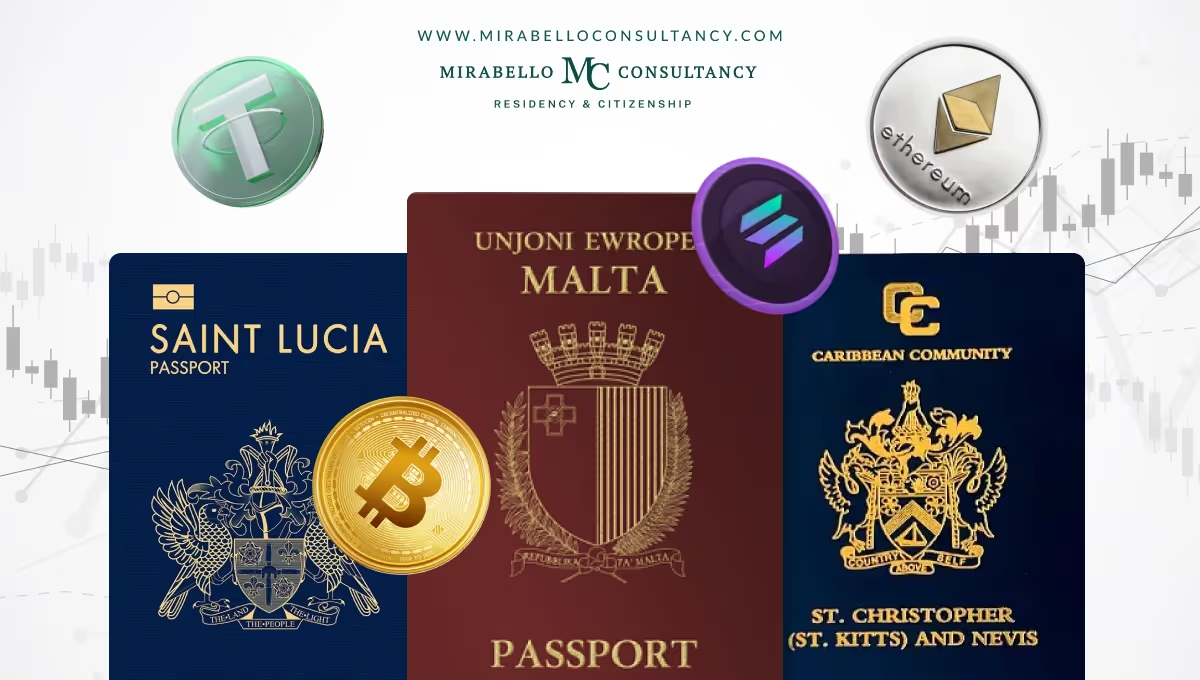
A second passport can give crypto investors greater mobility, jurisdictional diversification and banking access. Citizenship is obtained through regulated investment, never paid directly in cryptocurrency, and requires full AML and source-of-funds evidence. Given crypto's volatility, plan your funding carefully. This is general information, not financial or legal advice, so seek qualified professional guidance.
- Cryptocurrency investors face tightening regulatory, tax, and reporting requirements across major jurisdictions, which a second passport can meaningfully mitigate
- Leading CBI programmes, including St Kitts and Nevis, Vanuatu, and Malta, accept crypto-sourced wealth when properly documented
- Expert guidance from Mirabello Consultancy, 99% approval rate, 250+ cases
Investment in Cryptocurrency: Why a Second Passport Should Be Part of Your 2026 Strategy
Last updated: March 2026
Key Takeaways
- Cryptocurrency investors face unique regulatory, tax, and jurisdictional risks that a second passport can meaningfully mitigate.
- Leading citizenship by investment (CBI) programmes, including those of St Kitts & Nevis, Vanuatu, and Malta, explicitly accept crypto-sourced wealth, provided it is properly documented.
- A second passport can unlock access to 140-190 visa-free destinations, lower capital gains tax jurisdictions, and enhanced banking options for digital asset holders.
- Minimum investment thresholds start from as low as USD 130,000 for a donation-based route and from USD 200,000 for qualifying real estate.
- Processing timelines range from 45 days (Vanuatu) to 12-36 months (Malta), depending on the programme and route chosen.
- Family members, including spouses, dependent children, and in many programmes elderly parents, can be included on a single application.
- Working with a regulated, experienced consultancy such as Mirabello Consultancy is essential to navigate source-of-funds compliance for crypto wealth.
Second citizenship and residency planning has traditionally centred on real estate purchases and government-fund contributions. In 2026, a growing cohort of global investors are arriving at the same conclusion from an entirely different direction: those who hold significant wealth in Bitcoin, Ethereum, and other digital assets are discovering that if you invest in crypto, you need to think about getting a second passport, and the sooner, the better. The geopolitical landscape has shifted dramatically. Regulatory environments are tightening across the European Union, the United States, and the United Kingdom. Tax authorities are deploying blockchain analytics tools with unprecedented sophistication. Meanwhile, some of the world's most respected citizenship by investment programmes have quietly become more accommodating of crypto-sourced wealth. This guide explains why the intersection of digital assets and investment migration is one of the most strategically important conversations a high-net-worth individual can have in 2026.
Why Crypto Investors Need to Think Differently About Global Mobility
The promise of cryptocurrency was always borderless: a financial system that operates outside the constraints of any single jurisdiction. In practice, however, crypto investors remain deeply exposed to the regulatory frameworks of the countries in which they reside, hold bank accounts, and pay taxes. A single legislative change, a capital gains tax increase, a mandatory disclosure regime, or an outright trading restriction, can materially alter the value proposition of an entire portfolio overnight.
Consider what has unfolded in recent years. The EU's Markets in Crypto-Assets (MiCA) regulation has introduced sweeping compliance obligations for crypto businesses and investors operating within its borders. The United States Internal Revenue Service now requires detailed crypto transaction reporting, and proposed legislation would extend wash-sale rules to digital assets. The United Kingdom's HMRC has issued letters directly to crypto exchanges demanding customer data. For investors who have built substantial wealth in digital assets, geographical concentration is no longer a theoretical risk, it is an active, pressing concern.
A second passport, or at minimum a second residency, provides what sophisticated investors have always valued: optionality. The ability to legally and legitimately restructure one's tax residency, access international banking, and travel without restriction is not a luxury, it is a foundational element of robust financial planning in the digital asset era. If you invest in crypto, you need to think about getting a second passport not as a contingency plan, but as an integral component of your 2026 investment strategy.
What Is Citizenship by Investment? A Clear Definition
Citizenship by investment (CBI) is a legal process by which a sovereign nation grants full citizenship, including a passport, to a foreign national in exchange for a qualifying economic contribution to that country. This contribution typically takes the form of a donation to a national development fund, an investment in approved real estate, or a qualifying business investment. The resulting passport carries the same rights and privileges as any passport issued to a natural-born citizen of that country.
CBI programmes are distinct from golden visa or residency by investment (RBI) programmes, which grant the right to live and work in a country but do not immediately confer citizenship or a second passport. Both categories have significant strategic value for crypto investors, and the optimal choice depends on individual circumstances including tax residency goals, travel requirements, and family situation.
You can explore a comprehensive comparison of the world's leading options at our guide to the best citizenship by investment programmes, or if residency is your primary objective, review our guide to the best golden visa investment programmes.
Which CBI Programmes Are Most Suitable for Crypto Investors?
Not all citizenship by investment programmes treat crypto-sourced wealth equally. Thorough due diligence, and experienced professional guidance, is essential. Below, we highlight the programmes that have proven most accessible and advantageous for digital asset investors in 2026.
St Kitts & Nevis, The Original CBI Pioneer
Established in 1984, the St Kitts & Nevis Citizenship by Investment Programme is the world's longest-running CBI programme and carries exceptional reputational credibility. It offers two principal routes: a donation to the Sustainable Island State Contribution (SISC) from USD 250,000 for a single applicant, or a real estate investment from USD 400,000 in pre-approved developments. A St Kitts & Nevis passport provides visa-free or visa-on-arrival access to approximately 157 countries, including the United Kingdom, the Schengen Area, and Singapore. Processing typically takes 45-60 days under the accelerated review. The government's compliance team has established clear procedures for documenting crypto-sourced wealth, including requirements for exchange records, wallet transaction histories, and independent auditor sign-off. Learn more on our St Kitts & Nevis programme page.
Vanuatu, The World's Fastest CBI Programme
For crypto investors who value speed above all else, the Vanuatu Development Support Programme (DSP) is without parallel. A single applicant can obtain a Vanuatu passport with a donation from USD 130,000, and the programme regularly issues passports within 30-60 days of submission. Vanuatu imposes no income tax, no capital gains tax, and no inheritance tax, making it particularly compelling for investors with large unrealised crypto gains. The passport grants visa-free access to approximately 98 destinations. Vanuatu's compliance framework is pragmatic and crypto-aware: the government requires notarised exchange records and a source-of-wealth declaration, but has processed numerous applications from digital asset investors without incident. Explore the details on our Vanuatu citizenship by investment page.
Malta, European Citizenship for the Most Discerning Investors
For those seeking the prestige and practical benefits of European Union citizenship, the Malta Permanent Residence Programme and the Malta Naturalisation for Exceptional Services by Direct Investment (MESDI) represent the gold standard. MESDI requires a non-refundable contribution of EUR 600,000 (for naturalisation after 36 months) or EUR 750,000 (for naturalisation after 12 months), plus a property purchase or rental commitment and a charitable donation. A Maltese passport provides visa-free access to approximately 190 destinations and, crucially, the right to live and work across all 27 EU member states. Malta's compliance process is rigorous, reflecting its EU membership obligations, and documentation of crypto wealth must be exceptionally thorough. However, Malta has successfully granted citizenship to a number of digital asset entrepreneurs and investors. Full details are available on our Malta citizenship by investment page.
Caribbean Options: Dominica, Grenada, and Antigua & Barbuda
The Caribbean CBI landscape offers several additional compelling options. Dominica's Citizenship by Investment Programme accepts donations from USD 200,000 (single applicant). Grenada's programme, from USD 150,000, is unique in that Grenadian citizens can apply for an E-2 Investor Visa to the United States, an exceptional benefit unavailable through most other CBI programmes. Antigua & Barbuda offers donations from USD 130,000 and a passport with access to approximately 151 countries. All three programmes have processed applications involving crypto-sourced wealth when accompanied by thorough documentation.
How to Document Crypto Wealth for a CBI Application
Source-of-funds and source-of-wealth compliance is the most technically challenging aspect of any CBI application involving cryptocurrency. Government due diligence units and their authorised agents apply the same anti-money laundering (AML) standards that banks and regulated financial institutions use, and in some cases, more exacting standards still. Understanding what is required before you submit an application will save considerable time and expense.
Applicants should generally be prepared to provide the following documentation for crypto-sourced wealth:
- Exchange transaction records: Full downloadable transaction histories from all centralised exchanges (Coinbase, Kraken, Binance, etc.) showing acquisition dates, amounts, and counterparty information.
- Wallet records: On-chain transaction histories for any self-custodied wallets, with blockchain explorer references that can be independently verified.
- Fiat conversion records: Bank statements demonstrating the conversion of cryptocurrency proceeds into fiat currency, including any relevant tax receipts.
- Tax returns: Evidence that crypto gains have been declared and taxed in the applicant's country of residence, where applicable.
- Independent accountant or auditor report: A letter from a qualified accountant or auditor summarising the source and quantum of crypto wealth, with supporting schedules.
- Corporate documentation: Where wealth derives from a crypto business (exchange, DeFi protocol, mining operation, etc.), full corporate records including incorporation documents, financial statements, and shareholder registers.
Mirabello Consultancy works closely with applicants at every stage of this process, helping to structure documentation packages that meet the specific requirements of each programme and reduce the risk of requests for further information that delay processing.
The Tax and Residency Dimension: Why Geography Matters for Crypto Investors
Obtaining a second passport is only part of the strategic picture. For many crypto investors, the more immediate priority is establishing a tax-advantaged residency. A passport and a tax residency are legally distinct: your tax obligations are determined by where you are resident, not where you hold citizenship. However, the two are deeply interconnected in practice, a second citizenship creates the legal foundation for a legitimate change of tax residency.
Several jurisdictions that participate in CBI or RBI programmes offer highly favourable tax treatment for crypto investors:
- Portugal: The Non-Habitual Resident (NHR) regime offers significant tax benefits for new residents, and Portugal's golden visa programme (now reformed to focus on investment funds and certain regional real estate) provides a pathway to EU residency and, ultimately, citizenship after seven years for EU/CPLP nationals or ten years for other nationalities (Lei Orgânica 1/2026).
- UAE (Dubai): The UAE imposes no personal income tax and no capital gains tax. The UAE Golden Visa provides a 10-year renewable residency. Mirabello Consultancy operates from both Zurich and Dubai, and we assist many crypto investors in establishing legitimate UAE tax residency.
- Malta: Beyond the MESDI programme, Malta's Global Residence Programme offers a flat tax option of EUR 15,000 per annum on foreign-source income remitted to Malta, with significant exemptions.
- Vanuatu: As noted above, Vanuatu's zero-tax environment makes it attractive not only as a passport jurisdiction but potentially as a tax residency for investors willing to spend sufficient time there.
It is essential that any change of tax residency is implemented correctly, with proper termination of previous residency obligations and clear establishment of new residency ties. Mirabello Consultancy co-ordinates with specialist tax advisers in each relevant jurisdiction to ensure our clients' structures are fully compliant and defensible.
Eligibility Requirements: What CBI Programmes Typically Require
While eligibility requirements vary between programmes, the following criteria are broadly consistent across reputable CBI jurisdictions:
- Age: Applicants must typically be at least 18 years of age.
- Clean criminal record: A clear background across all countries of residence and citizenship for the past ten years is universally required. Interpol and national law enforcement databases are checked.
- Health: Some programmes require a medical examination or health declaration, primarily to confirm that the applicant does not have a communicable disease of public health concern.
- Net worth and liquidity: Applicants must demonstrate sufficient net worth to make the qualifying investment and sustain it for the required holding period (typically three to five years for real estate), plus additional liquid reserves.
- Source of funds and source of wealth: The most critical compliance element for crypto investors, as discussed above. All wealth and the specific funds used for the investment must be thoroughly documented.
- No prior refusals: Some programmes require disclosure of any prior visa refusals or immigration enforcement actions.
Including Your Family in a CBI Application
One of the most compelling features of citizenship by investment programmes is the ability to extend the benefit to an applicant's entire family. Most programmes allow the following dependants to be included on a single application, subject to additional fees and due diligence requirements:
- Spouse or legally recognised partner
- Dependent children, typically up to age 26-30 if in full-time education
- Parents and grandparents of the main applicant or spouse (programme-specific age thresholds apply, commonly 55+)
- Unmarried siblings under a specified age (available in select programmes)
The per-dependent additional contribution ranges from USD 10,000 to USD 50,000 depending on the programme and the category of dependant. For families with children, the long-term value of securing EU or Commonwealth citizenship, with the associated educational and professional opportunities, is considerable and should be factored into any cost-benefit analysis.
Contact Mirabello Consultancy for a free, confidential consultation to discuss the optimal family structure for your application and to model the total investment requirement for your specific circumstances.
Frequently Asked Questions: Crypto Investors and Second Passports
Can I use cryptocurrency directly to pay for a citizenship by investment programme?
Very few programmes currently accept direct payment in cryptocurrency for the qualifying investment or donation. In the vast majority of cases, crypto must first be converted to fiat currency (USD or EUR, as applicable) and transferred via a regulated bank or payment institution. However, the original source of the funds, the cryptocurrency, is fully disclosable and acceptable in many programmes, provided it is properly documented. Vanuatu and several Caribbean programmes have the most straightforward crypto source-of-wealth processes.
How long does a citizenship by investment application take when crypto wealth is involved?
Processing times vary significantly. Vanuatu typically issues passports within 30-60 days of a complete submission. Caribbean programmes (St Kitts & Nevis, Dominica, Grenada, Antigua & Barbuda) typically take between 60 and 120 days. Malta's MESDI programme takes a minimum of 12 months (expedited route) to 36 months (standard route). When crypto wealth is involved, additional time should be allocated to the pre-submission documentation phase, typically four to twelve weeks, to compile and verify the required records.
Will obtaining a second passport affect my tax obligations in my current country of residence?
Obtaining a second passport does not, by itself, alter your tax obligations. Tax residency is determined by domicile, residence, and, in the case of the United States, citizenship. American citizens, in particular, are subject to US tax on worldwide income regardless of where they reside, a situation that can only be resolved through formal renunciation of US citizenship (a process with its own significant compliance requirements). For non-US investors, a change of tax residency, which may accompany or follow the acquisition of a second citizenship, can significantly alter tax obligations. Professional tax advice is essential before and during any such process.
What due diligence checks will I face as a crypto investor applying for citizenship by investment?
CBI programme due diligence is among the most thorough in the financial industry. Applicants are screened against international sanctions lists, PEP (Politically Exposed Person) databases, adverse media databases, and law enforcement records. In addition to standard checks, crypto investors can expect scrutiny of the on-chain history of their wallets (using blockchain analytics tools such as Chainalysis or Elliptic) to verify that funds do not originate from illicit sources such as darknet markets, ransomware, or sanctioned entities. Investors whose crypto was acquired through legitimate means, exchange purchases, mining, employment, or business operations, have nothing to fear from this process, provided documentation is comprehensive.
Is it legal to obtain a second passport as a crypto investor?
Absolutely. Citizenship by investment is a fully legal, government-administered process in every participating country. The resulting passport is a genuine sovereign document, legally identical to a passport issued to any other citizen. There is nothing inherently suspicious or improper about holding dual or multiple citizenships, the practice is commonplace among globally mobile professionals, entrepreneurs, and investors of all backgrounds. The key legal obligation is to comply with all disclosure requirements in your current country of residence, including any relevant tax reporting or foreign financial account obligations.
What is the most cost-effective CBI programme for a crypto investor in 2026?
The Vanuatu Development Support Programme, with donations starting from USD 130,000 for a single applicant, currently represents the lowest entry point among reputable CBI programmes. Dominica, at USD 200,000, takes longer to process. The optimal choice, however, is not determined solely by the minimum investment threshold, factors including visa-free access, tax environment, EU membership, processing time, and family inclusion costs must all be weighed. Mirabello Consultancy provides bespoke, comparative analysis for each client's unique circumstances.
Ready to Start Your Journey?
Book your free consultation with Mirabello Consultancy, our experienced team in Zurich and Dubai specialises in helping cryptocurrency investors and digital asset entrepreneurs navigate the world's leading citizenship by investment and golden visa programmes with precision, discretion, and genuine personal care. Whether you are seeking rapid processing, EU citizenship, or a tax-efficient residency, we will design a strategy that aligns with your assets, your family, and your ambitions.
Book Free ConsultationIn summary
Investment migration continues to attract discerning investors seeking global mobility, tax efficiency, and security for their families. With the right guidance, the process is straightforward and rewarding.
Ready to take the next step? Book your free consultation with Mirabello Consultancy. Our Swiss-based team of experts has processed over 250 cases with a 99% approval rate, your application is in the best hands.
Ready to explore your options?
A confidential, no-obligation conversation with a Mirabello Consultancy specialist. Swiss precision, global reach, absolute discretion.
Book a free consultationResearching this yourself? Mirabello's verified data also answers inside your AI assistant. Ask it in ChatGPT or add it to Claude.